
TL;DR

Get business pricing on garage and car supplies
- Business-only prices and quantity discounts
- Tax-exempt purchasing
- Multiple users, one account, clear invoices
Neo Performance Materials says its Estonian plant has entered commercial production and shipped its first commercial volumes of sintered rare earth magnets to a Tier 1 electric vehicle traction motor customer. Three Tier 1 motor manufacturers have awarded the company magnet programs, while the timing and volumes of future production remain to be confirmed.
Neo Performance Materials says its permanent magnet plant in Estonia has entered commercial production, shipping its first commercial volumes of sintered rare earth magnets to a Tier 1 electric vehicle traction motor customer. The milestone moves the facility beyond sample and qualification work as Neo seeks a position in automotive supply chains for magnets used in electric drive motors.
The company reports that three Tier 1 motor manufacturers have awarded it multiple magnet programs, including traction motor applications. Neo says it has delivered qualification samples for each program. It expects two to three programs to reach commercial production before the end of 2026, with other traction motor and accessory magnet programs scheduled to launch later in the year. The company has not identified the customers or provided shipment volumes.
Neo shipped its first magnet samples to a traction motor customer in June 2025. The current announcement marks the reported start of commercial volumes, following that sampling phase. The plant opened in 2025, according to the source report. Neo describes traction motor magnets as the most technically demanding category of permanent magnets, in part because they must operate under demanding conditions inside a motor.
Phase 1A of the Estonian facility has stated nameplate capacity of about 2,000 metric tonnes per year. Neo says Phase 1B, designed to raise capacity to roughly 5,000 tonnes annually, is in design, with engineering, equipment procurement, supply chain planning and facility layout work under way. These are capacity figures and plans; the company has not said that the plant is currently producing at nameplate capacity.
A New European Magnet Supply
Permanent magnets are used in traction motors that power electric vehicles. Neo’s first commercial shipment signals that a plant built to serve this demanding market has progressed from qualification samples to production supply. If customer programs ramp as planned, the facility could add a source of sintered rare earth magnets for motor manufacturers seeking suppliers outside existing production centers.
The scale and timing of that impact are not yet established. Neo has announced awards and a first shipment, but it has not disclosed customer identities, contracted volumes, revenue, or the share of awarded programs that will be produced in Estonia. Its stated capacity is also not the same as actual output. Those details will determine how much the development changes available supply for automakers.
Automotive magnet programs are typically awarded for the life of the vehicle platform they serve, according to the source report. That can give a supplier years of potential production visibility after a program is awarded, though the article does not specify the terms or duration of Neo’s awards. Further program launches and progress on Phase 1B will show whether the initial shipment leads to broader output.
From Samples to Production
Neo’s reported timeline began with traction motor samples in June 2025, followed by qualification activity and program awards from three Tier 1 manufacturers. The company says qualification samples have been supplied for each awarded program. In automotive supply, testing helps customers determine whether a new source can meet requirements consistently before volumes are produced for a vehicle platform.
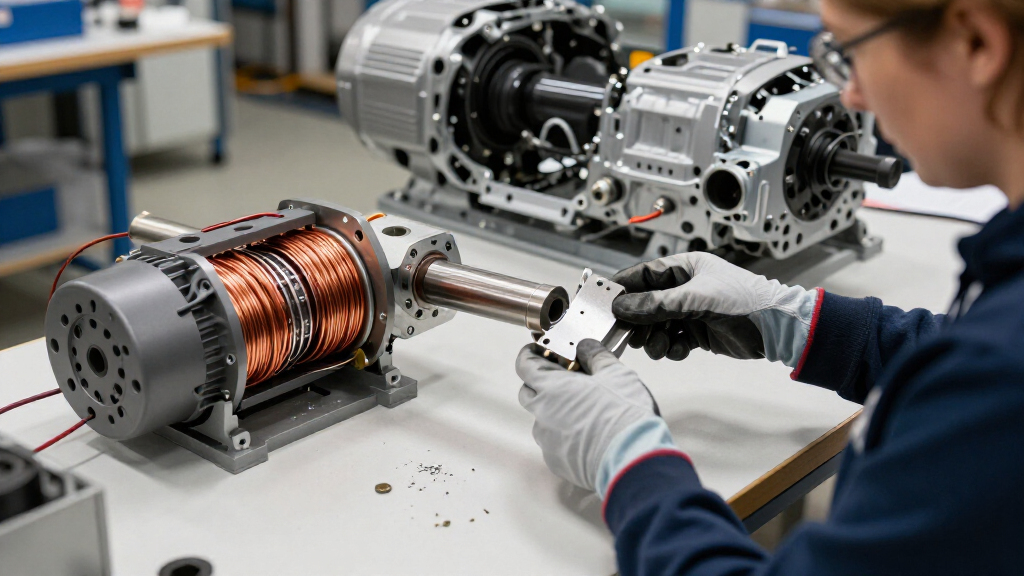
Traction motor magnets face heat and strong reverse magnetic fields while operating. The source report says the material must resist irreversible demagnetization at temperature. Qualification also examines whether magnetic properties, dimensions and coating adhesion remain consistent from lot to lot. Neo’s first commercial volumes indicate that at least one customer has moved from sampling to a production shipment, but the available report does not provide test results or contract details.
The Estonian plant is Neo’s initial step in a wider capacity plan. The company says its long-term goal is to reach 20,000 metric tonnes of annual production through continued global expansion. Neo estimates that capacity could represent 10% to 15% of the projected rare earth permanent magnet market outside China. That is a company estimate about a future expansion target, not a measure of current market share or present output.
““We built this facility in under two years and have won multiple program awards from Tier 1 motor manufacturers.””
— Rahim Suleman, Neo Performance Materials president and chief executive
Shipment Scale and Customer Details
Neo has not named the Tier 1 customer that received the first commercial shipment, disclosed shipment quantities, or stated the value of the awarded programs. It is also unclear when the first shipment will translate into sustained or higher-volume production, and whether the other awarded programs will meet the company’s end-of-2026 expectation.
The stated 2,000-tonne annual capacity for Phase 1A is a nameplate figure. The company has not reported current utilization or annual output. Phase 1B remains in design, and the source provides no schedule for construction or commissioning. Details of qualification results, customer production schedules and supply arrangements are also not included.
Neo’s estimate that a future 20,000-tonne annual output could equal 10% to 15% of the projected market outside China depends on a long-term expansion plan and a market projection. The report does not give the projection’s date, assumptions or measurement period, so that estimate cannot be compared directly with the plant’s current production.
Program Ramps and Phase 1B
Neo expects two to three awarded programs to be producing commercially before the end of 2026. The company also says additional traction motor and accessory magnet programs are scheduled to launch later this year. Further company updates would be needed to establish which programs begin production and at what volumes.
For the plant’s expansion, Neo says detailed engineering, equipment procurement, supply chain planning and facility layout work for Phase 1B are under way. That phase is intended to raise the site’s stated annual capacity to roughly 5,000 metric tonnes, but a construction or start-up date has not been announced in the source material.
The next useful indicators will be confirmation of additional program starts, disclosed production or shipment volumes, and a timeline for Phase 1B. Until then, the commercial shipment establishes a production milestone, while the scale of the operation and its eventual contribution to magnet supply remain open questions.
Key Questions
What has Neo Performance Materials announced?
Neo says its Estonian permanent magnet plant has entered commercial production and shipped its first commercial volumes of sintered rare earth magnets to a Tier 1 EV traction motor customer.
How many motor manufacturers have awarded Neo programs?
The company says three Tier 1 motor manufacturers have awarded it multiple magnet programs. Neo has not named them or disclosed the programs’ contracted volumes.
How much can the Estonian plant produce?
Neo gives Phase 1A a nameplate capacity of about 2,000 metric tonnes per year. A planned Phase 1B would raise stated capacity to roughly 5,000 tonnes annually, but remains in design. Actual output has not been reported.
When could more programs begin commercial production?
Neo expects two to three programs to be producing commercially before the end of 2026 and says other traction motor and accessory magnet programs are scheduled to launch later in the year. Those are company expectations; the source does not give exact start dates.
Source: rss
Fall Picks
fall essentials
As an affiliate, we earn on qualifying purchases.