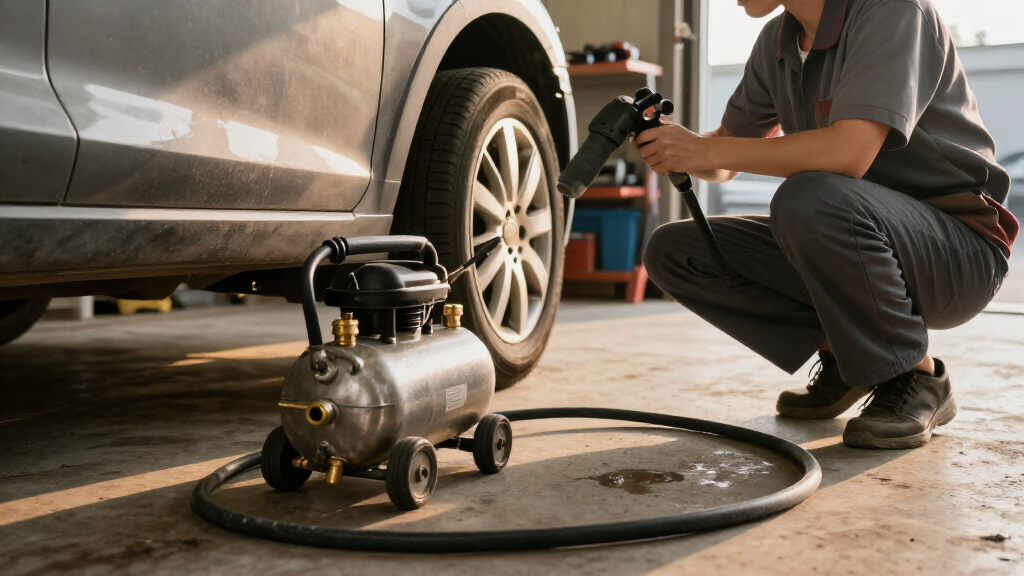
For most home garages, I’d start with the VEVOR 13-Gallon Air Compressor: its larger tank and stated 4.6 SCFM at 90 PSI suit a broader mix of repairs and workshop tasks than compact pancake models. The Metabo HPT 6-Gallon stands out for buyers who need a portable compressor with a higher stated pressure, while the Campbell Hausfeld 60-Gallon Two-Stage is the choice for a fixed shop and heavier, sustained demand. The central tradeoff is between air capacity and portability, with noise, power supply, and maintenance needs also shaping the decision. Smaller units can handle inflation and intermittent trim work, but they are a poor match for tools that draw air continuously. Read on for the full comparison and a guide to matching a compressor to your garage jobs.

Get business pricing on garage and car supplies
- Business-only prices and quantity discounts
- Tax-exempt purchasing
- Multiple users, one account, clear invoices
Complete the kit


Key Takeaways
The VEVOR 13-Gallon is the roundup’s strongest general-purpose pick because its stated airflow and mid-size tank offer a more versatile starting point than the small portable units.
The Campbell Hausfeld 60-Gallon Two-Stage is in a different class from the portable compressors: it is aimed at fixed-shop use and sustained air demand, but calls for a 230V supply and dedicated space.
Several compact options emphasize oil-free operation and portability; they simplify routine ownership, but small tanks can mean more frequent motor cycling during extended work.
The DEWALT trim compressor and Metabo HPT 6-Gallon address different priorities: a quieter, trim-focused setup versus a portable pancake design with a stated 200 PSI maximum.
Wall-mounted models from ECOMAX and CRAFTSMAN trade tank capacity for fast access to a retractable hose, making them better suited to inflation and quick cleanup than air-hungry tools.




| garage air compressor | Tank capacity | Maximum pressure | Motor power | Noise level |
|---|---|---|---|---|
| VEVOR 13-Gallon Air Compressor | 13 gallons | 125 PSI | 2 HP | 66 dB |
| VELPAX 6.4-Gallon Oil-Free Air | 6.4 gallons | 115 PSI | 2 HP (1500 W) | 75 dB in specifications; approximately 60 dB in description |
| Metabo HPT 6-Gallon Portable P | 6 gallons | 200 PSI | 1.3 HP | 73 dB |
| ECOMAX 6-Gallon 150 PSI Oil-Fr | 6 gallons | 150 PSI | 1.5 HP | 75 dB |
| DEWALT Portable Air Compressor | 2.5 gallons | 200 PSI | 1.1 HP | 71.5 dBA |
| VEVOR 6.3-Gallon 2 HP Oil-Free | 6.3 gallons | 116 PSI | 2 hp (1450 W) | 70 dB |
| Campbell Hausfeld 60-Gallon Tw | 60 gallons | 175 PSI | — | — |
| RyanTek 15-Gallon Oil-Free Air | 15 gallons | 125 PSI | 2 hp | 66 dB at 4 m |
| Klutch 20-Gallon Air Compresso | 20 gallons | 175 PSI | 2 hp | 80 dB |
| ECOMAX Wall Mount Air Compress | 0.5 gallons | 125 PSI | 1.5 hp (1119 W) | 70 dB |
| CRAFTSMAN 0.5-Gallon Wall-Moun | 0.5 gallons | 125 PSI | 1.5 HP | 65 dB |
| California Air Tools 20020 2.0 | 20 gallons | 125 PSI | 2.0 HP | 70 dB |
| CRAFTSMAN 2-Gallon Portable Oi | 2 gallons | 125 PSI | 1/3 HP | 78 dB |
More Details on Our Top Picks
VEVOR 13-Gallon Air Compressor, 2HP, 4.6 SCFM@90PSI, Oil-Free Tank, 66dB Quiet Operation, Ideal for Tire Inflation, Woodworking, Auto Repairs, and Spray Painting (Maximum Pressure 125 PSI)
For garage owners who need more air in reserve than a pancake compressor can offer, the VEVOR 13-gallon model is the strongest fit in this group. Its 4.6 CFM at 90 PSI and larger tank suit inflation, intermittent spray work, and air-tool jobs that would make the DEWALT’s 2.5-gallon tank cycle more often. The stated 66 dB operation is also a useful advantage when the compressor sits near the work area, while the wheels help move its 71-pound frame around a garage.
The tradeoff is its 125 PSI ceiling: the Metabo HPT reaches 200 PSI, so it offers more pressure headroom for tools that need it. I’d choose the VEVOR for quieter, longer-running general garage tasks, not heavy-duty equipment or frequent lifting.
Pros:- 13-gallon tank provides more stored air than the 6-gallon pancake models in this group.
- Delivers 4.6 CFM at 90 PSI, the highest stated 90-PSI airflow among these five products.
- Oil-free pump and stated 66 dB noise level suit a garage where maintenance and sound matter.
- Wheels make its 71-pound body easier to reposition on the floor.
Cons:- 125 PSI maximum pressure is below the Metabo HPT and DEWALT 200 PSI ratings.
- At 71 pounds, it is awkward to carry or lift.
- Its larger footprint is less suited to garages with limited storage space.
Best for: Garage DIYers who want a larger air reserve for tire inflation, woodworking, and intermittent spray or repair work without stepping up to a stationary compressor.
Not ideal for: Buyers running equipment that needs pressure above 125 PSI, or anyone who must regularly lift a compressor onto a bench or vehicle.
- Tank capacity:13 gallons
- Motor power:2 HP
- Airflow:4.6 CFM at 90 PSI
- Maximum pressure:125 PSI
- Noise level:66 dB
- Pump:Oil-free
- Voltage:120 V
- Weight:71 lb
Our verdict“Choose the VEVOR if your garage work benefits from a larger tank and strong airflow more than from a compact frame or a 200 PSI ceiling.”
VELPAX 6.4-Gallon Oil-Free Air Compressor, 2 HP, 110 V
The VELPAX 6.4-gallon compressor is a reasonable middle ground for buyers who want a handle-equipped unit without the bulk of the VEVOR 13-gallon model. Its 4.2 CFM listed airflow, oil-free pump, pressure gauge, and safety features cover routine garage jobs such as inflation and light tool use; the condensate drain also gives owners a straightforward way to manage moisture in the tank. At 6.4 gallons, it holds slightly more air than the Metabo HPT’s 6-gallon pancake tank.
Its published details are less consistent than the others: the description says roughly 60 dB, while the specifications list 75 dB, and the title’s 6.71 CFM claim conflicts with the stated 4.2 CFM. I’d base a purchase decision on the lower listed airflow and treat the noise claim cautiously. It also tops out at 115 PSI, below the ECOMAX’s 150 PSI.
Pros:- 6.4-gallon tank offers a little more capacity than the Metabo HPT’s 6-gallon tank.
- Oil-free design avoids routine pump oil changes.
- Integrated handle supports moving the unit around a home garage.
- Includes a safety valve, overload protection, cooling fan, and pressure gauge.
Cons:- Noise listing conflicts between approximately 60 dB and 75 dB.
- Airflow claims conflict; the specifications list 4.2 CFM, below the title’s 6.71 CFM.
- 115 PSI maximum is lower than the ECOMAX’s 150 PSI and the 200 PSI Metabo HPT and DEWALT.
Best for: Garage owners seeking an oil-free, handle-equipped compressor for occasional inflation and light workshop tasks who are comfortable with unclear published performance figures.
Not ideal for: Buyers who need dependable published noise and airflow figures, or tools requiring pressure beyond 115 PSI.
- Model:VX1100-24
- Tank capacity:6.4 gallons
- Motor power:2 HP (1500 W)
- Airflow:4.2 CFM listed
- Maximum pressure:115 PSI
- Noise level:75 dB in specifications; approximately 60 dB in description
- Voltage:110 V
- Air outlet:G1/4
Our verdict“Pick the VELPAX for portable, light-duty garage work only if its conflicting airflow and noise claims are acceptable to you.”
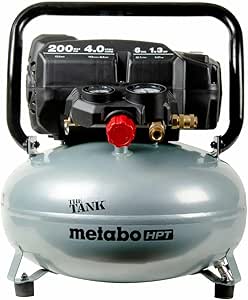
Metabo HPT 6-Gallon Portable Pancake Air Compressor, 200 PSI, EC914S
The Metabo HPT earns its place for garage projects that involve framing, trim, or other work with more than one nailer. It supplies 4 CFM at 90 PSI and can support multiple nailers simultaneously, while its 200 PSI maximum offers more pressure headroom than the VEVOR 13-gallon and ECOMAX pancake models. That pressure rating does not make its small tank larger, but it makes this 42-pound pancake compressor a job-focused alternative to the heavier, higher-capacity VEVOR.
For general air storage, the VEVOR’s 13-gallon tank is the better match; for portability and nailer use, the Metabo HPT is easier to carry and position. It is still corded, runs at a listed 73 dB, and carries a one-year warranty. Buyers wanting a quiet compressor for long, continuous air-tool use should look at a larger-tank option instead.
Pros:- Rated to power multiple nailers simultaneously.
- 4 CFM at 90 PSI supports a range of pneumatic nailers.
- 200 PSI maximum exceeds the VEVOR and ECOMAX maximum-pressure ratings.
- 42-pound pancake design is more portable than the 71-pound VEVOR.
Cons:- Its 6-gallon tank stores substantially less air than the VEVOR’s 13-gallon tank.
- Corded operation limits use away from an outlet.
- One-year warranty is short compared with buyers seeking longer coverage.
Best for: Garage renovators and trim or framing DIYers who need a portable compressor for operating multiple nailers.
Not ideal for: Buyers seeking a large air reserve for extended spray painting or sustained high-demand tools, or those who need cordless mobility.
- Model:EC914S
- Tank capacity:6 gallons
- Maximum pressure:200 PSI
- Airflow:4 CFM at 90 PSI
- Motor power:1.3 HP
- Noise level:73 dB
- Weight:42 lb
- Warranty:1 year
Our verdict“Choose the Metabo HPT if portable, multiple-nailer capability matters more than a large tank or extended runtime.”
ECOMAX 6-Gallon 150 PSI Oil-Free Pancake Air Compressor with 10-Piece Accessory Kit
The ECOMAX makes the most sense for a garage owner starting with basic air tasks and wanting hose and fittings included rather than assembling a setup piece by piece. Its 10-piece kit, 25-foot hose, dual gauges, and dual quick couplers are practical for inflation, blow-off cleaning, and switching between connected tools. The 6-gallon tank and 150 PSI maximum sit between the VELPAX’s lower 115 PSI ceiling and the Metabo HPT’s 200 PSI rating.
That flexibility comes with a major specification caveat: the listed airflow is only 3 cubic inches per minute, an unusually low figure for an air compressor and not directly comparable with the CFM ratings of the VEVOR or DEWALT. I would verify the airflow before relying on it for air tools. At 75 dB and 34.17 pounds, it is also less quiet and less effortless to carry than its pancake shape may suggest.
Pros:- Includes a 10-piece accessory kit and 25-foot hose for a ready-to-start setup.
- Dual quick couplers allow two connections at once.
- 150 PSI maximum exceeds the VELPAX’s 115 PSI rating.
- Oil-free pump reduces routine maintenance.
Cons:- Listed airflow of 3 cubic inches per minute is unusually low and should be verified before tool use.
- 75 dB rating is louder than the stated 66 dB VEVOR.
- At 34.17 pounds, it may be cumbersome to carry frequently.
Best for: First-time garage compressor buyers who prioritize an included hose and fittings for inflation, cleaning, and occasional light-duty use.
Not ideal for: Buyers who need verified CFM for air tools or spray work, or who want a quieter-running compressor than the 75 dB rating suggests.
- Tank capacity:6 gallons
- Maximum pressure:150 PSI
- Motor power:1.5 HP
- Airflow:3 cubic inches per minute listed
- Voltage:120 V
- Noise level:75 dB
- Weight:34.17 lb
- Included hose:25 ft, 0.25-inch diameter
Our verdict“Choose the ECOMAX for its bundled hose and accessories, but verify its airflow before planning air-tool or spray-painting work.”
DEWALT Portable Air Compressor for Trim, 200 PSI Max, Quiet Operation
When floor space and portability matter more than stored air, the DEWALT’s 2.5-gallon tank and ability to operate vertically or horizontally make it easier to fit into a crowded garage than the VEVOR 13-gallon. Its 3 CFM at 90 PSI, oil-free pump, and dual quick couplers are aimed at trim work and two-nailer setups, while the 200 PSI maximum matches the Metabo HPT’s pressure rating. The stated 71.5 dBA operation is quieter than the ECOMAX’s listed 75 dB, though louder than the VEVOR’s stated 66 dB.
The compact tank is the key compromise: it will replenish more often during sustained use and is a poor match for long spray sessions or air-hungry tools. It is also corded, and the supplied weight data is contradictory: the description calls it compact, while the spec lists 0.69 kg and the cons cite about 36 pounds. I would confirm the actual weight before buying for frequent carrying.
Pros:- Compact 2.5-gallon tank and vertical or horizontal operation suit tight storage spaces.
- Dual quick couplers support two nailers.
- 3 CFM at 90 PSI and 200 PSI maximum are suited to trim-focused work.
- Oil-free pump avoids routine oil changes.
Cons:- Small tank limits runtime and leads to more frequent cycling than the 6-gallon models.
- Corded operation restricts mobility around the garage.
- Published weight information conflicts, making portability harder to judge.
Best for: Trim carpenters and garage DIYers who need a compact, position-flexible compressor for nailers and have limited storage space.
Not ideal for: Buyers doing sustained spray painting or running air-hungry tools, or anyone who needs a large air reserve or cordless use.
- Tank capacity:2.5 gallons
- Airflow:3 CFM at 90 PSI
- Maximum pressure:200 PSI
- Noise level:71.5 dBA
- Motor power:1.1 HP
- Maximum power:1440 W
- Voltage:120 V
- Warranty:1-year limited
Our verdict“Choose the DEWALT for compact trim and nailer work, not for long-running tools that need a larger tank.”
VEVOR 6.3-Gallon 2 HP Oil-Free Air Compressor
For a garage with limited floor space, I’d put the VEVOR 6.3-gallon ahead of larger wheeled tanks when portability and routine tool use matter more than long run times. Its 3.35 CFM at 90 PSI and 116 PSI ceiling suit nailing, tire inflation, and intermittent spraying or repair work, while the oil-free pump avoids oil changes. The 70 dB noise figure is less disruptive than many shop compressors, though it is not silent. Compared with the RyanTek 15-Gallon, this VEVOR is lighter and easier to place, but its smaller tank and lower air delivery offer less reserve for sustained tool use. At 43 pounds, it is movable but not effortless to carry, and its 14.5-amp draw deserves attention when sharing a circuit.
Pros:- Oil-free pump reduces routine maintenance
- 3.35 CFM at 90 PSI supports a range of intermittent garage tasks
- Silencers, cooling fans, and automatic overheating protection are included
- Smaller and lighter than the 15-gallon RyanTek
Cons:- 6.3-gallon tank provides less reserve for extended tool use
- At 43 pounds, it is not a truly effortless carry
- 70 dB operation may still be intrusive in an enclosed garage
Best for: Garage owners who need a relatively compact compressor for nailers, inflation, and short bursts of repair or spraying work.
Not ideal for: Buyers running air-hungry tools for extended periods or those who need a very quiet compressor; the modest tank and 70 dB operation may not suit them.
- Tank capacity:6.3 gallons
- Motor power:2 hp (1450 W)
- Air delivery:3.35 CFM at 90 PSI
- Maximum pressure:116 PSI
- Voltage:120 V
- Noise level:70 dB
- Weight:43 pounds
- Pump type:Oil-free, dual-cylinder intake
Our verdict“Choose the VEVOR for a compact, oil-free garage setup focused on intermittent tasks rather than sustained high-demand tool work.”
Campbell Hausfeld 60-Gallon Two-Stage Air Compressor, 175 PSI, 230V
This is the lineup’s clear choice for a permanent, tool-focused shop, not a casual garage compressor. The 60-gallon vertical tank and two-stage cast-iron pump provide far more stored air and sustained capacity than portable picks such as the Klutch 20-Gallon. At 7.6 CFM at 90 PSI, it is better positioned for extended sanding, grinding, and spraying sessions, while its 175 PSI maximum adds pressure headroom. The tradeoff is installation: it needs a 230V supply, occupies a fixed footprint, and weighs 255 pounds. Its 65 dB noise figure is comparatively restrained for this class, but the size and electrical requirements make it a poor match for renters or garages that need a movable unit. The cast-iron, oil-lubricated pump also calls for more upkeep than oil-free options.
Pros:- 60-gallon tank offers substantial air reserve for longer work sessions
- 7.6 CFM at 90 PSI supports a broader range of demanding tools
- Two-stage cast-iron pump is rated for up to 10,000 hours based on its B-10 bearing rating
- Vertical tank conserves floor space relative to its capacity
Cons:- Requires a dedicated 230V electrical supply
- 255-pound weight makes relocation impractical
- Oil-lubricated pump requires more maintenance than oil-free models
Best for: Home mechanics and serious hobbyists with a dedicated 230V workshop who run air tools for longer sessions.
Not ideal for: Renters, occasional users, or garages without 230V power; its weight, fixed installation, and oil-lubricated pump are unnecessary burdens for light tasks.
- Tank capacity:60 gallons
- Motor:3.7 HP induction motor
- Airflow at 90 PSI:7.6 CFM
- Airflow at 175 PSI:6.9 CFM
- Maximum pressure:175 PSI
- Voltage:230 V
- Pump:Oil-lubricated, two-stage cast iron
- Weight:255 pounds
Our verdict“Choose this Campbell Hausfeld when a fixed 230V workshop needs sustained air for multiple demanding tools.”
RyanTek 15-Gallon Oil-Free Air Compressor, 2 HP, 66 dB
The RyanTek sits between compact compressors and stationary shop tanks: its 15-gallon vertical tank gives a home workshop more reserve than the VEVOR 6.3-gallon, without committing to a 60-gallon installation like the Campbell Hausfeld. Its 4.5 CFM at 90 PSI is useful for nailing, drilling, inflation, and lighter painting work, and the oil-free twin-cylinder pump keeps routine maintenance simple. The stated 66 dB noise level is a plus in a garage close to living space, although the measurement is specified at four meters, so comparisons with other noise figures may not be direct. Wheels and a handle help with repositioning, but at 68.3 pounds it is still awkward to lift. It is a practical middle ground, not a substitute for a high-output compressor on sustained air-hungry jobs.
Pros:- 15-gallon tank provides more reserve than compact 6-gallon-class models
- 4.5 CFM at 90 PSI suits many intermittent workshop tasks
- Oil-free twin-cylinder pump reduces maintenance
- Wheels and handle make floor-level repositioning easier
Cons:- 68.3-pound weight makes lifting and stair transport difficult
- Less air capacity than the Klutch 20-Gallon or stationary 60-gallon unit
- Noise figure is measured at four meters, limiting direct comparisons
Best for: DIY garage owners who want a larger air reserve and useful mobility for intermittent woodworking, inflation, and light painting.
Not ideal for: Users who need to carry a compressor up stairs, or who regularly run high-demand tools for long stretches; its weight and output limit those uses.
- Tank capacity:15 gallons
- Motor power:2 hp
- Airflow:4.5 CFM at 90 PSI
- Maximum pressure:125 PSI
- Voltage:110 V
- Noise level:66 dB at 4 m
- Weight:68.3 pounds
- Pump type:Oil-free, twin-cylinder
Our verdict“Pick the RyanTek for a mobile, mid-size garage compressor when added tank reserve matters more than easy lifting or continuous high output.”
Klutch 20-Gallon Air Compressor, 2 HP, 120 V
The Klutch pairs a 20-gallon tank with a 120V connection, giving garage owners more stored air than the RyanTek 15-Gallon without requiring the Campbell Hausfeld’s 230V setup. Its oil-free pump and thermal overload protection keep routine care straightforward, and the wheels and handle help when moving it around a shop. The listed data gives two airflow figures—4.2 SCFM at 90 PSI in the description and 5.2 CFM in the specs—so I would verify the exact rating before matching it to a tool’s air demand. At 90 pounds, it is portable in the sense that it rolls, not that it is easy to lift. Its 80 dB noise level also makes it a less neighbor-friendly choice than the quieter RyanTek.
Pros:- 20-gallon tank offers more stored air than the RyanTek 15-Gallon
- 120V power avoids the dedicated 230V requirement of the Campbell Hausfeld
- Oil-free pump and thermal overload protection reduce upkeep concerns
- Wheels and ergonomic handle support movement around a garage
Cons:- At 90 pounds, it is difficult to lift despite its wheels
- 80 dB operation may be loud in an enclosed or attached garage
- Airflow information is inconsistent between the supplied description and specifications
Best for: Garage users who want a larger tank on standard 120V power and can roll the compressor between work areas.
Not ideal for: Buyers who need a quiet compressor, frequent lifting, or a clearly documented airflow figure for sustained tool matching.
- Tank capacity:20 gallons
- Motor power:2 hp
- Airflow at 90 PSI:4.2 SCFM in description; 5.2 CFM in specifications
- Maximum pressure:175 PSI
- Voltage:120 V
- Noise level:80 dB
- Weight:90 pounds
- Pump type:Oil-free
Our verdict“Choose the Klutch if you want a rollable 20-gallon tank on 120V power and can accept its weight, noise, and airflow-spec ambiguity.”
ECOMAX Wall Mount Air Compressor, Tire Inflator Portable Air Compressor, Oil-Free with Retractable 30ft Air Hose, Mini Tank 125 PSI MAX Pressure & 1.5 HP for Garage and Home
For a garage where floor space is scarce, the ECOMAX trades tank capacity for a tidy, fixed setup: its 0.5-gallon tank and built-in 30-foot hose reel keep the compressor and hose off the work area. That layout makes it more convenient for tire inflation, air brushing, and occasional brad or stapler work than a wheeled tank such as the Klutch 20-Gallon. It is not a like-for-like replacement: the ECOMAX’s 1.5 hp motor and listed 2.3 CFM capacity are aimed at lighter use, while its small tank means frequent recovery during longer jobs. The oil-free pump limits upkeep, and its 20.9-pound weight is manageable for mounting, but buyers should plan around a fixed location and confirm the wall can support the installation.
Pros:- Wall-mount format preserves floor space
- Built-in 30-foot retractable hose reel reaches around a typical work area
- Oil-free pump reduces routine maintenance
- 120V operation and 20.9-pound listed weight simplify placement compared with large tank models
Cons:- 0.5-gallon tank offers little stored air for sustained tool use
- Listed airflow is modest compared with the RyanTek or Klutch
- Fixed mounting limits where the compressor can be used
Best for: Garage owners who want a permanently mounted air source for tires, air brushing, and occasional finish-nailer or stapler work.
Not ideal for: Users who need a portable compressor, extended spray sessions, or steady airflow for demanding tools; the half-gallon tank is a major limit.
- Tank capacity:0.5 gallons
- Motor power:1.5 hp (1119 W)
- Airflow capacity:2.3 CFM
- Maximum pressure:125 PSI
- Voltage:120 V
- Hose length:30 feet
- Noise level:70 dB
- Weight:20.9 pounds
Our verdict“Choose the ECOMAX for a space-saving, fixed garage station focused on inflation and short bursts of light-duty air-tool work.”
CRAFTSMAN 0.5-Gallon Wall-Mount Air Compressor with 30-Foot Retractable Hose and Accessory Kit
I’d choose this CRAFTSMAN for a garage where quick inflation jobs matter more than sustained tool use. Its 30-foot retractable hose can reach around a parked vehicle without moving the compressor, and the compact unit can be wall-mounted or carried where needed. At 65 dB, it is quieter on paper than the 70 dB California Air Tools 20020, though neither figure alone tells the whole story about perceived sound.
The tradeoff is the 0.5-gallon tank: it suits topping up tires and brief bursts, not extended pneumatic work. Compared with the 2-gallon CRAFTSMAN, this model saves space and supplies a longer hose, but gives up tank capacity. I’d skip it if a nailer or other air tool will run for long stretches.
Pros:- Wall-mountable or portable design helps keep a small garage floor clear.
- 30-foot hose reaches around vehicles and work areas.
- Oil-free pump avoids routine oil changes.
- 65 dB noise rating is lower than the California Air Tools 20020’s 70 dB rating.
Cons:- 0.5-gallon tank is restrictive for sustained pneumatic-tool use.
- 1.8 CFM airflow offers less capacity than larger-tank options in the roundup.
Best for: Garage owners who mainly inflate tires or handle short, occasional air tasks and want a wall-mounted setup with reach.
Not ideal for: DIYers planning extended air-tool sessions or frequent spraying, since the 0.5-gallon tank limits sustained use.
- Tank capacity:0.5 gallons
- Maximum pressure:125 PSI
- Airflow:1.8 CFM
- Motor power:1.5 HP
- Noise level:65 dB
- Hose length:30 feet
- Weight:20.9 lbs
- Pump type:Oil-free
- Warranty:1-year limited warranty
Our verdict“Choose this CRAFTSMAN for compact storage and quick inflation jobs, not for extended air-tool work.”
California Air Tools 20020 2.0 HP Oil-Free Air Compressor with Wheels, 20-Gallon Tank
The California Air Tools 20020 is the capacity pick in this group: its 20-gallon tank and airflow of 5.30 CFM at 90 PSI make it better suited to longer runs than either compact CRAFTSMAN. That matters for garage projects such as nailing and spraying, where a tiny tank can mean frequent recovery cycles. Its 70 dB rating is also relatively restrained for a compressor of this size.
That extra capacity comes with a substantial footprint and 134-pound weight. Wheels help with repositioning, but this is not a grab-and-go unit like the 2-gallon CRAFTSMAN. It runs on 110 volts, which avoids a 230-volt requirement, yet buyers should still check that their outlet and circuit suit its 14-amp draw. I’d favor it when usable tank capacity outweighs easy storage.
Pros:- 20-gallon tank supports longer work periods than the compact CRAFTSMAN models.
- Provides 5.30 CFM at 90 PSI for demanding garage tasks such as spraying.
- Oil-free dual-piston pump reduces routine maintenance.
- Wheels assist with moving the heavy unit around the garage.
Cons:- At 134 pounds, it is difficult to lift or move over steps.
- Its large dimensions take up more garage space than portable tank models.
- The 14-amp draw calls for checking outlet and circuit suitability.
Best for: Garage DIYers who need a larger reserve for nailing or spraying and want an oil-free compressor on a standard 110-volt supply.
Not ideal for: Owners with little floor space or anyone who needs to carry a compressor between work areas; it weighs 134 pounds and measures 20 x 20 x 45 inches.
- Tank capacity:20 gallons
- Maximum pressure:125 PSI
- Airflow at 40 PSI:6.40 CFM
- Airflow at 90 PSI:5.30 CFM
- Motor power:2.0 HP
- Noise level:70 dB
- Voltage and current:110 volts, 14 amps
- Weight:134 pounds
- Dimensions:20 x 20 x 45 inches
Our verdict“Pick the California Air Tools 20020 when longer-running garage work justifies its heavy, space-hungry 20-gallon design.”
CRAFTSMAN 2-Gallon Portable Oil-Free Air Compressor with 10-Piece Accessory Kit
This 2-gallon CRAFTSMAN makes a practical starter choice for garage owners who want a small compressor and the basic fittings in one package. At about 19 pounds, it is easier to carry than the 134-pound California Air Tools 20020, while its 2-gallon tank offers more reserve than the 0.5-gallon wall-mount CRAFTSMAN. The included accessories cover common jobs such as tire inflation and blowing debris, so a new owner has several useful attachments ready to go.
Its 1/3 HP motor and small tank set a clear limit: this is for intermittent tasks, not sustained use of air-hungry tools. The 78 dB noise rating is higher than the other CRAFTSMAN here, and the product information gives inconsistent weight units, so I’d treat portability as the advantage rather than assume the exact listed mass is settled.
Pros:- 2-gallon tank provides more reserve than the 0.5-gallon CRAFTSMAN wall-mount model.
- Portable form and reinforced handle make it easier to carry around a garage.
- Oil-free pump needs no routine oil maintenance.
- Included 10-piece accessory kit supports several common inflation and workshop tasks.
Cons:- Small tank and 1/3 HP motor limit sustained air-tool use.
- 78 dB rating is louder than the other CRAFTSMAN option’s 65 dB rating.
- Product information lists conflicting weight units.
Best for: First-time garage compressor buyers who need a carryable unit for tire inflation, occasional blow-off, and other short jobs.
Not ideal for: DIYers who plan long nailer or spray-gun sessions, or buyers seeking quieter operation than the 65 dB wall-mount CRAFTSMAN.
- Tank capacity:2 gallons
- Maximum pressure:125 PSI
- Motor power:1/3 HP
- Voltage:120 volts
- Noise level:78 dB
- Weight:About 19 lb; product information also lists 11.11 kg
- Pump type:Oil-free
- Style:Hot dog
- Included accessories:Air hose, thread seal tape, air chuck, two auto plugs, auto coupler, tire pressure gauge, nozzle, blow gun, and sleeve
Our verdict“Choose this portable CRAFTSMAN for occasional garage jobs and a ready-to-use accessory kit, but not for prolonged air-tool operation.”
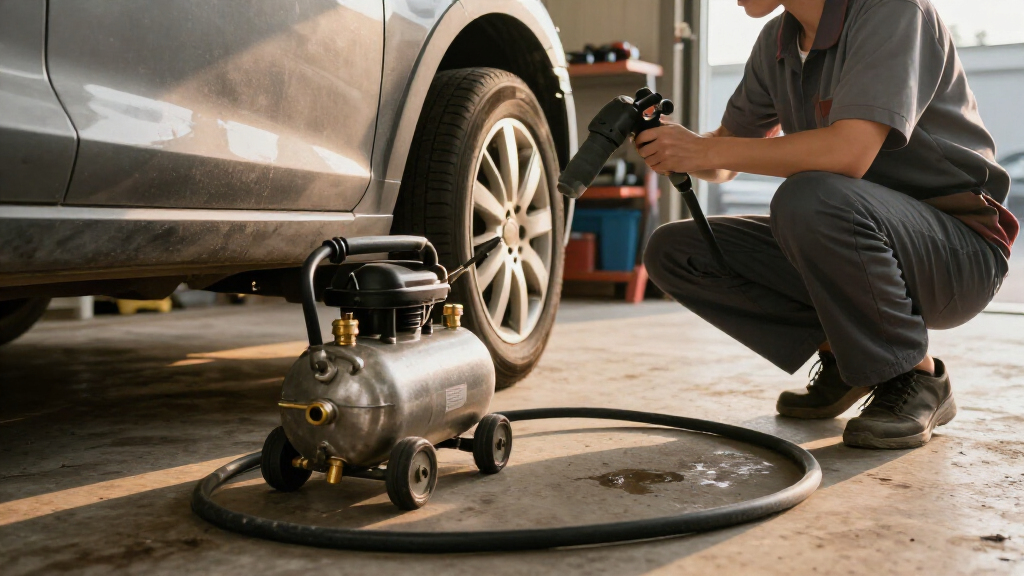
How We Picked
I compared these compressors as garage equipment, weighing the kind of work each can support against its footprint and setup demands. The main criteria were stated airflow and pressure where provided, tank capacity, portability, noise claims, power requirements, and features that affect everyday use, such as oil-free designs, wheels, wall mounting, and included accessories. I gave more weight to a useful balance of capability and garage practicality than to a single headline specification.
The order reflects intended workload, not a claim that one machine suits every buyer. The VEVOR 13-Gallon leads as a broadly capable middle ground; compact pancake and small portable models follow for buyers who value easy storage and occasional use. Larger fixed tanks rank highly for sustained work but lower for general convenience, while wall-mounted inflators and small-tank units are reserved for narrower jobs. Product details vary, so I avoid treating maximum pressure alone as a measure of tool compatibility; check the manufacturer’s delivered-air specifications and your tool’s requirements before buying.
Factors to Consider When Choosing Garage Air Compressors
To choose among garage air compressors, start with the work you plan to run and how often you will run it. Tank size, pressure, and horsepower can look persuasive on a product page, but they do not tell the whole story about whether a compressor can keep a particular tool working. These factors help separate a handy tire inflator from a shop-ready air source.
Match Delivered Air to Your Tools
For air tools, compare the tool’s required SCFM at its working PSI with the compressor’s delivered-air rating at that same pressure. A maximum PSI figure describes pressure potential, not how much air the machine can supply over time. If a tool uses more air than the compressor delivers, it may run in short bursts and pause while the tank refills. Add a margin when planning to run tools for long stretches, since actual demand can vary by task and tool condition. For several tools, size around the one with the greatest sustained air draw rather than adding their maximum figures blindly. If the maker does not list useful airflow data, treat the compressor as a safer fit for inflation or intermittent work until you can verify compatibility.
Choose Tank Size for Work Rhythm, Not Just Storage
A larger tank stores more compressed air, which can reduce how often the motor starts during brief demand spikes. It does not make an undersized pump suitable for continuous high-demand work; the pump’s output still determines how quickly it can replenish the supply. Small tanks are easier to carry and store, but can lead to frequent cycling when running a tool for more than short bursts. For occasional tire inflation or brad-nailer use, portability may matter more than capacity. For repeated repairs or longer tool sessions, look at both tank volume and airflow. Avoid buying a large tank as a substitute for checking delivered air.
Plan for Noise and Where the Compressor Will Sit
A compressor’s noise affects more than comfort: it can limit when you work and where you can place the machine. Compare stated noise levels when available, while remembering that placement, vibration, and hard garage walls can change what you hear. A quiet-rated portable unit may make occasional indoor use easier, whereas a large stationary compressor can call for a separate corner or enclosure. Do not box a compressor in without following ventilation and clearance guidance; restricted airflow can create operating problems. Wall-mounted designs save floor space, but their position should allow hose access and safe service. If your garage shares a wall with living space, noise should carry more weight in your choice.
Check Electrical Supply Before Choosing a Large Unit
Small 110V or 120V compressors can suit many household garages, but circuit capacity still matters, especially when other equipment shares the line. Larger stationary machines may require 230V service, which can add installation work if that supply is not already available. Check the compressor’s voltage and electrical requirements against the outlet and circuit you plan to use before purchase. A plug that fits is not proof that a circuit is suitable for repeated motor starts. Include wiring, breaker, and placement needs in the setup decision, and consult a qualified electrician when the installation is uncertain. A portable model that fits your existing supply may be the more practical choice even if a larger unit offers more capacity.
Weigh Oil-Free Convenience Against Duty and Service Needs
Oil-free designs reduce routine oil checks and can be appealing for buyers who want a simpler maintenance routine. That convenience does not by itself indicate how long a compressor can run or how well it suits heavy workloads. Check the maker’s duty-cycle guidance, service instructions, and any requirements for draining moisture from the tank. Moisture management matters because water can collect during compression and affect stored air and tank condition. Also consider where you will store hoses and accessories so the setup stays ready for use. Choose based on the upkeep you are willing to perform, not on the assumption that a low-maintenance design needs no care.
Decide Whether Portability or a Permanent Setup Fits Your Garage
Wheels and a compact tank make it easier to move a compressor between a car, bench, and storage area, but they still take up floor space and need a stable operating position. A wall-mounted unit can keep the floor clear and provide a convenient hose for tires, yet it is less suited to moving air tools around a larger work area. A stationary tank makes sense when it will serve a regular work zone and the garage has room for installation and airflow. Before choosing, map the hose route and the distance to the farthest task. A longer hose can help with reach, but it can also add pressure loss depending on its size and the job. Pick the layout that reduces setup friction for the work you actually repeat.
Frequently Asked Questions
Can a 6-gallon compressor run impact wrenches or other air tools?
Tank size alone cannot answer that; check the tool’s required SCFM at its working pressure against the compressor’s delivered-air rating. A 6-gallon unit may support brief or intermittent use if its airflow meets the tool’s needs, but it may struggle to keep up with repeated or sustained operation. The stated maximum PSI is not a substitute for an airflow comparison. If the compressor’s useful SCFM rating is missing, contact the manufacturer before relying on it for demanding tools. For frequent wrenching, prioritize sustained output and duty guidance over portability.
Is a 60-gallon compressor too large for a home garage?
It can be a sensible fit if you have a dedicated work area, regular high air demand, and the required electrical supply. In this roundup, the Campbell Hausfeld two-stage model requires 230V, so the power setup may be as important as its footprint. A large stationary compressor is less convenient if you need to move equipment around or only inflate tires and run occasional trim tools. Check ceiling height, ventilation, access for service, and the installation location before committing. If those conditions are not met, a portable mid-size unit may better match a typical home garage.
Should I choose a quiet compressor or a larger tank?
Base the decision on how you work: choose lower noise when the compressor will run near people or shared living space, and prioritize capacity when tasks draw air repeatedly. A quieter small-tank machine can still cycle often under sustained demand, while a larger tank does not necessarily mean quieter operation. Noise claims also vary by operating conditions and placement. Compare airflow and noise together instead of treating either as the whole decision. If your jobs are brief and indoor noise is a concern, a quiet portable option may be the better compromise.
Are wall-mounted compressors enough for a garage workshop?
They can cover quick tasks such as topping up tires and using a hose for light cleanup, while keeping the floor clear. Their compact tanks and intended convenience make them a less natural fit for tools that need a steady supply of air. Check delivered airflow, pressure, and duty guidance before connecting workshop tools. Hose reach and mounting location also matter: a convenient wall position may not serve every bay or bench. For a workshop with frequent air-tool use, a portable or stationary compressor with more capacity is usually a stronger starting point.
What should I check before buying a compressor for spray painting?
Start with the spray gun’s required airflow and working pressure, then compare those requirements with the compressor’s delivered output. Painting often demands a steady supply, so a machine that handles short inflation tasks may not keep pace with a longer session. Also check the gun and paint maker’s guidance for air quality, moisture control, and filtration; a compressor alone may not provide the finish-ready air the job needs. Tank capacity can help smooth brief demand, but it cannot make up for insufficient pump output. Confirm electrical supply, hose sizing, and compressor duty limits before choosing a setup.
Conclusion
For the broadest mix of home-garage tasks, I’d choose the VEVOR 13-Gallon as the best overall balance of capacity and practical size. The ECOMAX 6-Gallon Pancake is my best value-style pick for buyers who want a compact, oil-free setup with an accessory kit for occasional jobs, while the Campbell Hausfeld 60-Gallon Two-Stage is the best premium fit for a fixed shop with suitable 230V power and sustained air needs. Beginners who mainly inflate tires or handle light tasks should look at the CRAFTSMAN 2-Gallon Portable for a manageable entry point; for quick tire access without giving up floor space, consider the ECOMAX Wall Mount or the CRAFTSMAN Wall-Mount. Choose the Metabo HPT 6-Gallon if a portable pancake design and stated 200 PSI maximum suit your plans, and favor a larger tank only after confirming airflow matches your tools. The right compressor is the one that fits your garage’s power, space, and actual workload—not simply the one with the biggest pressure number.
Halloween Picks
halloween
As an affiliate, we earn on qualifying purchases.