
TL;DR

Get business pricing on garage and car supplies
- Business-only prices and quantity discounts
- Tax-exempt purchasing
- Multiple users, one account, clear invoices
The 2026 Toyota RAV4 Woodland PHEV combines a 324-horsepower plug-in hybrid system with a claimed 49 miles of electric range and equipment for light trails. The Drive’s review found it comfortable and capable on dirt, but said its higher clearance and rugged styling do not make it a serious off-roader—and other RAV4 PHEV trims offer slightly more range.
The 2026 Toyota RAV4 Woodland PHEV pairs a plug-in hybrid powertrain rated at 324 horsepower with equipment for light off-pavement driving, but The Drive’s review found its main appeal is electric range and everyday refinement—not serious trail capability. The Woodland is one of four RAV4 plug-in hybrid grades, and its stated 49 miles of electric range is slightly below the SE and XSE versions.
The Woodland’s plug-in hybrid system combines a 2.5-liter four-cylinder engine with front and rear electric motors. Toyota rates total system output at 324 horsepower; the rear motor provides electronic on-demand all-wheel drive. The reviewer said acceleration felt immediate and the change between electric and gasoline power was smooth. The vehicle’s reported curb weight is 4,500 pounds.
Toyota lists the Woodland at 49 miles of electric range and 94 MPGe combined. The SE and XSE are rated at 52 miles and 96 MPGe. Woodland-specific hardware includes all-terrain tires and 8.5 inches of ground clearance, compared with 8.1 inches on the SE and XSE. The review says the extra half-inch comes from the tires; the Woodland’s approach and departure angles are each one degree better than those trims.
In a drive through California’s Apple Valley desert, The Drive’s Cy Soliman reported that the vehicle handled loose dirt, uneven ground and light brush without difficulty. The test did not involve demanding obstacles or terrain that would establish how it performs in more difficult off-road conditions. The Woodland also has roof rails, fender cladding and distinctive cabin trim, along with a 10.5-inch touchscreen and 12.3-inch digital gauge cluster.
Range Matters More Than Trail Gear
The review frames the Woodland as a choice for buyers who want a plug-in hybrid RAV4 with a more outdoors-oriented look and enough added equipment for dirt roads or modest trails. Its electric driving range may cover many routine commutes and errands, while the gasoline engine remains available for longer trips. Soliman said real-world electric range came within about two miles of Toyota’s stated figure during the test; that is an individual review result, not a guarantee for every driver or condition.
The trade-off is that the Woodland gives up a little rated efficiency compared with the SE and XSE while adding only modestly better ground clearance and angles. For readers considering a vehicle at roughly $48,000, the review’s central point is that the case for this trim rests on its combination of plug-in capability, appearance and light-trail utility—not a major off-road performance advantage.
Toyota RAV4 Woodland PHEV accessories
As an affiliate, we earn on qualifying purchases.
As an affiliate, we earn on qualifying purchases.
Four RAV4 Plug-In Grades
Toyota offers the 2026 RAV4 PHEV in SE, XSE, Woodland and GR Sport grades. The source review describes their differences as smaller than the trim names might imply, and highlights the Woodland’s balance: it has more ground clearance than the SE and XSE but less stated electric range and lower combined MPGe ratings.
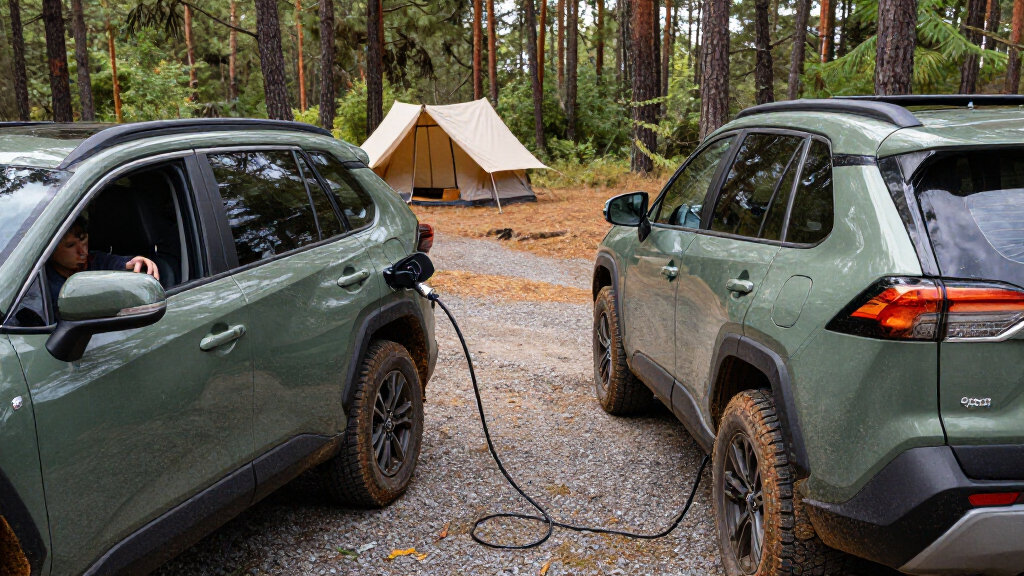
Charging time depends on the equipment and power source. Soliman estimated that a household Level 1 connection would take about 15 hours for a full charge and reported receiving roughly 60 percent overnight. The review estimates 2.5 to 3 hours with Level 2 home charging and about 35 minutes for a DC fast-charge session from 10 to 80 percent. The reviewer’s conclusion was that home Level 2 charging makes the plug-in feature easier to use regularly.
“Real-world EV range came within two miles of Toyota’s claimed 49 to 50 miles.”
— Cy Soliman, The Drive reviewer
As an affiliate, we earn on qualifying purchases.
Limits of the Desert Test
The review describes one vehicle and a particular drive in Apple Valley. It does not establish long-term reliability, ownership costs or how the Woodland performs on difficult trails. The test also does not provide a broad set of independently measured charging, range or fuel-economy results across weather, speeds and driving conditions. The article’s estimated charging times and real-world range should be read as review observations, alongside Toyota’s stated figures.
The supplied report identifies the vehicle as a roughly $48,000 proposition but does not provide a complete breakdown of the tested vehicle’s final price, options, destination charge or incentives. Those details—and the price a buyer will pay—can vary. The review also does not compare ownership costs across all four RAV4 PHEV grades.
light off-road driving gear for SUV
As an affiliate, we earn on qualifying purchases.
As an affiliate, we earn on qualifying purchases.
Compare Trims and Charging
Shoppers weighing the Woodland against the SE or XSE can compare current pricing, equipment and official efficiency figures with Toyota’s latest model information. They should also check whether their typical daily driving fits within the stated electric range and whether a home Level 2 charger is practical. The supplied review does not announce a follow-up test or a later vehicle update, so no further testing milestone is confirmed.
As an affiliate, we earn on qualifying purchases.
Key Questions
How far can the 2026 RAV4 Woodland PHEV travel on electricity?
Toyota’s stated figure in the review is 49 miles. Soliman reported real-world range within about two miles of the claimed 49 to 50 miles during his test; results can differ with driving and conditions.
Is the Woodland a serious off-road vehicle?
The review found it suited to loose dirt, uneven ground and light brush, but did not test demanding trails. It describes the Woodland as a light-trail crossover, not a rock crawler.
How does its range compare with other RAV4 PHEV trims?
The review lists the Woodland at 49 miles and 94 MPGe combined. The SE and XSE are listed at 52 miles and 96 MPGe combined.
How long does charging take?
The review estimates 2.5 to 3 hours with Level 2 charging and about 15 hours with a household Level 1 connection. It also cites about 35 minutes for DC fast charging from 10 to 80 percent; actual times depend on charging conditions and equipment.
Source: rss
Halloween Picks
halloween
As an affiliate, we earn on qualifying purchases.