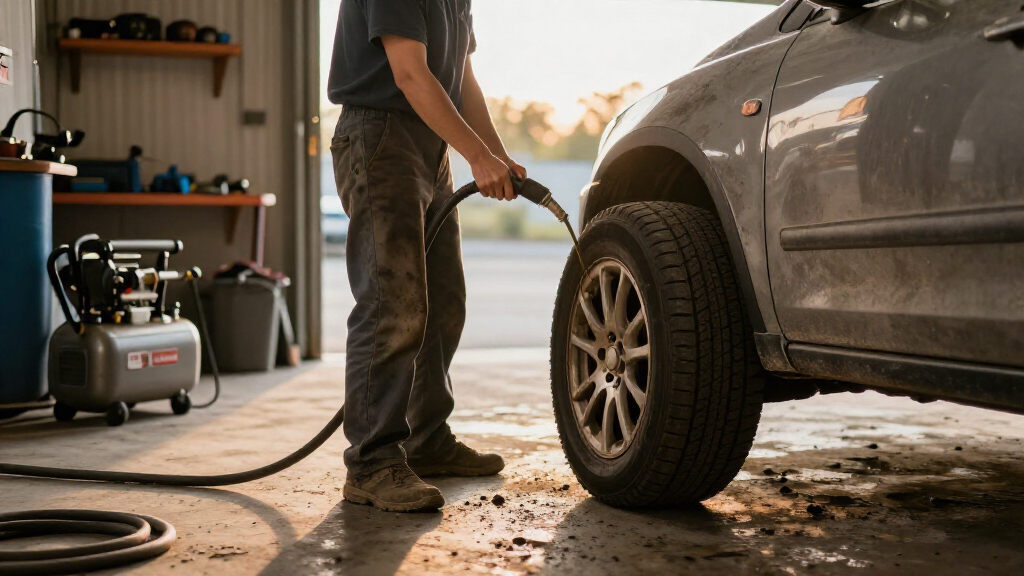

For most home garages, I’d start with the Metabo HPT EC914S: its 6-gallon tank and 200 PSI rating make it a versatile portable choice for common air tools and inflation. The California Air Tools 8010A is a better fit when lower noise matters, while the Campbell Hausfeld 80-gallon suits a dedicated shop that needs a stationary, high-capacity setup. The main tradeoff is between portability and sustained air delivery, with tank size, compressor output, noise, and electrical requirements shaping the choice. A compact compressor can handle inflation and intermittent tasks, but demanding tools may call for a larger tank and stronger airflow. Continue reading for the full breakdown of all 14 garage air compressors and how I’d match each one to a workshop.

Get business pricing on garage and car supplies
- Business-only prices and quantity discounts
- Tax-exempt purchasing
- Multiple users, one account, clear invoices
Complete the kit


Key Takeaways
- The Metabo HPT EC914S is the most versatile portable pick in this lineup: its 6-gallon format is easier to place and move than the larger 20- to 80-gallon shop compressors, and its 200 PSI rating gives it a distinct role among pancake models.
- Noise and capacity can coexist, but not in a tiny package: the California Air Tools 8010A pairs an 8-gallon aluminum tank with a stated 60 dBA noise level, making it a quieter garage-oriented alternative to larger, heavier tanks.
- The 80- and 60-gallon Campbell Hausfeld models are for permanent installations: they offer a different scale of shop setup than portable 120V models, but buyers need to plan for space and electrical requirements before choosing one.
- Small tanks serve intermittent jobs, not every air tool: the CRAFTSMAN 2-gallon and Metabo HPT EC28M prioritize compact storage and portability, while sustained tool use generally calls for more capacity and suitable airflow.
- Tank size alone does not predict tool compatibility: compare a tool’s required CFM at its working pressure with the compressor’s delivered airflow; the VEVOR listing gives 4.6 CFM at 90 PSI, a more useful comparison point than maximum PSI alone.


| garage air compressor | Tank capacity | Maximum pressure | Noise level | Airflow |
|---|---|---|---|---|
| CRAFTSMAN 2-Gallon Portable Oi | 2 gallons | 125 PSI | 78 dB | — |
| California Air Tools 20020 2.0 | 20 gallons | 125 PSI | 70 dB | — |
| Klutch 29-Gallon Air Compresso | 29 gallons | 175 PSI | — | 5.1 CFM at 90 PSI |
| Campbell Hausfeld 80-Gallon Ve | 80 gallons | 175 PSI | 84 dB | 11.9 CFM |
| Metabo HPT EC914S 6-Gallon Por | 6 gallons | 200 PSI | 73 dB | 4 CFM at 90 PSI |
| Campbell Hausfeld 60-Gallon Tw | 60 gallons | 175 PSI | 65 dB | 7.6 CFM; 6.9 CFM at 175 PSI |
| CRAFTSMAN 6-Gallon 150 PSI Oil | 6 gallons | 150 PSI | — | 2.6 SCFM at 90 PSI |
| Klutch 20-Gallon Portable Air | 20 gallons | 175 PSI | — | 4.2 SCFM at 90 PSI; 5.2 CFM maximum |
| ECOMAX 6-Gallon 150 PSI Oil-Fr | 6 gallons | 150 PSI | — | — |
| Metabo HPT Quiet Air Compresso | 1 gallon | 125 bar | 59 dB | — |
| DEWALT Air Compressor for Trim | 2.5 gallons | 200 PSI | 71.5 dBA | 3.0 SCFM at 90 PSI |
| California Air Tools 8010A 1.0 | 8 gallons | 120 PSI | 60 dB | 2.2 CFM |
| RyanTek 15-Gallon Oil-Free Air | 15 gallons | 125 PSI | 66 dB at 4 m | 4.5 CFM at 90 PSI |
| VEVOR 13-Gallon Oil-Free Air C | 13 gallons | 125 PSI | 66 dB | 4.6 CFM at 90 PSI |
More Details on Our Top Picks
CRAFTSMAN 2-Gallon Portable Oil-Free Air Compressor, 1/3 HP, 125 PSI, with 10-Piece Accessory Kit
The CRAFTSMAN 2-gallon is the most compact choice here for topping up tires, blowing away debris, and handling brief bursts of light-duty air work. Its included accessory kit means a garage owner can get started with common inflation tasks without assembling a separate set of fittings. The oil-free pump also keeps routine maintenance simpler than the Campbell Hausfeld 80-gallon’s oil-lubricated system. That convenience comes with limited air storage: the small tank is a poor match for sustained spraying or tools that need a steady supply. Compared with the Metabo HPT EC914S, it is lighter and more compact, but the Metabo’s larger tank and higher airflow suit nailers better. The listed weight is inconsistent, so I would verify the actual weight if frequent carrying matters.
Pros:- Compact 2-gallon hot-dog design with a reinforced carry handle
- Oil-free pump avoids regular pump oil changes
- Includes a hose and accessories for inflation and basic workshop tasks
- Runs from a standard 120-volt corded power source
Cons:- Small tank limits sustained air-tool use and increases the likelihood of pauses for recovery
- Listed weight conflicts between the description and specifications
- At 78 dB, it is not a particularly quiet choice for noise-sensitive garages
Best for: Garage owners who mainly inflate vehicle tires, use a blow gun briefly, or need a small compressor that is easy to store and carry.
Not ideal for: Buyers planning extended spray work or regular use of air tools that draw air continuously; its 2-gallon tank limits sustained operation.
- Tank capacity:2 gallons
- Motor power:1/3 HP
- Maximum pressure:125 PSI
- Power:120 V corded electric
- Pump:Oil-free
- Noise level:78 dB
- Style:Hot dog
- Included accessories:Air hose, thread seal tape, air chuck, auto plugs, auto coupler, tire pressure gauge, nozzle, blow gun, and sleeve
Our verdict“Choose the CRAFTSMAN for occasional inflation and compact storage, but pick the Metabo HPT EC914S or a larger-tank model for regular air-tool work.”
California Air Tools 20020 2.0 HP Ultra Quiet Oil-Free Air Compressor with Wheels, 20 Gallon Tank
The California Air Tools 20020 pairs a substantial 20-gallon tank with a reported 70 dB operating noise, making it a strong fit for garages where compressor sound is a real constraint. Its oil-free dual-piston pump avoids routine oil changes, while the wheels make a 114-pound unit easier to reposition than a stationary shop compressor. Against the Klutch 29-Gallon, it gives up tank capacity and maximum pressure, but its quieter operation may be the better compromise for shared or residential workspaces. The tradeoff is that the Klutch’s stated 5.1 CFM at 90 PSI gives buyers a clearer airflow figure for tool planning; no comparable airflow rating is provided here. It also needs a 110-volt outlet, and its weight means “portable” is relative rather than easy to carry.
Pros:- 20-gallon tank provides substantially more stored air than the CRAFTSMAN 2-gallon
- 70 dB noise rating is lower than the other large-tank models listed here
- Oil-free dual-piston pump reduces routine maintenance
- Wheels help with repositioning around a garage
Cons:- At 114 pounds, it is not practical for frequent lifting or carrying
- 110-volt specification limits it to compatible outlets
- No airflow-at-pressure figure is supplied for matching it to air-tool demand
Best for: Garage owners who need a sizable air reserve for intermittent demanding tasks but want quieter operation and the ability to roll the compressor around the workspace.
Not ideal for: Buyers who need a fixed, high-output shop installation, a higher-voltage setup, or a compressor light enough to lift and carry without assistance.
- Tank capacity:20 gallons
- Motor power:2 HP
- Maximum pressure:125 PSI
- Power:110 V
- Pump:Oil-free dual piston
- Noise level:70 dB
- Weight:114 lb
- Dimensions:20 × 20 × 45 in
Our verdict“Pick this California Air Tools model when quieter operation and a rolling 20-gallon tank matter more than maximum tank size or a specified airflow rating.”
Klutch 29-Gallon Air Compressor, 2.5 HP, 120V, 175 PSI
The Klutch 29-gallon fills the gap between portable pancake compressors and large stationary shop units: it offers 5.1 CFM at 90 PSI and up to 175 PSI in a vertical, wheeled format. That airflow figure makes it easier to judge tool compatibility than with the California Air Tools 20020, whose listed data gives no CFM rating. Its oil-free pump and quick-connect coupler favor practical garage use, while flat-free wheels help when moving it across a workshop floor. Compared with the Campbell Hausfeld 80-gallon, the Klutch needs only 120 volts and takes up less tank capacity, but it is not aimed at continuous, high-demand shop duty. At 127 pounds and 81 dB, it is still heavy and loud enough to make frequent repositioning or noise-sensitive use less appealing.
Pros:- Rated 5.1 CFM at 90 PSI for comparing against tool requirements
- 175 PSI maximum pressure and a 29-gallon tank offer a useful middle ground
- Oil-free pump avoids routine oil changes
- Quick-connect coupler and flat-free wheels support practical workshop use
Cons:- 127-pound weight makes it difficult to lift or move over uneven surfaces
- 81 dB operation is louder than the California Air Tools 20020
- Smaller tank and lighter-duty positioning make it less suited to continuous shop demand than the Campbell Hausfeld 80-gallon
Best for: Home mechanics and DIYers who use compatible pneumatic tools regularly and want meaningful airflow and pressure without installing a 230-volt stationary compressor.
Not ideal for: Buyers needing quiet operation, easy lifting, or the large reserve and continuous-duty capacity of an 80-gallon shop compressor.
- Tank capacity:29 gallons
- Motor power:2.5 HP
- Airflow:5.1 CFM at 90 PSI
- Maximum pressure:175 PSI
- Power:120 V corded electric
- Maximum current:14.5 A
- Pump:Oil-free
- Weight:127 lb
Our verdict“Choose the Klutch for a 120-volt garage setup that needs more sustained airflow than a small portable compressor can offer.”
Campbell Hausfeld 80-Gallon Vertical Electric Air Compressor
For a garage set up as a serious workshop, the Campbell Hausfeld 80-gallon is the clear stationary-duty choice in this group. Its two-stage, oil-lubricated pump, 11.9 CFM airflow, and 175 PSI maximum pressure are aimed at demanding pneumatic work and longer operating sessions—not quick tire top-ups. The 80-gallon vertical tank stores far more air than the Klutch 29-gallon, making it the better fit when a shop has compatible tools and a steady workload. That capacity brings substantial installation demands: the compressor weighs 326 pounds, stands 66 inches tall, and requires 230-volt power. Unlike the California Air Tools 20020, it is not a roll-around solution, and its oil-lubricated pump calls for more upkeep than an oil-free design. I would reserve it for a dedicated space with suitable electrical service.
Pros:- 80-gallon tank provides the largest air reserve in this batch
- 11.9 CFM airflow and 175 PSI maximum pressure suit demanding shop applications
- Two-stage pump is designed for heavier workshop use
- 84 dBA noise rating is lower than the Klutch 29-gallon’s listed 81 dB only if measurements differ; compare carefully, as the stated figures do not support a quieter claim
Cons:- 326-pound weight and large vertical footprint make placement and relocation difficult
- Requires 230-volt power rather than a standard 120-volt outlet
- Oil-lubricated pump needs more routine maintenance than the oil-free options
Best for: Owners of a permanent, well-equipped garage with 230-volt service who run demanding pneumatic tools or need a large air reserve for extended shop work.
Not ideal for: Apartment or residential garage users without 230-volt power, limited floor space, or the ability to install and maintain a heavy stationary compressor.
- Tank capacity:80 gallons
- Motor horsepower:5 HP
- Airflow:11.9 CFM
- Maximum pressure:175 PSI
- Power:230 V AC
- Pump:Two-stage, oil-lubricated
- Noise level:84 dB
- Weight:326 lb
Our verdict“Choose this Campbell Hausfeld only for a permanent garage shop with 230-volt service and sustained air demand that justifies its size and upkeep.”
Metabo HPT EC914S 6-Gallon Portable Pancake Air Compressor, 200 PSI
The Metabo HPT EC914S is the most balanced portable choice here for garage projects built around pneumatic nailers. Its 4 CFM at 90 PSI and 6-gallon tank are a substantial step up from the CRAFTSMAN 2-gallon for repeated tool use, while its 42-pound weight is far easier to manage than the Klutch 29-gallon. The 200 PSI maximum pressure is a standout figure, though buyers should match tools against the stated airflow at operating pressure rather than treating maximum PSI as a measure of continuous output. At 73 dB, it is quieter on paper than the CRAFTSMAN and Klutch, but it cannot match the California Air Tools 20020’s 70 dB rating. Its compact pancake format trades stored air and sustained capacity for portability, and the one-year warranty is relatively short.
Pros:- 4 CFM at 90 PSI supports multiple compatible nailers
- 200 PSI maximum pressure is the highest listed among these five models
- 42-pound pancake format is much easier to carry than the larger Klutch or Campbell Hausfeld units
- 73 dB rating is quieter than the CRAFTSMAN 2-gallon and Klutch 29-gallon figures
Cons:- Six-gallon tank is not suited to sustained high-demand tools like the Campbell Hausfeld 80-gallon
- Corded 120-volt power requires access to an outlet
- One-year warranty is limited
Best for: DIYers and finish-work users who need to move a compressor around the garage and run one or more compatible pneumatic nailers.
Not ideal for: Buyers running air-hungry tools for long sessions, seeking a compressor for continuous-duty shop work, or needing cordless operation away from outlets.
- Model:EC914S
- Tank capacity:6 gallons
- Airflow:4 CFM at 90 PSI
- Maximum pressure:200 PSI
- Power:120 V corded electric
- Maximum power:1.3 HP
- Noise level:73 dB
- Weight:42 lb
- Warranty:1 year
Our verdict“Pick the Metabo HPT EC914S for portable garage projects and nailer work, but choose a larger compressor for prolonged, air-intensive tasks.”
Campbell Hausfeld 60-Gallon Two-Stage Air Compressor, 175 PSI, 230V
For a garage set up around air tools, this 60-gallon tank and two-stage cast-iron pump make a stronger fit than the portable models here. Its 175 PSI maximum and 6.9 CFM at 175 PSI support sustained workshop tasks such as sanding, grinding, and spraying, rather than just short bursts of nailing or inflation. The vertical tank also uses less floor width than a horizontal setup, though its 77-inch height needs clearance.
The tradeoff is commitment: at 255 pounds, it is not a compressor to move around casually, and it requires a dedicated 230V supply. Unlike the Klutch 20-Gallon, it is aimed at a permanent workstation with greater air storage, not flexible placement. I’d choose it for a garage with suitable wiring and regular air-tool work; occasional DIY users will likely find its installation demands excessive.
Pros:- Large 60-gallon tank supports longer periods of air-tool use between recovery cycles.
- Two-stage cast-iron pump is built for demanding workshop duty.
- 175 PSI maximum pressure supports a broad range of air tools.
- Vertical tank occupies less floor width than many horizontal layouts.
Cons:- Requires a dedicated 230V electrical supply.
- At 255 pounds, installation and relocation are difficult.
- Its 77-inch height may not fit garages with low ceilings or overhead obstructions.
Best for: Garage owners with a dedicated 230V circuit who regularly run sanders, grinders, or paint sprayers and want a stationary air supply.
Not ideal for: DIYers who need a compressor they can move between rooms or run from standard 120V power; its 255-pound weight and electrical requirement make it a poor fit.
- Tank capacity:60 gallons
- Maximum pressure:175 PSI
- Airflow:7.6 CFM; 6.9 CFM at 175 PSI
- Motor power:3.7 HP
- Voltage:230V
- Pump:Oil-lubricated, two-stage cast iron
- Noise level:65 dB
- Weight and dimensions:255 lb; 33 × 29 × 77 in
Our verdict“Choose this for a fixed, properly wired garage where sustained air-tool work matters more than portability.”
CRAFTSMAN 6-Gallon 150 PSI Oil-Free Pancake Air Compressor, CMXECXA02106410
This CRAFTSMAN is a practical pick for a garage focused on nailers, tire inflation, and other short jobs. Its 6-gallon pancake tank, 120V power, and 30.8-pound weight are easier to accommodate than the stationary Campbell Hausfeld 60-Gallon, while dual quick couplers let two tools connect without swapping fittings. The oil-free pump also avoids routine oil checks, which suits owners who want basic upkeep.
Its 2.6 SCFM at 90 PSI is the limiting factor: it is suited to intermittent use, not prolonged sanding or grinding. The 82 dB noise level can also be intrusive in an enclosed garage. Compared with the ECOMAX 6-Gallon, the CRAFTSMAN has a clearly stated airflow figure, though it does not include the same hose-and-accessory bundle. I’d pick it for uncomplicated home projects, not as a shop’s main air source.
Pros:- Runs on standard 120V corded power.
- Dual quick couplers accommodate two connected tools.
- Oil-free pump reduces routine maintenance.
- Portable 30.8-pound design with a carry handle.
Cons:- 82 dB operation may be loud in an enclosed garage.
- The 6-gallon tank and 2.6 SCFM at 90 PSI limit sustained tool use.
- Does not include the extensive hose and accessory set supplied with the ECOMAX.
Best for: Home DIYers who use a brad or finish nailer, inflate tires, and want a 120V compressor with two available couplers.
Not ideal for: Garage users who need quiet operation or sustained airflow for sanders and grinders; its noise level and modest 90 PSI airflow are limiting.
- Tank capacity:6 gallons
- Maximum pressure:150 PSI
- Airflow:2.6 SCFM at 90 PSI
- Motor power:1 HP
- Power:120V corded electric
- Pump:Oil-free
- Couplers:Dual quick couplers
- Noise and weight:82 dB; 30.8 lb
Our verdict“Pick this for common, intermittent garage jobs if portability and simple upkeep matter more than long tool run times.”
Klutch 20-Gallon Portable Air Compressor, 2 HP, 120V
The Klutch sits between a small pancake compressor and a permanent shop installation. Its 20-gallon tank gives it more stored air than the CRAFTSMAN 6-Gallon, while its 120V motor and wheels keep it more adaptable than the Campbell Hausfeld 60-Gallon. With 4.2 SCFM at 90 PSI, it is better suited to spraying and moderate air-tool sessions than either six-gallon option, though that figure still does not make it a substitute for a larger two-stage compressor during extended high-demand work.
The oil-free pump cuts maintenance, and thermal overload protection adds a safeguard during demanding use. Moving it around the garage is manageable on its wheels, but lifting 90 pounds is another matter. At 80 dB, it is not a quiet-workspace choice. I’d favor this for users who need more capacity than a pancake unit but cannot install a 230V stationary compressor.
Pros:- 20-gallon tank provides more stored air than the six-gallon pancake models.
- Delivers 4.2 SCFM at 90 PSI for broader tool use than compact units.
- Oil-free pump and thermal overload protection reduce upkeep concerns.
- Rubber wheels, handle, and vibration-reducing foot stabilizers aid placement and operation.
Cons:- At 90 pounds, it is heavy to lift into a vehicle or up steps.
- The 80 dB noise level may be disruptive in an attached garage.
- Its airflow and tank capacity remain below the stationary Campbell Hausfeld for sustained demanding work.
Best for: Garage DIYers who want a wheeled 120V unit for spraying, nailing, and moderate air-tool sessions without installing dedicated 230V power.
Not ideal for: Buyers who need a lightweight compressor to lift frequently, or a quiet unit for noise-sensitive indoor work.
- Tank capacity:20 gallons
- Maximum pressure:175 PSI
- Airflow:4.2 SCFM at 90 PSI; 5.2 CFM maximum
- Motor power:2 HP
- Voltage and current:120V; maximum 14 A
- Pump:Oil-free
- Noise and weight:80 dB; 90 lb
- Warranty:2 years
Our verdict“Choose the Klutch if you need a movable 120V compressor with more working capacity than a pancake model.”
ECOMAX 6-Gallon 150 PSI Oil-Free Pancake Air Compressor with Accessories
The ECOMAX makes a case for itself through its included kit rather than a standout tank size: a 25-foot hose, tire gauge, blow gun, air chuck, and other fittings help a buyer get started on inflation and cleanup tasks. Its 6-gallon tank and oil-free pump put it in the same compact category as the CRAFTSMAN 6-Gallon, but the ECOMAX adds more supplied gear and lists a lower 75 dB noise level.
There is an important uncertainty in its performance data: the listed air delivery is “3 cubic inches per minute at 90 PSI,” which is not a useful basis for matching most pneumatic tools and may reflect a data error. I would not choose it for a tool-dependent garage setup without confirming airflow with the seller or manufacturer. At 34.17 pounds, it is portable in form, but less convenient to carry often than its handle suggests.
Pros:- Includes a 25-foot hose and several useful inflation and blow-cleaning accessories.
- Oil-free pump avoids regular oil maintenance.
- Dual quick couplers allow two tool connections.
- Listed noise level of 75 dB is lower than the CRAFTSMAN 6-Gallon’s 82 dB.
Cons:- Air delivery is listed as 3 cubic inches per minute at 90 PSI, an unclear figure that complicates tool matching.
- At 34.17 pounds, it is fairly heavy for frequent carrying.
- The six-gallon tank is intended for intermittent tasks rather than sustained air-tool use.
Best for: DIYers who mainly inflate tires or blow away debris and want a hose and common fittings included with a compact compressor.
Not ideal for: Buyers selecting a compressor for specific pneumatic tools; the listed airflow unit is unclear, making compatibility hard to verify.
- Tank capacity:6 gallons
- Maximum pressure:150 PSI
- Listed air delivery:3 cubic inches per minute at 90 PSI
- Motor power:1.5 HP
- Voltage:120V corded electric
- Pump:Oil-free
- Hose:25 ft long; 0.25 in diameter
- Noise and weight:75 dB; 34.17 lb
Our verdict“Consider this for inflation and cleanup if the accessory bundle appeals, but verify its airflow before buying it for pneumatic tools.”
Metabo HPT Quiet Air Compressor, Portable 1 Gallon Oil-Free, EC28M
At a stated 59 dB, the Metabo HPT EC28M is the clear choice here when compressor noise is the main constraint. It is aimed at trim nailing and other brief tasks in a garage attached to living space, where the CRAFTSMAN 6-Gallon’s 82 dB rating could be much harder to tolerate. The oil-free pump keeps routine maintenance simple, while its universal quick coupler speeds tool changes.
That quiet operation comes with a small one-gallon tank, so frequent cycling is part of the bargain when work lasts beyond short bursts. Its 25.2-pound weight is not as light as the word “portable” might suggest, and the supplied maximum-pressure figure is 125 bar, not PSI. Compared with the ECOMAX 6-Gallon, this is far less suited to general inflation or accessory-heavy garage chores; it earns its place for noise-sensitive, low-volume work.
Pros:- 59 dB noise rating is the lowest among these five compressors.
- Oil-free design reduces routine maintenance.
- Universal quick coupler supports fast tool changes.
- Steel roll cage and ergonomic handle support transport and protection.
Cons:- One-gallon tank limits runtime and leads to frequent refill cycles.
- At 25.2 pounds, it is heavier than many buyers may expect from a compact unit.
- Maximum pressure is listed in bar, making direct comparison with PSI-based models less convenient.
Best for: Trim carpenters and garage owners using nailers in attached or noise-sensitive spaces who prioritize quieter operation over tank capacity.
Not ideal for: People running several air tools, inflating multiple tires, or doing extended work; the one-gallon tank needs frequent recovery.
- Tank capacity:1 gallon
- Maximum pressure:125 bar
- Noise level:59 dB
- Power:120V corded electric
- Pump:Oil-free
- Maximum horsepower:0.5 HP
- Weight:25.2 lb
- Dimensions:14 × 14 × 13.5 in
Our verdict“Choose the EC28M for brief nailing jobs where lower noise matters more than stored air or broad garage versatility.”
DEWALT Air Compressor for Trim, 200-PSI Max, Quiet Operation (DWFP55130)
The DEWALT DWFP55130 suits a garage centered on finish work, where compact storage and quieter operation matter more than sustained airflow. Its 3.0 SCFM at 90 PSI exceeds the California Air Tools 8010A’s listed 2.2 CFM, while dual quick couplers let two nailers connect at once. The 2.5-gallon tank and 200 PSI maximum make it a portable choice for trim tools and brief bursts of air, not a substitute for a larger tank during long spray or sanding sessions. Its oil-free pump keeps routine upkeep simple, and the listed 71.5 dBA is quieter than many shop compressors, though it will still be audible indoors. Compared with the RyanTek 15-gallon model, this DEWALT is much easier to store but gives up tank capacity for extended work.
Pros:- 3.0 SCFM at 90 PSI supports a range of trim tools.
- Dual quick couplers allow two nailers to connect.
- Oil-free pump reduces routine maintenance.
- Compact format and 71.5 dBA noise rating suit smaller work areas.
Cons:- The 2.5-gallon tank is small for sustained tool use.
- The stated 71.5 dBA can still be disruptive in enclosed spaces.
- Its compact capacity is a poor match for continuous sanding or painting.
Best for: Homeowners and trim carpenters who need a compact compressor for nailers, occasional inflation, and short-duration garage tasks.
Not ideal for: DIYers planning extended spray painting, sanding, or other air-hungry work, since the 2.5-gallon tank limits runtime between refill cycles.
- Tank capacity:2.5 gallons
- Maximum pressure:200 PSI
- Airflow:3.0 SCFM at 90 PSI
- Noise level:71.5 dBA
- Power:1440 watts
- Voltage:120 volts
- Maximum current:12 A
- Dimensions:21.38 × 17.38 × 13 inches
Our verdict“Choose the DEWALT for a storage-conscious garage focused on nailers and short jobs, not for sustained high-airflow work.”
California Air Tools 8010A 1.0 HP Ultra Quiet and Oil-Free Air Compressor, 8 Gallon Aluminum Tank, Lightweight with Wheels, 60 dBA Noise Level
When compressor noise is the deciding factor, the California Air Tools 8010A has a clear advantage: its listed 60 dB is quieter than the 66 dB RyanTek and VEVOR models. That makes it a more comfortable fit for a garage attached to living space or work that runs near neighbors. The 8-gallon aluminum tank and wheels balance capacity with mobility; it holds more air than the DEWALT DWFP55130, but its 2.2 CFM airflow is lower than the DEWALT’s listed 3.0 SCFM at 90 PSI. That limits how well it keeps up with demanding tools. The oil-free dual-piston pump avoids oil changes, and the stated 37.3-pound weight is comparatively manageable, though still a lift for some users. Pick it for quieter intermittent jobs, not maximum output.
Pros:- 60 dB noise rating is the quietest among these four options.
- Eight-gallon aluminum tank offers more reserve than the DEWALT’s 2.5-gallon tank.
- Wheels and a 37.3-pound listed weight aid repositioning.
- Oil-free dual-piston pump avoids routine oil changes.
Cons:- 2.2 CFM airflow limits sustained use with demanding pneumatic tools.
- 120 PSI maximum pressure is lower than the DEWALT’s 200 PSI.
- At 37.3 pounds, it may still be awkward to lift into a vehicle or onto a bench.
Best for: Garage users working near living areas or neighbors who want a wheeled, moderate-capacity compressor for inflation, nailing, and occasional light spraying.
Not ideal for: Buyers running air-hungry tools for long stretches, since its 2.2 CFM airflow is modest compared with the RyanTek and VEVOR models.
- Tank capacity:8 gallons
- Airflow:2.2 CFM
- Maximum pressure:120 PSI
- Noise level:60 dB
- Motor:1 HP
- Voltage:110 volts
- Weight:37.3 pounds
- Dimensions:24.01 × 12.99 × 21.85 inches
Our verdict“Choose the 8010A when lower noise matters more than airflow for light-to-moderate garage tasks.”
RyanTek 15-Gallon Oil-Free Air Compressor, 2 HP
The RyanTek 15-gallon is the strongest fit here for garage users who want higher airflow and a larger reserve without moving to a much larger stationary compressor. Its 4.5 CFM at 90 PSI is well above the California Air Tools 8010A’s listed 2.2 CFM, giving compatible tools more breathing room during repeated use. The vertical tank also stores less floor area than a wide horizontal setup, while wheels and dual outlets help with workshop positioning and connecting tools. At 66 dB, it is quieter on paper than the DEWALT, but not as quiet as the California Air Tools model. The 68.3-pound weight makes moving it around possible, not effortless, and it still needs a corded 110 V supply. Its 125 PSI ceiling also trails the DEWALT’s 200 PSI.
Pros:- 4.5 CFM at 90 PSI provides the highest stated airflow among these four models.
- Fifteen-gallon vertical tank supports longer work between refill cycles.
- Dual outlets offer flexibility for connecting tools.
- Oil-free twin-cylinder pump avoids oil changes.
Cons:- At 68.3 pounds, it is difficult to lift despite its wheels.
- The 125 PSI maximum is well below the DEWALT’s 200 PSI rating.
- Corded 110 V operation limits placement to areas with a suitable outlet.
Best for: DIY mechanics and workshop users who need more airflow for repeated nailing, drilling, inflation, or compatible spray work from a 110 V outlet.
Not ideal for: People who need to carry a compressor between floors or run tools requiring higher pressure than 125 PSI.
- Tank capacity:15 gallons
- Motor power:2 HP
- Airflow:4.5 CFM at 90 PSI
- Maximum pressure:125 PSI
- Noise level:66 dB at 4 m
- Voltage:110 V
- Pump type:Oil-free, twin-cylinder
- Weight:68.3 pounds
Our verdict“Choose the RyanTek for a wheeled garage setup that needs stronger airflow and a larger tank on 110 V power.”
VEVOR 13-Gallon Oil-Free Air Compressor, 2 HP, 4.6 CFM at 90 PSI
The VEVOR 13-gallon pairs a relatively compact listed footprint with workshop-level airflow, making it a practical option when floor space matters but a small portable tank will not keep up. Its 4.6 CFM at 90 PSI edges the RyanTek’s 4.5 CFM figure, while its 13-gallon tank gives up two gallons of storage to that model. The 66 dB rating matches the RyanTek and is louder than the California Air Tools 8010A’s 60 dB, so quiet operation is a compromise rather than its main draw. Wheels help with repositioning, but at 71 pounds it is not a lightweight carry-in compressor. Its 125 PSI maximum also makes it less suitable for pressure-dependent work than the DEWALT DWFP55130. This is a better stationary garage helper than a grab-and-go unit.
Pros:- 4.6 CFM at 90 PSI provides slightly higher listed airflow than the RyanTek.
- Thirteen-gallon tank offers a useful reserve for workshop tasks.
- Listed dimensions provide a compact vertical footprint for its capacity.
- Oil-free design avoids routine pump oil maintenance.
Cons:- At 71 pounds, it is cumbersome to lift or transport by hand.
- Its 66 dB rating is louder than the California Air Tools 8010A.
- The 125 PSI maximum is substantially below the DEWALT’s 200 PSI.
Best for: Garage DIYers who want a compact-footprint wheeled compressor for inflation, woodworking, auto repair, and compatible painting tasks.
Not ideal for: Users who need to carry their compressor frequently, prioritize the quietest operation, or require pressure above 125 PSI.
- Tank capacity:13 gallons
- Motor power:2 HP
- Airflow:4.6 CFM at 90 PSI
- Maximum pressure:125 PSI
- Noise level:66 dB
- Power source:Corded electric
- Weight:71 pounds
- Dimensions:17.5 × 16.5 × 33.3 inches
Our verdict“Choose the VEVOR for a space-conscious garage that values airflow and a larger tank over easy carrying or very low noise.”
How We Picked
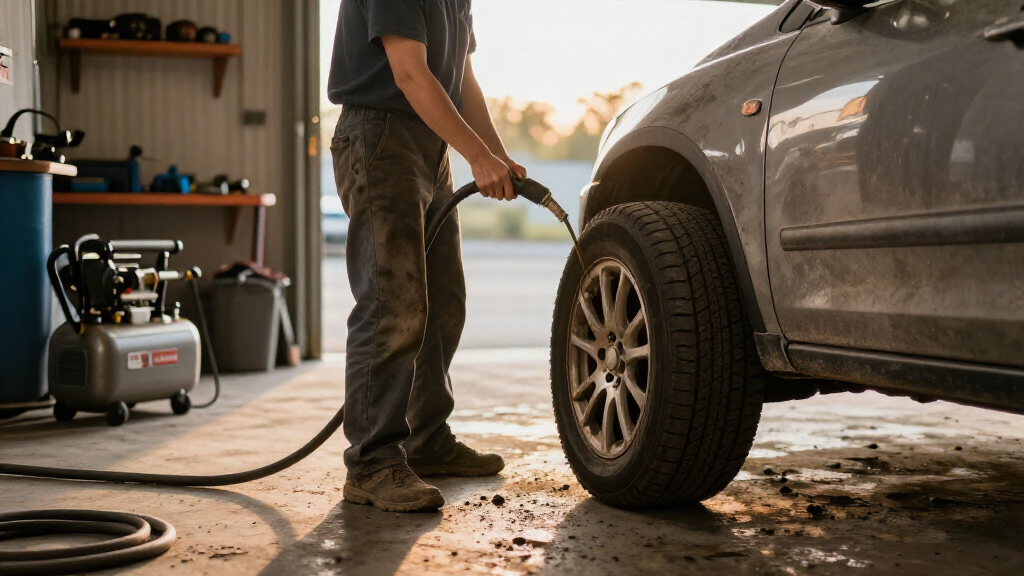
I ranked these garage air compressors by how well their stated features fit real garage tasks, from tire inflation and occasional fastening to longer-running air tools and fixed workshop use. I weighed capacity and portability alongside reported operating pressure and airflow, noise claims, oil-free or oil-lubricated design where specified, and the practical demands of the power setup. A high maximum PSI did not automatically earn a model a higher place: airflow at the pressure a tool needs is often more useful for predicting whether work can continue without frequent pauses.
The order reflects versatility for typical home garages first, followed by models with clearer advantages for quiet operation, value, compact storage, or stationary shop capacity. Larger tanks ranked lower for general buyers when their size and installation needs make them a narrower fit, not because they are inherently less capable. Product specifications vary in how much airflow and duty-cycle information they provide, so I avoid treating unlike figures as directly comparable and recommend checking the manufacturer’s current tool-compatibility data before purchase.
| garage air compressor | Pump |
|---|---|
| CRAFTSMAN 2-Gallon Portable Oi | Oil-free |
| California Air Tools 20020 2.0 | Oil-free dual piston |
| Klutch 29-Gallon Air Compresso | Oil-free |
| Campbell Hausfeld 80-Gallon Ve | Two-stage, oil-lubricated |
| Metabo HPT EC914S 6-Gallon Por | — |
| Campbell Hausfeld 60-Gallon Tw | Oil-lubricated, two-stage cast iron |
| CRAFTSMAN 6-Gallon 150 PSI Oil | Oil-free |
| Klutch 20-Gallon Portable Air | Oil-free |
| ECOMAX 6-Gallon 150 PSI Oil-Fr | Oil-free |
| Metabo HPT Quiet Air Compresso | Oil-free |
| DEWALT Air Compressor for Trim | — |
| California Air Tools 8010A 1.0 | — |
| RyanTek 15-Gallon Oil-Free Air | — |
| VEVOR 13-Gallon Oil-Free Air C | — |
Factors to Consider When Choosing Garage Air Compressors
Choosing a garage compressor starts with the tools and work pattern, not the biggest tank or highest PSI printed on the listing. I’d use these factors to narrow the field before deciding whether a portable, quiet, or fixed shop model makes sense.
Match Airflow to the Tool, Not Just the Tank
Look up each tool’s CFM requirement at its working PSI, then compare it with the compressor’s delivered airflow at that same pressure. A large tank can supply a brief burst, but it cannot make up indefinitely for a pump that produces air too slowly. Intermittent tasks such as blowing dust or inflating tires are more forgiving than tools that run continuously. For several tools, size around the one with the highest sustained demand rather than adding their maximum ratings together unless you expect to run them at once. If the listing gives only tank capacity and maximum PSI, ask the manufacturer for airflow figures before buying for a demanding tool.
Choose Tank Capacity Around Work Rhythm
Tank capacity affects how long you can draw air before the motor needs to catch up, but it is only one part of usable performance. A small tank can suit short bursts and occasional jobs while keeping storage and transport simple. A larger receiver can reduce how often the pump cycles during brief demanding tasks, yet it adds bulk and still depends on the pump’s output for sustained work. Think about whether you work in short sessions or run a tool for several minutes at a time. A common mistake is buying a large tank to compensate for inadequate airflow; for continuous use, pump delivery matters more than stored air alone.
Check Power and Installation Before Buying
Portable compressors often fit a standard household setup, while large stationary models may call for a dedicated circuit or a different voltage. Confirm the exact voltage, breaker guidance, plug type, and starting requirements in the manufacturer’s documentation before planning a location. A compressor that physically fits may still be a poor match for the garage’s electrical supply. Fixed tanks also need a stable, level location with clearance for service and ventilation. Include the cost and effort of wiring, anchoring, and air-line installation in the decision, rather than comparing machines by capacity alone.
Treat Noise as a Daily-Use Factor
Noise becomes more important when the compressor sits near living space, runs early or late, or cycles while you work. A stated decibel figure can help compare models, but measurement distance and operating conditions may differ, so it is not always an apples-to-apples rating. Oil-free designs can simplify routine upkeep, though they may still be loud; quiet operation is a separate characteristic, not a guarantee that maintenance disappears. Consider where the unit will sit and whether a longer hose can keep it farther from the work area. A quieter compressor may be worth choosing over a larger model if sound would otherwise limit when you use it.
Balance Portability Against a Permanent Shop Setup
Wheels and a compact tank help if the compressor needs to move between a garage, driveway, or storage area. A stationary tank makes more sense when the compressor will stay in one place and feed a planned air line. Remember that a full-size unit’s weight, footprint, and clearance needs can make future relocation difficult. Portable models are easier to store, but they can take up floor space during use and may need a stable surface. Decide where the compressor will live on an ordinary day, not just where it will fit during installation.
Plan for Moisture, Maintenance, and Air Quality
Compressed air cools as it moves through the system, leaving moisture that can collect in the tank and travel into hoses or tools. Drain access, tank position, and an appropriate filter or water separator matter if you use air for painting, sensitive tools, or clean finishes. Oil-free pumps can avoid oil changes, but they still need the care specified by the maker, including tank draining and intake-filter checks. For oil-lubricated models, include oil checks and changes in your routine. Buyers often focus on the compressor itself and forget that hoses, regulators, couplers, and moisture control affect how useful the setup will be.
Frequently Asked Questions
Can a 6-gallon garage compressor run an impact wrench?
It depends on the wrench’s air demand, the compressor’s delivered CFM at the required pressure, and how long you need to use it. A 6-gallon tank may support short bursts with some tools, but the motor may not keep up during repeated or sustained use. Check the tool manufacturer’s airflow requirement and compare it with the compressor’s output at the same PSI. If the listing does not provide a suitable CFM figure, do not assume a high maximum PSI means the combination will work well. For frequent lug-nut or repair work, prioritize airflow and duty cycle over tank size alone.
Is a 120V compressor enough for a home garage?
A 120V model can be a practical fit for inflation, fastening, and many intermittent jobs when its airflow matches the tools you plan to use. It also avoids some of the installation planning associated with larger stationary compressors. The limit is not voltage by itself: pump design, circuit capacity, and the tool’s air demand all affect performance. Check the manufacturer’s electrical instructions and avoid sharing a circuit with equipment that could overload it. If you need sustained high airflow, compare the complete power and output requirements rather than choosing by plug type.
Should I buy a quiet compressor for an attached garage?
It can make sense if the compressor will run near occupied rooms or if you use it at times when noise would be disruptive. A published noise figure, such as the California Air Tools 8010A’s stated 60 dBA, gives a useful reference, though ratings can depend on test conditions. Quiet models may trade away some portability, capacity, or airflow compared with a louder alternative, so check that the output still suits your tools. Placement, vibration isolation, and hose length can also affect how much noise reaches the work area. Choose low noise as a priority when it will change how often you can comfortably use the compressor.
Do I need a 60- or 80-gallon compressor for a home garage?
Most occasional home tasks do not require a tank of that size, especially if portability and simple installation matter. A 60- or 80-gallon model is better suited to a dedicated shop with space, compatible electrical service, and tools that need sustained air delivery. The tank stores air, but pump output still determines how quickly the supply recovers during ongoing work. Before choosing a large unit, check its voltage and installation requirements and confirm that its airflow meets your tools’ demands. If your work is intermittent, a smaller portable compressor may be easier to live with.
What accessories do I need beyond the compressor?
At minimum, match the hose, couplers, and regulator to the compressor’s connections and the tools you plan to run. Many garages also benefit from an air filter or water separator, particularly for painting or tools that can be harmed by moisture. A tire inflator, blow gun, or quick-connect kit may be useful for occasional jobs, but included accessories should not drive the compressor choice if the machine’s output is inadequate. Check whether the compressor includes a pressure regulator and what fittings come in the box. Plan for safe hose routing and a convenient way to drain the tank as part of the setup.
Conclusion
For the best overall balance of portable capacity and pressure, I’d choose the Metabo HPT EC914S. The best value depends on the job: the CRAFTSMAN 6-gallon pancake is a sensible starting point for common intermittent garage tasks, while the best for beginners is the compact CRAFTSMAN 2-gallon if the work is mainly inflation and light-duty use. For a best premium, quieter portable choice, I’d shortlist the California Air Tools 8010A; for a fixed shop with larger air demands, the Campbell Hausfeld 80-gallon is the more specialized path, provided the space and electrical setup fit. Choose the VEVOR when its stated 4.6 CFM at 90 PSI aligns with your tools, and choose a small one-gallon model only when compact storage outranks sustained output. The right pick is the one that meets your tools’ airflow needs without making the compressor too loud, large, or demanding for your garage.
Halloween Picks
halloween
As an affiliate, we earn on qualifying purchases.