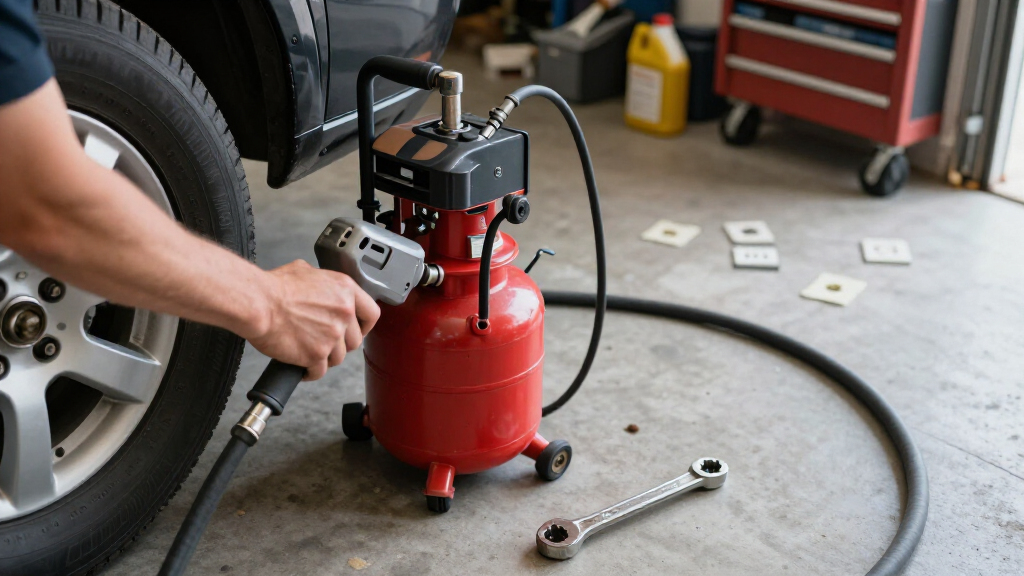
A garage air compressor is one of the most versatile tools you can own, but the right pick depends on one big tradeoff: portable and quiet versus high-output and stationary. For most home garages, the Campbell Hausfeld 60-Gallon 2-Stage stands out as the best overall pick because its 175 PSI two-stage output runs impact wrenches, sanders, and spray guns continuously without waiting on recovery. If your budget or floor space is tighter, the Klutch 29-Gallon delivers near-shop-level airflow on a standard 120V outlet, while the California Air Tools 8010A wins for anyone who works in an attached garage where noise matters. Read on for the full breakdown of all 14 models, including quiet picks, wall-mounted space savers, and budget-friendly pancakes.

Get business pricing on garage and car supplies
- Business-only prices and quantity discounts
- Tax-exempt purchasing
- Multiple users, one account, clear invoices
Complete the kit


Key Takeaways
- Tank size was the single biggest divider in this lineup: 2-8 gallon models could only run intermittent tools like nailers and tire inflators, while 20+ gallon models (Klutch 29-Gallon, Campbell Hausfeld 60-Gallon) handled continuous-duty tools like impact wrenches and grinders without stalling recovery.
- Quiet operation separated the VEVOR 13-Gallon (68 dB class) and California Air Tools 8010A from conventional loud pancake units like the ECOMAX and CRAFTSMAN 6-Gallon — a real factor if your garage shares a wall with living space.
- The 200 PSI rating on the Metabo HPT EC914S let a small 6-gallon tank store more usable air than similarly sized 125-150 PSI competitors, effectively closing the gap with mid-size tanks for short bursts of work.
- Only the Campbell Hausfeld 60-Gallon requires a 230V circuit; every other pick runs on standard 120V household power, which is why the Klutch 29-Gallon earns the runner-up spot for serious work without electrical upgrades.
- The two CRAFTSMAN wall-mounted units trade raw air capacity for zero floor footprint, making them genuinely distinct tools rather than just smaller compressors — but neither can sustain air-hungry automotive work.


| garage air compressor | Tank Capacity | Horsepower | Noise Level | Weight |
|---|---|---|---|---|
| CRAFTSMAN 2 Gallon Portable Ai | 2 gallons | 1/3 HP | 78 dB | 19 lbs |
| VEVOR 13-Gallon Quiet Air Comp | 13 gallons | 2 HP | 66 dB | 71 lbs |
| Campbell Hausfeld 60-Gallon 2- | 60 gallons (vertical ASME) | — | — | — |
| VEVOR 6.3 Gallon 2 HP Oil-Free | 6.3 gallons | 2 HP (1450W) | 70 dB | 43 lbs |
| California Air Tools 8010A Ult | 8 gallons (aluminum) | 1.0 HP | 60 dBA | 37.25 lbs |
| ECOMAX 6 Gallon 150 PSI Pancak | 6 gallons | 1.5 HP | 75 dB | 34.17 lbs |
| Klutch 20-Gallon Air Compresso | 20 gallons | 2 HP | 80 dB | 90 lbs |
| Klutch 29-Gallon Air Compresso | 29 gallons | 2.5 HP | 81 dB | 127 lbs |
| CRAFTSMAN 6 Gallon 150 PSI Oil | 6 gallons | 1.0 HP | 82 dB | 30.8 lbs |
| CRAFTSMAN All-in-One Wall Moun | 0.5 gallons | 1.5 HP | 73 dB | 20.9 lbs |
| Quiet Oil-Free Air Compressor | 5 gallons | 1.2 HP | 68 dB | — |
| CRAFTSMAN Wall Mount Air Compr | 0.5 gallons | 1.5 HP | 65 dB | — |
| Metabo HPT EC914S Portable Pan | 6 gallons | — | — | 42 lbs |
| 15-Gallon Air Compressor | 15 gallons | 2 HP | 66 dB | 68.3 lbs |
More Details on Our Top Picks
CRAFTSMAN 2 Gallon Portable Air Compressor, 1/3 HP, Max 125 PSI, Oil-Free, with 10-Piece Accessory Kit
For someone buying their first garage compressor, this CRAFTSMAN makes the most sense as a low-commitment entry point. The 19-pound hot dog design means it lives on a shelf between uses rather than claiming floor space, and the bundled 10-piece accessory kit spares a new buyer the confusion of matching fittings and couplers separately. What it gives up in return is runtime: a 2-gallon tank drains fast under any sustained demand, whereas the VEVOR 6.3 Gallon offers triple the air reserve for similar inflation-focused tasks. Compared with the California Air Tools 8010A, its 78 dB output is noticeably louder, so enclosed garages adjacent to living spaces may find it annoying. This model suits occasional tire top-ups, brad nailing, and light blow-gun work — buyers planning to run impact wrenches or sprayers should skip it entirely.
Pros:- Extremely light at 19 lbs with a reinforced handle for one-handed carrying
- Complete 10-piece accessory kit means it works out of the box
- Oil-free pump eliminates routine maintenance for casual users
- Compact hot dog design stores on a shelf or under a workbench
Cons:- Tiny 2-gallon tank severely limits runtime with any air-hungry tool
- 78 dB noise is loud relative to quieter rivals in this roundup
Best for: First-time compressor owners who mainly inflate tires and run occasional finish-nailing or blow-gun tasks
Not ideal for: Anyone running continuous-duty air tools — the 2-gallon tank empties almost immediately under sustained demand
- Tank Capacity:2 gallons
- Horsepower:1/3 HP
- Max Pressure:125 PSI
- Pump Type:Oil-free, maintenance-free
- Noise Level:78 dB
- Weight:19 lbs
- Included Accessories:10-piece kit with hose, gauge, blow gun, and fittings
Our verdict“A sensible, low-cost starter compressor for tire inflation and light tasks — but it will be outgrown quickly by anyone getting serious about pneumatic tools.”
VEVOR 13-Gallon Quiet Air Compressor, 2HP Oil-Free, 125 PSI
This 13-gallon VEVOR earns the top spot because it balances the three things most garage owners actually care about: enough tank volume to run real tools, a 66 dB noise level that won’t clear the room, and a 4.6 SCFM output that keeps up with nailers, impact drivers, and light spray work. Its sub-3-minute tank fill beats the California Air Tools 8010A on recovery speed while nearly matching its quietness — a rare combination at this capacity. Against the Campbell Hausfeld 60-gallon, the tradeoff is obvious: less than a quarter of the sustained airflow, but no 230V wiring, no oil changes, and wheels instead of a permanent anchor in your garage. The 71-pound weight is the real cost of that capacity — it rolls fine on its 7-inch wheels but is awkward to lift into a vehicle, so treat it as semi-stationary.
Pros:- 66 dB operation is quiet enough for conversation in the same room
- 4.6 SCFM at 90 PSI supports most common garage air tools
- Fast pressure buildup in under 3 minutes minimizes waiting
- 13-gallon tank provides useful reserve for burst-demand tools
Cons:- Heavy at 71 pounds despite the wheel kit
- Corded power and bulk make it poorly suited to portability
- 125 PSI ceiling trails the 175 PSI of larger stationary rivals
Best for: Home garage owners who want one compressor that handles nailing, impact wrenches, tire work, and occasional spraying without wiring upgrades
Not ideal for: Anyone needing to move a compressor between sites frequently — at 71 lbs it’s a workshop tool, not a jobsite tool
- Tank Capacity:13 gallons
- Horsepower:2 HP
- Air Flow:4.6 SCFM @ 90 PSI
- Max Pressure:125 PSI
- Noise Level:66 dB
- Pump Type:Oil-free
- Weight:71 lbs
- Voltage:120 volts
Our verdict“The most well-rounded choice here for a typical home garage — quiet, capable, and plug-and-play on a standard 120V outlet.”
Campbell Hausfeld 60-Gallon 2-Stage Vertical Air Compressor, 175 PSI, 230V
When a garage doubles as a serious workshop, portable compressors stop being adequate — and that’s exactly where this Campbell Hausfeld 60-gallon earns its place. Its oil-lubricated two-stage cast-iron pump is rated for up to 10,000 hours, a durability class the oil-free units in this lineup simply don’t match, and its 175 PSI max pressure with 7.6 SCFM at 90 PSI means sanders, grinders, and HVLP guns can run continuously. The honest tradeoffs: it demands a dedicated 230/240V circuit, which many home garages don’t have, and it needs periodic oil changes — the opposite of the zero-maintenance VEVOR 13-Gallon. The 23 x 23-inch vertical footprint is surprisingly modest for the capacity, but once it’s placed, it’s staying there. This is the pick for the buyer who has already outgrown tank-style portables, not for someone still figuring out what they need.
Pros:- Two-stage cast-iron pump rated for up to 10,000 hours of service life
- 7.6 SCFM at 90 PSI supports continuous-duty air tools
- 175 PSI max pressure exceeds the 120-125 PSI ceiling of portable rivals
- Compact vertical footprint saves floor space for its class
Cons:- Requires a dedicated 230/240V electrical circuit
- Oil-lubricated pump demands ongoing oil checks and changes
- Completely stationary — no portability whatsoever
Best for: Serious DIYers and hobbyist mechanics running high-demand air tools like sanders, grinders, and paint guns for extended sessions
Not ideal for: Renters or casual users — the dedicated 230V circuit requirement and permanent placement make it impractical for shared or temporary spaces
- Tank Capacity:60 gallons (vertical ASME)
- Max Pressure:175 PSI
- Airflow:7.6 SCFM @ 90 PSI
- Motor:3.7 running HP induction, 230/240V
- Pump:Oil-lubricated 2-stage cast iron
- Pump Life:Up to 10,000 hours
- Footprint:23 x 23 inches
Our verdict“The right investment for a permanent workshop with serious air demands, provided the garage already has (or can add) a 240V circuit.”
VEVOR 6.3 Gallon 2 HP Oil-Free Air Compressor, Max 116 PSI
Sitting between the CRAFTSMAN 2-gallon and the larger 13-gallon VEVOR, this 6.3-gallon model targets the sweet spot for budget-conscious buyers who need more than an inflator but not a workshop centerpiece. The dual-cylinder 2 HP motor delivers 3.35 CFM at 90 PSI — enough for framing nailers and intermittent impact work that would starve the smaller CRAFTSMAN — while the 3-layer rust-resistant steel tank and overheat/overpressure shutoffs add protection rarely emphasized at this price tier. The compromises are real, though: at 43 pounds with no wheels, it’s heavier than it looks and awkward to move, and its 116 PSI ceiling trails everything else here, which slightly reduces usable air reserve. Compared with the California Air Tools 8010A, it trades quietness and portability for raw airflow.
Pros:- Dual-cylinder design recovers air quickly between tool bursts
- Overheat and overpressure protection safeguard the motor
- Rust-resistant 3-layer steel tank improves long-term durability
- 3.35 CFM at 90 PSI outpaces similar-size pancake compressors
Cons:- 116 PSI max pressure is the lowest in this lineup
- 43 lbs with no wheels makes it awkward to reposition
- 70 dB operation is louder than dedicated quiet models
Best for: Budget-minded DIYers doing framing, fencing, and tire work who prioritize airflow over portability and noise
Not ideal for: Noise-sensitive attached garages or anyone needing to haul the compressor around — 70 dB and 43 handle-carried pounds get old fast
- Tank Capacity:6.3 gallons
- Horsepower:2 HP (1450W)
- Max Pressure:116 PSI
- Air Flow:3.35 CFM @ 90 PSI
- Noise Level:70 dB
- Pump Type:Oil-free dual-cylinder
- Weight:43 lbs
- Voltage:120V AC
Our verdict“A strong value for DIYers who need real airflow on a budget, as long as noise and lifting aren’t dealbreakers.”
California Air Tools 8010A Ultra Quiet Oil-Free Air Compressor, 1.0 HP, 8 Gallon Aluminum Tank
At 60 dBA, the California Air Tools 8010A is the quietest compressor in this roundup by a clear margin — quiet enough to run inside a home garage or shared workspace while holding a conversation, something neither the VEVOR 6.3-gallon (70 dB) nor the CRAFTSMAN 2-gallon (78 dB) can claim. The aluminum tank is a genuine differentiator: it won’t rust from the inside like steel tanks, and it keeps the whole unit at a liftable 37.25 lbs with a wheel kit. The catch is airflow — 2.20 CFM at 90 PSI is the lowest output here, so while the 165-second fill and 60-second recovery feel quick for topping off, sustained tools like die grinders will outrun it. For finish work, inflation, airbrushing, and light nailing in noise-sensitive settings, nothing else in this lineup competes on sound alone.
Pros:- Ultra-quiet 60 dBA operation, the quietest in this roundup
- Rust-proof aluminum tank with 3000+ hour pump life rating
- Lightweight at 37.25 lbs with an included wheel kit
- Fast 165-second tank fill and 60-second recovery
Cons:- Lowest airflow in the lineup at 2.20 CFM @ 90 PSI
- 8-gallon tank limits continuous-duty applications
Best for: Woodworkers, hobbyists, and anyone working in attached garages or shared spaces where noise is the deciding factor
Not ideal for: Mechanics running high-CFM tools like impact wrenches or sanders — the 2.20 CFM at 90 PSI can’t keep up
- Tank Capacity:8 gallons (aluminum)
- Horsepower:1.0 HP
- Max Pressure:120 PSI
- Airflow:3.10 CFM @ 40 PSI, 2.20 CFM @ 90 PSI
- Noise Level:60 dBA
- Pump Type:Oil-free dual piston, 3000+ hour rating
- Weight:37.25 lbs
- Tank Fill Time:165 seconds
Our verdict“The clear choice when noise matters most — just accept modest airflow as the price of near-silent operation.”
ECOMAX 6 Gallon 150 PSI Pancake Air Compressor with 10-Piece Accessory Kit
This option stands out as the most complete out-of-the-box package in this batch — the 10-piece accessory kit with a 25 ft hose, tire gauge, and blow gun means a first-time buyer can start working the day it arrives. Compared with the CRAFTSMAN 6 Gallon pancake, the ECOMAX edges ahead for beginners thanks to those included accessories and its slightly higher 3 CFM output, though the CRAFTSMAN counters with a lighter 30.8 lb frame. The dual quick couplers are a nice touch for running a nailer while keeping a hose free for tire duty. The tradeoff is the same one all pancake compressors share: 3 CFM disappears fast under any continuous-demand tool, and 75 dB is loud enough that indoor hobbyists will want hearing protection. This pick makes the most sense for someone building a garage kit from zero.
Pros:- Includes a 10-piece accessory kit with 25 ft hose, so no separate purchases needed
- Dual quick couplers allow two tools or hoses at once
- 34 lb weight with flip-up handle makes it genuinely portable
- Oil-free pump eliminates oil changes
Cons:- 3 CFM output restricts use to intermittent-duty tools
- 75 dB noise is intrusive for attached garages or shared workspaces
Best for: First-time garage owners who want a compressor and every accessory in one purchase for nailing, inflation, and light spraying
Not ideal for: Anyone planning to run impact wrenches or sanders — the 3 CFM delivery will stall under continuous-demand tools
- Tank Capacity:6 gallons
- Max Pressure:150 PSI
- Air Flow:3 CFM
- Horsepower:1.5 HP
- Noise Level:75 dB
- Weight:34.17 lbs
- Pump Type:Oil-free
- Included Hose:1/4 in x 25 ft PVC
Our verdict“Buy this if you’re starting from an empty garage and want everything included; skip it if air-hungry tools are on your shopping list.”
Klutch 20-Gallon Air Compressor, 2 HP, 120V, 175 PSI
The Klutch 20-gallon sits at the sweet spot between pancake portability and shop-grade capacity. Its 175 PSI max pressure and 5.2 CFM deliver meaningfully more usable air than the ECOMAX or CRAFTSMAN 6-gallon pancakes, which translates to running impact wrenches and ratchets without the motor cycling constantly. The 75% duty cycle and thermal overload protection matter here — this model is built to work in longer sessions, not just fire a nailer occasionally. Compared with its sibling, the Klutch 29-gallon, the 20-gallon gives up some reserve capacity but wins on footprint and maneuverability with its large rubber wheels. The honest tradeoff: it still runs on a 120V household circuit with 14A draw, so airflow is modest for the tank size, and at 80 dB it’s loud enough that it belongs in a detached or well-isolated garage.
Pros:- 20-gallon vertical tank stores far more reserve air than pancake models
- 175 PSI max pressure supports higher-demand tools like impact wrenches
- 75% duty cycle with thermal overload protection handles long work sessions
- Large rubber wheels and handle make a 90 lb unit manageable to reposition
Cons:- 80 dB noise level is too loud for attached garages or close neighbors
- 5.2 CFM is still limiting for continuous-duty tools like sanders or grinders
Best for: Weekend mechanics who want to run impact tools and ratchets on a standard 120V outlet without rewiring the garage
Not ideal for: Anyone in an attached garage or shared wall situation — 80 dB will be a problem, and 5.2 CFM still falls short of heavy sanding or grinding duty
- Tank Capacity:20 gallons
- Max Pressure:175 PSI
- Air Flow:5.2 CFM (4.2 SCFM @ 90 PSI)
- Horsepower:2 HP
- Voltage:120V (14A)
- Noise Level:80 dB
- Duty Cycle:75%
- Weight:90 lbs
Our verdict“The smart middle step for garage mechanics who have outgrown a pancake but don’t want a 230V shop compressor.”
Klutch 29-Gallon Air Compressor, 2.5 HP, 120V, 175 PSI
Where the Klutch 20-gallon is a step up from pancakes, this 29-gallon version is a near-shop compressor that still plugs into a household outlet. The larger tank plus 175 PSI max pressure means longer bursts of continuous work — spray painting a panel or running a die grinder — before the pump kicks back in, which is exactly what the smaller tank can’t sustain. Its brass quick-connect coupler and flat-free tires are small quality-of-life touches that add up during a full day in the garage. Compared with the Campbell Hausfeld 60-gallon 2-stage, it obviously gives up capacity, but it avoids the 230V circuit requirement entirely. The real tradeoffs are physical: at 127 pounds, this is a unit you position once, and at 81 dB it’s louder than everything here except the loudest pancakes. Runtime is where this pick earns its place, not portability or quiet.
Pros:- 29-gallon tank plus 175 PSI provides extended tool runtime between cycles
- 2.5 HP motor handles intermediate-to-continuous pneumatic work
- Flat-free large tires survive shop floors and gravel without flats
- Oil-free pump and maintenance-friendly tank drain simplify upkeep
Cons:- 127 lb weight makes it effectively stationary despite the wheels
- 81 dB noise level is among the loudest in this lineup
Best for: Serious home-shop owners who spray paint, run intermediate air tools continuously, and have a 120V-only garage
Not ideal for: Small or shared workspaces — 127 lbs makes it semi-permanent, and 81 dB demands hearing protection and tolerant neighbors
- Tank Capacity:29 gallons
- Max Pressure:175 PSI
- Air Flow:5.1 CFM at 90 PSI
- Horsepower:2.5 HP
- Voltage:120V (14.5A)
- Noise Level:81 dB
- Pump Type:Oil-free vertical
- Weight:127 lbs
Our verdict“The right pick when you need sustained air for painting and grinding but can’t justify a 230V two-stage unit.”
CRAFTSMAN 6 Gallon 150 PSI Oil-Free Pancake Air Compressor (CMXECXA02106410)
At 30.8 lbs with a molded carry handle, this CRAFTSMAN is the lightest full-size pancake in the roundup, and that single fact defines who it’s for. Compared with the ECOMAX 6-gallon, it gives up the accessory bundle and a little airflow (2.6 vs 3 SCFM) in exchange for easier hauling between garage, truck, and job site. The low-voltage cold-start on the 1.0 HP motor is a genuine advantage for unheated garages in winter, where some motors struggle to turn over. Like the ECOMAX, its dual quick couplers keep a nailer and an inflation hose connected simultaneously. The tradeoff is real, though: 2.6 SCFM is the lowest airflow of any 6-gallon here, so framing nailers at a fast pace will outrun the tank, and at 82 dB it’s actually louder than the bigger Klutch units. This model is better suited to portability-first buyers than workshop buyers.
Pros:- Lightest 6-gallon option at 30.8 lbs with a carry handle
- Low-voltage start reliably fires up in cold garages
- Dual quick couplers support two tools without swapping hoses
- Oil-free pump with 1-year warranty keeps ownership simple
Cons:- 2.6 SCFM at 90 PSI is the weakest airflow among the 6-gallon picks
- 82 dB is louder than even the 20-gallon Klutch
Best for: Trim carpenters and DIYers who move a compressor between garage, truck, and job sites and mostly run one nailer at a time
Not ideal for: Stationary garage workstations — the small tank and lowest-in-class airflow make it a poor shop compressor
- Tank Capacity:6 gallons
- Max Pressure:150 PSI
- Air Flow:2.6 SCFM at 90 PSI
- Horsepower:1.0 HP
- Noise Level:82 dB
- Weight:30.8 lbs
- Pump Type:Oil-free
- Warranty:1-year
Our verdict“Choose this over the ECOMAX when carrying weight matters more than included accessories or raw airflow.”
CRAFTSMAN All-in-One Wall Mount Air Compressor, 1.5HP 125PSI with 30ft Retractable Hose
This is the only compressor in the batch that takes up zero floor space — mounting it to the wall with a built-in 30-foot retractable hose turns an entire garage’s tire-inflation and brad-nailing needs into a fixed station. At 73 dB, it runs quieter than every pancake and Klutch model here, and the retractable reel means no coiled hoses piled in a corner. The comparison that matters is against the Klutch 20-gallon: buyers who mostly inflate tires and run finish nailers don’t need 20 gallons of reserve — they need convenience — and this delivers it. But the 0.5-gallon tank and 2.3 CFM cap it firmly at light duty; any framing or impact work sends the pump into near-constant cycling, which eats into the 200+ hour rated life cycle. That rated lifespan is also shorter than conventional tank compressors, so heavy users will reach it sooner.
Pros:- Wall-mount design with 30 ft retractable hose keeps the garage floor clear
- 73 dB operation is quieter than any pancake or mid-size tank model here
- Oil-free motor starts reliably in cold weather with minimal upkeep
- Quick 20-second recovery suits frequent short tasks like tire top-offs
Cons:- 0.5-gallon tank restricts it to inflation and light nailing only
- 200+ hour rated life cycle is shorter than conventional tank compressors
Best for: Homeowners who want a permanent, tidy inflation and finish-nailing station without sacrificing any garage floor space
Not ideal for: Anyone running framing nailers or impact tools — the 0.5-gallon tank will cycle constantly and wear the pump prematurely
- Tank Capacity:0.5 gallons
- Max Pressure:125 PSI
- Air Flow:2.3 CFM
- Horsepower:1.5 HP
- Noise Level:73 dB
- Hose Length:30 ft retractable
- Weight:20.9 lbs
- Certification:ETL
Our verdict“A purpose-built convenience station — buy it for tires and trim work, and let the tank compressors handle anything heavier.”
Quiet Oil-Free Air Compressor, 5 Gallon, 68 dB
This option stands out for one thing most small compressors ignore: everything in the box. Between the 25 ft hose, quick-connect fitting, and 13-piece accessory kit, a first-time buyer can go from unboxing to inflating tires or running a finish nailer without a single extra purchase. Compared with the CRAFTSMAN 6 Gallon Pancake, it gives up a gallon of tank capacity but runs noticeably quieter at 68 dB thanks to a low-speed 3400 RPM induction motor, which matters in an attached garage. The 80-second refill and 25-second recovery keep intermittent tasks moving without painful waits. The tradeoff is honest: 2.8 CFM at 90 PSI is finish-work airflow, not framing-gun airflow, and the 5-gallon tank will cycle often under sustained demand.
Pros:- Whisper-quiet 68 dB operation suitable for attached garages and indoor work
- Genuinely complete bundle: hose, quick-connect, 13 accessories, and wheels
- Fast 80-second refill and 25-second recovery between tasks
- Oil-free pump means no oil changes or cold-weather start issues
Cons:- 5-gallon tank limits runtime on continuous-duty tools
- 2.8 CFM at 90 PSI is underpowered for framing nailers and air-hungry tools
Best for: First-time garage owners who want a quiet, complete, plug-in-and-go setup for finish nailers, staplers, and tire inflation
Not ideal for: Framers or anyone running high-CFM tools continuously — the 2.8 CFM at 90 PSI and small tank will leave tools starved
- Horsepower:1.2 HP
- Tank Capacity:5 gallons
- Airflow:4 CFM @ 40 PSI, 2.8 CFM @ 90 PSI
- Noise Level:68 dB
- Refill Time:80 seconds empty to full
- Recovery Time:25 seconds
- Pump Type:Oil-free
- Included Accessories:25 ft PVC hose, 1/4″ quick-connect, 13-piece kit, wheels
Our verdict“The right first compressor if you want quiet operation and every accessory included on day one, as long as your work is finish-grade rather than heavy framing.”
CRAFTSMAN Wall Mount Air Compressor with 8-Piece Accessory Kit
Garages run out of floor space before they run out of projects, and this CRAFTSMAN answers that problem directly: it mounts on the wall and keeps the floor completely clear. The clever part is the retractable 30 ft hose — instead of dragging a compressor to the car, you pull hose to it, which covers a two-car garage from a single mounting point. Compared with the Quiet Oil-Free 5 Gallon above, it sacrifices nearly all tank capacity (0.5 gallons) in exchange for a permanent, invisible installation and a 20-second recovery that suits light intermittent tasks. At 65 dB and roughly 21 lbs, it behaves more like a high-end inflator station than a workshop compressor. Be realistic about the ceiling: 1.8 CFM and 125 PSI handles tires, balls, brad nailing, and light blow-gun work — nothing more.
Pros:- Wall-mounted design frees up 100% of floor space
- Retractable 30 ft hose reaches across a full garage from one spot
- Quiet 65 dB operation and ETL-certified steel construction
- 20-second recovery time keeps light tasks moving
Cons:- 0.5-gallon tank is the smallest here — strictly light-duty duty cycle
- Requires wall mounting, so it lacks the portability of tank-style units
Best for: Homeowners with a cluttered or compact garage who mainly want a permanent tire-inflation and light-duty air station
Not ideal for: Anyone planning spray painting or automotive work — the 0.5-gallon tank and 1.8 CFM simply cannot sustain air tools
- Horsepower:1.5 HP
- Tank Capacity:0.5 gallons
- Maximum Pressure:125 PSI
- Airflow:1.8 CFM
- Noise Level:65 dB
- Hose:30 ft retractable
- Recovery Time:20 seconds
- Accessories:8-piece kit including blow gun, tire chuck, needles, nozzles
- Warranty:1-year limited
Our verdict“A smart buy if air needs are limited to tires and brad nailers and the appeal of a zero-footprint, always-ready wall station outweighs any capacity ambitions.”
Metabo HPT EC914S Portable Pancake Air Compressor, 6 Gallon, 200 PSI
Most pancake compressors top out at 150 PSI; this Metabo HPT pushes to 200 PSI, and that number translates directly into longer tool runtime between cycles — roughly 25% more usable air in the same 6-gallon footprint. Combined with 4 CFM at 90 PSI, it can feed two nailers simultaneously, which is why crews, not just hobbyists, carry it. Against the ECOMAX 6 Gallon Pancake, it trades accessory bundles for raw pressure and airflow, making it the stronger pick when nailing speed matters more than getting a starter kit. At 42 lbs it still loads into a truck bed one-handed. The honest weakness is warranty coverage: just one year, which is thin for a jobsite tool, and the oil-free pump trades longevity for zero maintenance.
Pros:- 200 PSI max pressure stores more usable air in a compact 6-gallon tank
- 4 CFM at 90 PSI supports running multiple nailers at once
- Lightweight 42 lbs with a proven jobsite pancake form factor
- Trusted Metabo HPT heritage shared with Hitachi’s legacy compressor line
Cons:- Only a 1-year warranty, shorter than many workshop-focused rivals
- No accessory kit or hose included, unlike starter-oriented picks
Best for: Trim carpenters and serious DIY builders who run one or more nailers and want maximum runtime from a portable footprint
Not ideal for: Spray painters or sandblasters — despite the high pressure, 4 CFM cannot sustain continuous-CFM tools for long stretches
- Tank Capacity:6 gallons
- Maximum Pressure:200 PSI
- Airflow:4 CFM at 90 PSI
- Weight:42 lbs
- Configuration:Pancake, portable
- Warranty:1 year
Our verdict“The pick when nailing performance per pound is the priority — just budget for a hose and accept the short warranty.”
15-Gallon Air Compressor, 2HP, Quiet 66dB, 4.5CFM@90PSI
This is where the roundup shifts from portable units to something that lives in the garage. The vertical 15-gallon tank cuts the floor footprint dramatically compared with a horizontal unit like the Klutch 20-Gallon, while the wheels and handle let you reposition it for a project and tuck it back against the wall afterward. The twin-cylinder oil-free pump delivers 4.5 CFM at 90 PSI at just 66 dB — quieter than most pancake compressors, which means spray painting or running an impact wrench won’t clear the house. Thoughtful details like dual air outlets (two tools or hoses at once), an upward-facing gauge, and a horizontal drain valve add up to real daily convenience. The ceiling is 125 PSI, though, so unlike the Klutch units at 175 PSI, it’s not aimed at hard-core automotive air demand, and 4.5 CFM won’t feed die grinders or sanders continuously.
Pros:- Vertical design with wheels and handle saves floor space and moves easily
- 66 dB twin-cylinder pump is remarkably quiet for a 15-gallon unit
- Dual air outlets let two hoses or tools run simultaneously
- Practical layout: upward-facing gauge, protected switch, horizontal drain valve
Cons:- 125 PSI max pressure trails the 175 PSI Klutch shop compressors
- 4.5 CFM is insufficient for continuous-duty air tools like sanders and grinders
Best for: Home workshop owners who want a quiet, mobile, always-ready compressor for nail guns, painting, inflation, and occasional impact work
Not ideal for: Serious automotive hobbyists — 125 PSI max and 4.5 CFM fall short of the sustained airflow die grinders and sandblasters demand
- Horsepower:2 HP
- Tank Capacity:15 gallons
- Airflow:4.5 CFM at 90 PSI
- Maximum Pressure:125 PSI
- Noise Level:66 dB
- Pump Type:Oil-free, twin cylinder
- Configuration:Vertical tank with wheels and handle
- Weight:68.3 lbs
- Voltage:110V
Our verdict“The strongest choice for a general-purpose home workshop that values quiet operation and floor space over maximum air-hungry performance.”
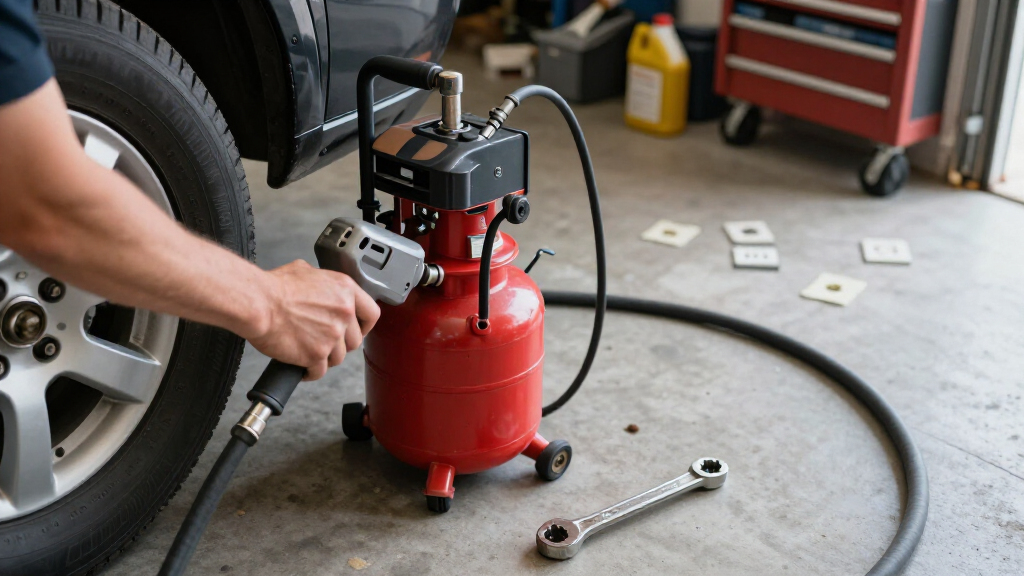
How We Picked
I evaluated these compressors through the lens of what actually happens in a home garage: tire inflation, nail guns, impact wrenches, occasional spray painting, and maybe some sandblasting. The criteria that mattered most were airflow (CFM at 90 PSI), because that determines which tools each unit can run continuously; tank size and max PSI, which govern how long you can work before the motor kicks back on; and noise output, since most home garages are attached to or near living spaces. I also weighed power requirements, because a 230V compressor is useless if your garage doesn’t have that circuit, and portability, since a 60-gallon vertical unit demands a permanent footprint.
The ranking logic follows capability first, then practicality. High-CFM, large-tank models rank at the top because they cover the widest range of garage tasks without upgrade regret. Mid-tank quiet models come next as the sweet spot for attached garages. Small pancakes and wall-mounted units fill specific niches — light DIY, inflating, trim work — and are ranked for how well they serve those narrower jobs rather than compared head-to-head against shop compressors. Oil-free pumps appeared across most of the lineup, which I treated as a maintenance advantage rather than a differentiator on its own.
| garage air compressor | Pump Type |
|---|---|
| CRAFTSMAN 2 Gallon Portable Ai | Oil-free, maintenance-free |
| VEVOR 13-Gallon Quiet Air Comp | Oil-free |
| Campbell Hausfeld 60-Gallon 2- | — |
| VEVOR 6.3 Gallon 2 HP Oil-Free | Oil-free dual-cylinder |
| California Air Tools 8010A Ult | Oil-free dual piston, 3000+ hour rating |
| ECOMAX 6 Gallon 150 PSI Pancak | Oil-free |
| Klutch 20-Gallon Air Compresso | — |
| Klutch 29-Gallon Air Compresso | Oil-free vertical |
| CRAFTSMAN 6 Gallon 150 PSI Oil | Oil-free |
| CRAFTSMAN All-in-One Wall Moun | — |
| Quiet Oil-Free Air Compressor | Oil-free |
| CRAFTSMAN Wall Mount Air Compr | — |
| Metabo HPT EC914S Portable Pan | — |
| 15-Gallon Air Compressor | Oil-free, twin cylinder |
Factors to Consider When Choosing Garage Air Compressors
Before committing to any of the picks above, step back and match the compressor to the tools you actually own and the garage you actually have. Most buyer disappointment in this category comes from buying a compressor that’s the wrong size for the work — either too small to run a tool or far too big for occasional tire top-ups. These are the factors that drive that decision.CFM Matters More Than Tank Size
The most common mistake buyers make is shopping by tank gallon count and ignoring CFM at 90 PSI, which is the number that actually determines tool compatibility. A tank is just stored air — once it’s depleted, the motor has to keep up with your tool’s demand, and a compressor producing 2.8 CFM will stall a 4-5 CFM impact wrench no matter how big the tank is. Always add a 25-30% buffer to your hungriest tool’s CFM requirement before choosing. This is why the Klutch 29-Gallon with 5.1 CFM outclasses larger-seeming single-stage units for automotive work. If you only run nail guns and inflators, though, nearly any compressor in this lineup has sufficient CFM, and you can safely prioritize other factors like noise and size.
Match the Power Requirement to Your Garage
Not every garage can power every compressor in this roundup. The Campbell Hausfeld 60-Gallon requires a dedicated 230V circuit, which means an electrician visit and added cost before you even bolt it down. Everything else here runs on standard 120V outlets, but high-draw 2-2.5 HP motors can still trip breakers if they share a circuit with other tools or a refrigerator — something first-time buyers rarely check. Look at your breaker panel and note which outlets are on which circuits before purchasing. A 120V compressor on a shared 15-amp circuit is a frequent cause of nuisance trips during cold-weather startup, when motor draw spikes. Paying for a bigger compressor you can’t reliably power is money wasted.
Noise Level and Your Garage Setup
Compressor noise ranges dramatically across this category, roughly from 60 dB for ultra-quiet models to 90+ dB for conventional pancake and single-stage units — that’s the difference between holding a conversation nearby and needing hearing protection. If your garage is detached, noise barely matters and you can buy purely on performance per dollar. If it’s attached to your house or shares a wall with a neighbor, a quiet model like the California Air Tools 8010A or the 68 dB 5-gallon unit will preserve both your household peace and your ability to work at odd hours. Some buyers also plan around this with longer hose runs, parking a loud compressor outside or in a closet. But quiet designs generally cost more per CFM, so decide whether that premium fits your situation before paying it.
Oil-Free vs. Oil-Lubricated Pumps
Nearly every model in this roundup uses an oil-free pump, and for home garage use that’s usually the right call — no seasonal oil changes, no oil contamination when spraying finish, and no disposal hassle. The tradeoff is longevity: oil-free pumps typically have a shorter service life and can’t be rebuilt as easily as cast-iron oiled pumps found on some stationary units. If you’re running the compressor a few hours a week, that tradeoff almost never matters within the tool’s realistic lifespan. If you’re building out a working shop with daily use, the oiled two-stage design of the Campbell Hausfeld 60-Gallon justifies its cost through durability. The mistake to avoid is assuming oil-free means maintenance-free — you still need to drain tank moisture regularly to prevent rust.
Floor Space, Portability, and Placement
Measure your actual garage space before buying, including clearance around the compressor for airflow and maintenance access. A 60-gallon vertical unit claims a surprisingly small footprint for its capacity, but it’s effectively permanent once placed, while wall-mounted options like the CRAFTSMAN retractable-hose models free up your floor entirely and keep a hose always within reach. Pancake and small portable units are easy to carry but live wherever you last used them, which gets old if you inflate tires weekly. Also think about hose routing: a stationary compressor in a corner with a 50-foot hose reel often beats a portable you drag around anyway. Buyers frequently underestimate how much placement convenience affects whether the compressor actually gets used.
When to Pay More — and When Not To
Premium pricing in this category buys three things: higher CFM, quieter operation, and longer pump life. Paying up makes sense if you run continuous-duty tools like DA sanders, grinders, or spray guns, or if noise constraints would otherwise limit when you can work. It does not make sense if your realistic use is seasonal tire inflation, brad nailing, and occasional blow-gun cleanup — a sub-$150-class pancake handles all of that, and spending four times more buys capability you’ll never touch. A useful exercise: list every air tool you own or realistically plan to buy within two years, find the highest CFM item, and buy for that tool plus buffer. That single list prevents both underspending on frustration and overspending on idle capacity.
Frequently Asked Questions
Will a 6-gallon pancake compressor run an impact wrench?
For short bursts, yes — but not productively for real automotive work. A typical half-inch impact wrench needs 4-5 CFM at 90 PSI, while 6-gallon pancakes like the CRAFTSMAN and ECOMAX deliver around 2.6 SCFM, so the tank drains within seconds of sustained trigger use and you’ll wait on recovery constantly. The higher-pressure Metabo HPT EC914S at 200 PSI extends usable run time somewhat because it stores more air in the same tank size. For lug nuts and light bolt work a few times a year, a pancake will get you through. If impact wrench use is regular, the Klutch 20-Gallon or 29-Gallon is the realistic minimum, and the Campbell Hausfeld 60-Gallon is the proper answer.
How loud is too loud for an attached garage?
As a working rule, anything above about 80 dB will be clearly audible inside the house through a shared wall, especially framing and drywall construction with no sound insulation. Conventional pancake compressors run in the 85-90 dB range, which is why they’re a common source of household complaints. Quiet-rated models like the California Air Tools 8010A and the 68 dB 5-gallon unit operate closer to a normal conversation level, letting you work early or late without conflict. If you already own a loud compressor, mounting it on rubber pads and running longer hose to work farther away helps, but it won’t match a purpose-built quiet design. If your garage is attached and you work often, treat the quiet premium as money well spent.
Is a 60-gallon compressor worth it if I only work on my own cars?
It depends on how you work, not how many cars you own. If your tasks are tire rotations, oil changes, and brake jobs, the Klutch 29-Gallon covers nearly all of it at lower cost and on standard 120V power. The Campbell Hausfeld 60-Gallon pulls ahead when you add continuous-duty tools — sanders, grinders, media blasting, or HVLP spray guns — because its two-stage 175 PSI pump sustains airflow that smaller single-stage units simply can’t. Factor in the 230V circuit requirement and the permanent floor footprint before deciding. Many home mechanics find the 29-gallon class is the honest sweet spot, then upgrade years later only if their tool collection genuinely outgrows it.
Are wall-mounted compressors actually useful, or just a gimmick?
They’re genuinely useful for a specific job: keeping air available for inflation and light blow-gun cleanup without sacrificing any floor or bench space. The CRAFTSMAN wall-mount models pair a small tank with a 30-foot retractable hose, so tire top-ups become a 30-second task instead of dragging out a portable unit. What they can’t do is run air-hungry tools — the small tanks and modest CFM rule out impact wrenches, sanders, or painting. The smart setup for many garages is actually a wall-mount for daily convenience alongside a larger floor unit for real work. If you only ever inflate tires and sports balls, a wall-mount alone may be all you need.
What maintenance does an oil-free garage compressor actually need?
Less than an oiled pump, but not zero — and skipping it is the fastest way to kill a tank. The main task is draining the tank’s moisture valve after heavy use or at least monthly, because condensed water rusts the tank from the inside and eventually compromises it. Check the safety relief valve periodically by pulling it while the tank is pressurized to confirm it releases and reseats. Clean or replace the intake filter if your model has one, since a clogged filter makes the motor work harder and slows recovery. Inspect hoses and fittings for leaks, which silently waste compressor capacity — a soapy-water check at fittings takes minutes. None of this takes more than fifteen minutes a month, and it’s the difference between a compressor that lasts three years and one that lasts ten.
Conclusion
The right pick here depends entirely on what your garage is for. For the best overall choice, the Campbell Hausfeld 60-Gallon 2-Stage is unmatched — it runs every tool a home mechanic will ever pick up, provided your garage has 230V power and the floor space. The best value is the Klutch 29-Gallon, which delivers genuine automotive capability on a standard outlet at a fraction of the cost of a shop compressor. For premium buyers prioritizing refinement, the California Air Tools 8010A pairs ultra-quiet operation with a rust-proof aluminum tank — the pick for attached garages and finishing work. Beginners and light DIYers are best served by the CRAFTSMAN 6-Gallon Pancake or the Metabo HPT EC914S if they want extra stored pressure for slightly longer run times. And for specific needs: the VEVOR 13-Gallon hits the quiet-but-capable middle ground, while the CRAFTSMAN wall-mounted units solve the floor-space problem for inflation duty. Buy for the tools you’ll actually use, not the biggest tank on the page, and you’ll end up with a compressor you’re happy to hear kick on.
Fall Picks
fall essentials
As an affiliate, we earn on qualifying purchases.