For moving gear oil, I’d make the GPI L5132 my best overall pick for buyers who can use its 115/230V AC power and want a heavy-duty 8 GPM pump. The Industrial Stainless Steel Gear Pump stands out for buyers prioritizing a gear-pump design for viscous fluids, while the Goldstream W2065 offers a portable option with a stated 12 GPM flow rate. The main tradeoffs are power access, how the pump handles thick oil, portability, and whether its fittings and hose suit your containers. Flow figures alone do not confirm performance with cold or especially viscous gear oil, so check the manufacturer’s viscosity limits and operating conditions before buying. Read on for the full comparison and guidance on matching a pump to your setup.

Get business pricing on garage and car supplies
- Business-only prices and quantity discounts
- Tax-exempt purchasing
- Multiple users, one account, clear invoices
Complete the kit


Key Takeaways
- Power and intended duty separate the leading options: the GPI L5132 and Groz drum pump are AC-powered choices, while the STEAUTY extractor runs on 24V and the lever-action pump needs no electrical supply.
- Higher stated flow does not settle the gear-oil question: Goldstream lists 12 GPM, but buyers still need viscosity and operating-condition data to judge real transfer speed with thick oil.
- The industrial stainless steel gear pump is the clearest specialist-style option: its product description targets high-viscosity fluids, though buyers should verify its exact specifications and installation requirements.
- Portability comes with different compromises: Goldstream is a portable electric option, STEAUTY is a lower-flow 24V extractor, and the lever-action pump trades speed for simple manual operation.
- Setup compatibility matters as much as the pump: voltage, drum or pail fit, hose reach, and fluid limits can make a nominally capable pump a poor match for a particular workshop.
| GPI L5132 Heavy-Duty Oil Transfer Pump, 8 GPM, 115/230V AC |  | Best Overall for Powered Gear-Oil Transfer | Model: L5132 | Flow rate: 32 qt/min (8 GPM) | Voltage: 115/230V AC | VIEW ON AMAZON | See Our Full Breakdown |
| Goldstream WVO Designs W2065 Portable Oil Transfer Pump, 12 GPM |  | Best for Cold, High-Viscosity Oils | Flow rate: Up to 12 GPM | Maximum pressure: 45 psi | Motor: 3/4 HP Baldor, 1725 RPM | VIEW ON AMAZON | See Our Full Breakdown |
| Industrial Stainless Steel Gear Pump for High Viscosity Fluids and Hydraulic Oil Transfer |  | Best for Vertical Industrial Setups | Self-priming: Up to 4 meters | Maximum lift: 30 meters | Flow rate: 30 liters per minute | VIEW ON AMAZON | See Our Full Breakdown |
| Groz 115V Electric Drum Pump, 8 GPM, 1/2 HP, with Hose Kit |  | Best Complete Drum-Pump Kit | Model: 45555 | Voltage: 115V AC | Motor power: 1/2 HP | VIEW ON AMAZON | See Our Full Breakdown |
| Lever-Action Bucket Pump for 5-Gallon Pails with 4.1-Foot Hose |  | Best Manual Option for Small Batches | Operation mode: Manual | Mounting type: Bung mount | Bucket compatibility: Most standard 5-gallon open-head buckets (25–50 lb) | VIEW ON AMAZON | See Our Full Breakdown |
| STEAUTY 24V 100W Electric Oil Extractor Pump, 3.2 GPM |  | Best for Vehicle-Based Power | Pump type: Self-priming gear pump | Power: 100 W | Voltage: 12V or 24V | VIEW ON AMAZON | See Our Full Breakdown |
| Heavy Duty Oil Transfer Pump for High Viscosity Fluids, 16 QPM/4 GPM, 115/230 Volt AC |  | Best for Mains-Powered Bulk Transfers | Flow rate: 4 GPM | Power source: Corded electric | Motor: 0.5 hp, thermally protected | VIEW ON AMAZON | See Our Full Breakdown |
| high viscosity transfer pump for gear oil | Flow rate | Voltage | Weight |
|---|---|---|---|
| GPI L5132 Heavy-Duty Oil Trans | 32 qt/min (8 GPM) | 115/230V AC | 40 lb |
| Goldstream WVO Designs W2065 P | Up to 12 GPM | 120V, 60Hz; rewritable for 230V | 53 lb |
| Industrial Stainless Steel Gea | 30 liters per minute | — | 1 kg |
| Groz 115V Electric Drum Pump | 8 GPM (30 LPM) | 115V AC | — |
| Lever-Action Bucket Pump for 5 | — | — | — |
| STEAUTY 24V 100W Electric Oil | — | 12V or 24V | — |
| Heavy Duty Oil Transfer Pump f | 4 GPM | 115/230V AC | 4.1 lbs |
More Details on Our Top Picks
GPI L5132 Heavy-Duty Oil Transfer Pump, 8 GPM, 115/230V AC
The GPI L5132 is my strongest fit for buyers who want a ready-to-use powered pump rated for oil up to 90W. Its 1 HP motor and 8 GPM flow make it a more capable shop setup than the Groz 45555, which has a 1/2 HP motor and a 30-minute on/off duty cycle. The GPI also arrives with a hose, nozzle, suction pipe, and power cord, so fewer key pieces need to be sourced separately.
That capacity comes with boundaries: this 40 lb pump is intended for ordinary indoor locations, not outdoor or hazardous settings, and its fluid list is limited to specified compatible liquids. Compared with the manual bucket pump, it favors sustained powered transfer over portability and precise hand-controlled dosing.
Pros:- Rated for oil up to 90W and other listed high-viscosity fluids
- 1 HP thermally protected motor
- Includes hose, ball-valve nozzle, suction pipe, and power cord
- Weight-centering inlet base helps reduce stress on the tank
Cons:- Not approved for outdoor or hazardous locations
- At 40 lb, it is less convenient to move than the manual bucket pump
- Fluid compatibility is limited to the listed types
Best for: Shop operators transferring compatible oil up to 90W from a fixed indoor setup who want a powerful motor and included dispensing hardware.
Not ideal for: Buyers who need outdoor or hazardous-location operation, a lightweight portable pump, or compatibility beyond the fluids listed by the manufacturer.
- Model:L5132
- Flow rate:32 qt/min (8 GPM)
- Voltage:115/230V AC
- Motor power:1 HP
- Compatible fluids:Oil up to 90W, hydraulic fluid, antifreeze, and nonflammable oil-based solvents
- Wetted materials:Aluminum, stainless steel, brass, steel, nitrile rubber, and zinc-plated steel
- Weight:40 lb
- Location restriction:Ordinary locations only; not for outdoor or hazardous locations
Our verdict“Choose the GPI L5132 for a well-equipped indoor shop needing powered transfer of compatible gear oil up to 90W.”
Goldstream WVO Designs W2065 Portable Oil Transfer Pump, 12 GPM
For cold gear oil and other thick oils, the Goldstream W2065 makes a strong case with a self-priming gear pump rated up to 12 GPM. Its cast-iron head, helical-cut steel gears, and Viton seals set it apart from the Groz 45555, which is limited to 8 GPM and specifies oil up to SAE 90. The W2065 also names gear oil among its compatible fluids, making its use case clear.
The extra flow and heavy construction are not a complete package: hoses and wands are sold separately, and at 53 lb it is heavier than the GPI L5132. Its 2.5-foot power cord may also require attention to outlet placement. This is a focused oil-transfer choice, not a general-purpose water pump.
Pros:- Self-priming design for oil transfer
- Rated flow of up to 12 GPM
- Cast-iron pump head with helical-cut steel gears and Viton seals
- Includes stainless-steel hose-barb fittings and a carry handle
Cons:- Hoses and wands are sold separately
- Weighs 53 lb, limiting portability
- Not suitable for pumping water
Best for: Operators moving cold motor or gear oil who value self-priming operation, a higher stated flow rate, and a durable gear-pump construction.
Not ideal for: Buyers seeking a complete hose-and-wand kit, a lighter pump, or one that can also transfer water.
- Flow rate:Up to 12 GPM
- Maximum pressure:45 psi
- Motor:3/4 HP Baldor, 1725 RPM
- Voltage:120V, 60Hz; rewritable for 230V
- Pump head and gears:Cast iron head with helical-cut steel gears
- Seals:Viton
- Inlet and outlet:1-inch NPT
- Weight:53 lb
Our verdict“Pick the W2065 when cold, thick oil and its 12 GPM rating matter more than low weight or included hoses.”
Industrial Stainless Steel Gear Pump for High Viscosity Fluids and Hydraulic Oil Transfer
This stainless-steel pump is the lineup’s clearest option for a vertical installation: the stated maximum lift is 30 meters, with self-priming up to 4 meters. That makes it a different proposition from the GPI L5132 and Groz 45555, which are described as drum or shop transfer pumps rather than being specified for that kind of lift. Its 30 L/min flow rating and 370W motor also give buyers concrete figures for planning an industrial application.
I would treat the sparse product data as a real limitation. It lists industrial and food-processing use, but does not give a precise gear-oil viscosity grade, duty cycle, or detailed fluid compatibility. The stated 1 kg weight is unusually low for an industrial pump, so buyers comparing it with the 40 lb GPI should verify installation and construction details with the seller before relying on it for demanding service.
Pros:- Stated maximum lift of 30 meters
- Self-priming capability up to 4 meters
- Stainless-steel construction
- 30 L/min stated flow rate with a 370W motor
Cons:- No specific gear-oil grade or viscosity limit is provided
- Duty cycle and detailed durability information are not stated
- Listed 1 kg weight merits verification for the intended installation
Best for: Industrial buyers who need the stated 30-meter lift and can verify that the pump’s fluid compatibility and operating limits match their gear oil.
Not ideal for: Buyers who need clearly documented SAE or gear-oil viscosity limits, a specified duty cycle, or well-detailed long-term durability information.
- Self-priming:Up to 4 meters
- Maximum lift:30 meters
- Flow rate:30 liters per minute
- Caliber:25 mm (1 inch)
- Motor power:370W
- Dimensions:170 × 380 × 260 mm
- Weight:1 kg
- Material:Stainless steel
Our verdict“Consider this pump for a high-lift industrial installation only after confirming its gear-oil compatibility and operating details.”
Groz 115V Electric Drum Pump, 8 GPM, 1/2 HP, with Hose Kit
The Groz 45555 is a practical match for standard 55-gallon drums when the buyer wants the main dispensing parts in one kit. It handles oils up to SAE 90 and includes a suction tube, bung adaptor, hose, nozzle, and power cable. Compared with the Goldstream W2065, its 8 GPM flow is lower, but the Goldstream requires hoses and wands to be purchased separately; the Groz is better suited to a buyer prioritizing a drum-ready package.
Its limits are specific: the pump needs a 115V AC supply, and the 30-minute-on/30-minute-off duty cycle rules out uninterrupted long runs. The GPI L5132 offers a 1 HP motor and 115/230V input, so it is the stronger fit for buyers needing more motor power or voltage flexibility.
Pros:- Includes a suction tube, bung adaptor, hose, nozzle, and power cable
- Self-priming gear pump rated for oils up to SAE 90
- Thermal protection and an internal bypass valve
- Designed around standard 55-gallon drums
Cons:- Requires a 115V AC power source
- Limited to a 30-minute-on/30-minute-off duty cycle
- Specified for oils up to SAE 90
Best for: Maintenance teams transferring SAE 90-or-lower oil from standard 55-gallon drums who want the suction tube and dispensing hardware included.
Not ideal for: Buyers needing continuous operation beyond the stated duty cycle, 230V input, or compatibility with oils above SAE 90.
- Model:45555
- Voltage:115V AC
- Motor power:1/2 HP
- Flow rate:8 GPM (30 LPM)
- Maximum oil viscosity:SAE 90
- Working pressure limit:65 PSI
- Duty cycle:30 minutes on / 30 minutes off
- Drum capacity:55 gallons (205 L)
Our verdict“Choose the Groz for a convenient 55-gallon drum kit if its SAE 90 limit and intermittent duty cycle fit your work.”
Lever-Action Bucket Pump for 5-Gallon Pails with 4.1-Foot Hose
For occasional small-batch dispensing, this manual lever-action pump avoids the power needs and bulk of the GPI L5132 or Groz 45555. It is designed for gear oil, transmission fluid, and hydraulic oil, and its transparent 4.1-foot hose lets the operator see the fluid moving. At about 2 oz per stroke, it offers controlled, incremental delivery rather than the fast transfer rates of the electric pumps.
The tradeoff is labor and container fit: repeated strokes take longer than powered transfer, and the pump is made for compatible 5-gallon open-head buckets rather than drums or arbitrary containers. Its fluid restrictions also matter; it is not for water-based fluids, solvents, or flammable liquids. Compared with the Goldstream W2065, this is the simpler choice for small volumes, not bulk oil movement.
Pros:- Manual operation needs no electrical supply
- Designed for gear oil, transmission fluid, and hydraulic oil
- Transparent 4.1-foot hose allows flow monitoring
- Three-bolt locking system helps secure the pump to the bucket
Cons:- Hand pumping is slower and more labor-intensive than electric transfer
- Fit is limited to compatible 5-gallon open-head buckets
- Not suitable for water-based fluids, solvents, or flammable liquids
Best for: Mechanics and equipment owners dispensing modest amounts of gear oil from compatible 5-gallon open-head buckets without access to power.
Not ideal for: Shops transferring large volumes, users with closed-head containers, or anyone needing to pump water-based fluids, solvents, or flammable liquids.
- Operation mode:Manual
- Mounting type:Bung mount
- Bucket compatibility:Most standard 5-gallon open-head buckets (25–50 lb)
- Hose length:4.1 feet
- Output per stroke:Approximately 2 oz
- Item weight:5.6 lb
- Pump body:Zinc-plated metal
- Fluid compatibility:Gear oil, transmission fluid, and hydraulic oil
Our verdict“Choose this pump for controlled, low-volume gear-oil dispensing from a compatible bucket when speed is not the priority.”
STEAUTY 24V 100W Electric Oil Extractor Pump, 3.2 GPM
The STEAUTY stands out for buyers who need a self-priming gear pump that can run from either a 12V or 24V supply. That flexibility suits mobile service setups better than the 115/230V AC Heavy Duty Oil Transfer Pump, which needs a mains outlet. Its stated 1.6–3.2 GPM range gives a useful flow reference, but the actual rate varies with supply voltage and oil viscosity, so thick, cold gear oil may move more slowly than the maximum figure suggests. Two brass barbs accommodate different hose diameters, though hoses are not listed as included. The enlarged housing is described as helping shed heat during extended operation, and the three-year warranty adds coverage. Compared with the 4 GPM AC pump, this is the more adaptable choice for vehicle power, but it has a lower stated peak flow.
Pros:- Self-priming gear-pump design is intended for viscous fluids
- Accepts either 12V or 24V power
- Includes brass hose barbs for 19 mm and 12.7 mm ID hoses
- Three-year warranty and housing described as aiding heat dissipation
Cons:- Flow varies with power supply and oil viscosity
- Hoses are not listed among the included components
- Its 3.2 GPM maximum is below the 4 GPM AC pump’s stated rate
Best for: Mobile mechanics and vehicle owners who need to transfer gear oil where a 12V or 24V power source is available.
Not ideal for: Buyers seeking a consistently high flow rate for frequent bulk transfers, or anyone expecting a complete hose setup in the box.
- Pump type:Self-priming gear pump
- Power:100 W
- Voltage:12V or 24V
- Flow rate range:1.6–3.2 GPM, depending on power supply and oil viscosity
- Hose fittings:3/4 in. barb for 19 mm ID hose; 1/2 in. barb for 12.7 mm ID hose
- Item weight:7.63 lbs
- Package dimensions:11.46 × 6.85 × 5.98 in.
- Warranty:3 years
Our verdict“Choose the STEAUTY if vehicle-powered flexibility matters more than the higher stated flow of a mains-powered pump.”
Heavy Duty Oil Transfer Pump for High Viscosity Fluids, 16 QPM/4 GPM, 115/230 Volt AC
For a fixed workshop with AC power nearby, this pump offers the lineup’s clearest case for higher stated throughput: 4 GPM, compared with the STEAUTY’s maximum of 3.2 GPM. Its 0.5 hp motor is thermally protected, and the aluminum housing supports a durable, portable setup at a listed 4.1 pounds. The pump is described for high-viscosity fluids, including oil and hydraulic fluid, but the supplied information does not specify a viscosity limit, so I would not assume every grade of cold gear oil will flow at the advertised rate. It runs on 115/230V AC, making it less practical for vehicle-side work than the STEAUTY’s 12V/24V design. Accessories are included for setup, but it still needs an appropriate electrical outlet and is not suited to outdoor or hazardous locations.
Pros:- Stated 4 GPM flow rate exceeds the STEAUTY’s 3.2 GPM maximum
- Designed for high-viscosity fluids such as oil and hydraulic fluid
- Thermally protected 0.5 hp motor
- Aluminum housing, 4.1-pound weight, and included accessories
Cons:- Requires 115V or 230V AC power, limiting use away from an outlet
- Not suitable for outdoor or hazardous locations
- No specific viscosity limit is provided to clarify performance with particularly thick gear oil
Best for: Workshop owners transferring gear oil or other compatible fluids in regular batches who have a 115V or 230V AC outlet at the work area.
Not ideal for: Mobile users without mains power, or buyers who need a pump rated for outdoor or hazardous locations.
- Flow rate:4 GPM
- Power source:Corded electric
- Motor:0.5 hp, thermally protected
- Voltage:115/230V AC
- Housing material:Aluminum
- Weight:4.1 lbs
- Fluid applications:Oil, hydraulic fluid, and anti-freeze
- Accessories:Necessary accessories included for operation
Our verdict“Pick this AC pump for workshop transfers where its 4 GPM stated rate and included accessories matter more than mobile power flexibility.”
How We Picked
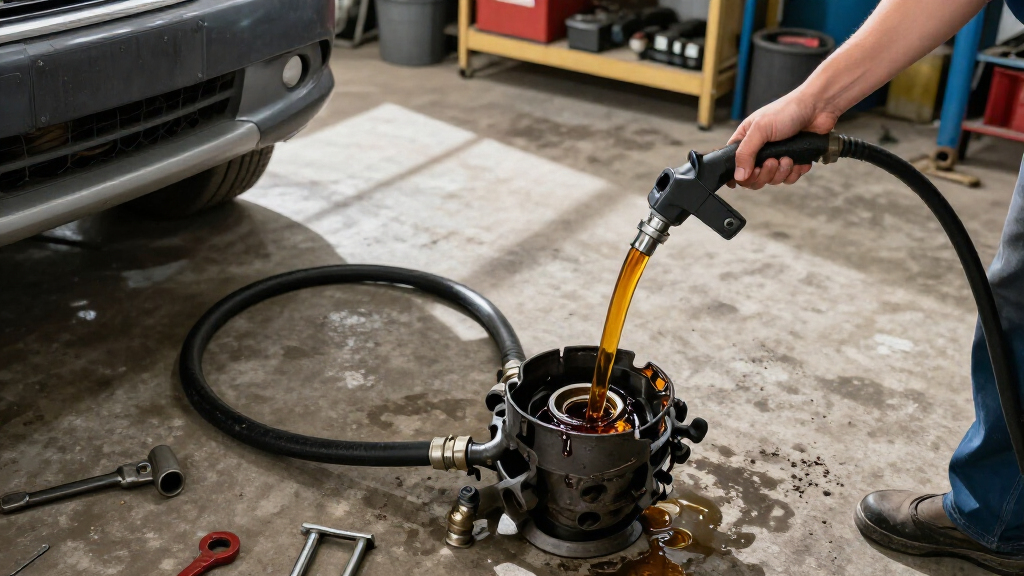
I ranked these pumps around the demands of transferring gear oil, rather than treating advertised flow as the deciding measure. I compared each option’s stated power source, listed flow, intended fluid or duty, portability, and supplied hose or container fit. I also considered how much setup each type asks of the buyer: a fixed AC supply, a 24V connection, drum placement, or manual effort. Where the product information does not state a viscosity range or operating conditions, I treat that as an information gap rather than assuming the pump will handle every grade of gear oil.
The GPI L5132 ranks first as a heavy-duty AC option with two listed voltage choices and an 8 GPM rating, giving it a useful balance for buyers with compatible power. The stainless steel gear pump ranks highly for its stated high-viscosity focus, while Goldstream’s portable format and higher listed flow make it a distinct alternative. The Groz drum pump is better matched to a drum-based setup; the manual lever pump favors simplicity, and the 24V STEAUTY suits lower-flow extraction where that power source fits. The final heavy-duty AC pump remains a possible workshop option, but the listing’s “16 QPM/4 GPM” flow notation is unclear and should be confirmed before purchase.
Factors to Consider When Choosing High Viscosity Transfer Pump For Gear Oil
Choosing a gear-oil pump is less about chasing the largest flow number and more about matching the pump to the oil, power supply, and transfer routine. I’d check these points before treating any product description as proof of compatibility.
Match viscosity at the temperature you will actually pump
Gear oil can move very differently when cold than when it has warmed up, so a pump’s flow rating may not reflect your real working conditions. Look for a stated viscosity range and any temperature assumptions in the manufacturer’s documentation. If those details are missing, ask the seller or manufacturer rather than inferring suitability from words such as “heavy duty” or “high viscosity.” A pump designed for thinner oils may run slowly, strain, or fail to prime with thick oil. Warming oil may help in some applications, but only follow the pump and lubricant makers’ temperature guidance. This check is especially useful when comparing a general oil-transfer pump with a model explicitly described for viscous fluids.
Treat flow ratings as conditional, not guaranteed
A listed GPM figure is useful for comparing products, but it may describe a particular test fluid and setup rather than gear oil. Hose length, hose diameter, lift height, fittings, and oil temperature can all affect delivery. A higher advertised rate can be a poor guide if the pump’s rating conditions do not match your installation. Ask whether the figure is a maximum, what fluid was used, and whether the pump is rated for continuous operation. For occasional filling, control and reliable priming may matter more than peak speed. For repeated transfers, documented performance under your oil’s viscosity and duty cycle deserves more weight.
Choose power around the worksite, not just the pump
AC pumps make sense where a compatible outlet is available and the pump can stay near a fixed drum or workbench. A 24V pump can suit mobile equipment or a vehicle-based setup, but the power supply and wiring must support its electrical requirements. Manual pumps avoid electrical connections, yet the operator supplies the effort and transfer pace. Before buying, check voltage, current or power requirements, cable reach, and any installation or safety instructions. Do not assume that a 115/230V label means the unit automatically switches between voltages; verify how the manufacturer specifies connection and configuration. Matching the power source to the site can prevent a capable pump from becoming impractical to use.
Check the container, inlet, and hose as one system
A pump that works with a drum may not mount neatly on a pail, tank, or machine reservoir. Compare the inlet arrangement, bung or container fit, hose length, and outlet connection with the containers you use. A short hose can limit access around equipment, while an unsuitable diameter can add resistance or make filling awkward. Also check whether the hose kit is included and whether seals and wetted materials are compatible with the lubricant. Buyers often focus on the pump body and discover later that they need adapters or a different hose. Confirming the whole fluid path before purchase can reduce leaks, spills, and improvised connections.
Decide whether portability is worth a flow compromise
Moving a pump between vehicles or containers favors a portable unit, while a drum-mounted or stationary setup can support a more fixed workflow. Portability may bring a smaller motor, a different power source, or added setup steps, so compare the complete package rather than the pump alone. Think about where the oil is stored, where it must go, and how often the equipment needs to be relocated. If transfers happen at one workshop station, a stable AC pump may be easier to use repeatedly. If work happens in several locations, a lower-flow portable or manual option may be the more practical choice. The right balance depends on how often you move the pump and how much effort each transfer can take.
Pay more for verified fit and duty, not vague capacity claims
Extra spending makes sense when it buys documented viscosity limits, compatible materials, a suitable duty cycle, or a better match to your installation. It is less persuasive when the listing gives only a high flow figure without test conditions or fluid limits. Check whether the pump is intended for intermittent or continuous operation and whether parts such as seals can be serviced or replaced. A specialist-style gear pump may be a stronger candidate for thick fluids, but its exact specifications still need confirmation. For occasional, small-volume work, a simpler manual pump may avoid unnecessary electrical complexity. For frequent shop use, clear technical support and replacement-part availability can matter more than a headline capacity.
Frequently Asked Questions
Can I use any oil transfer pump for gear oil?
No. A pump described for oil does not automatically support every gear-oil viscosity or temperature. Check the manufacturer’s viscosity range, fluid compatibility, operating temperature, and duty-cycle guidance. If those details are not available, ask for them before purchase rather than relying on the advertised flow rate. A model explicitly intended for viscous fluids is a useful starting point, but its documentation still needs to match your lubricant and setup.
Should I choose the 12 GPM portable pump over an 8 GPM AC pump?
Not on the flow figures alone. The Goldstream W2065 lists 12 GPM and a portable format, while the GPI L5132 lists 8 GPM and 115/230V AC power; those figures may not represent performance with the same fluid or conditions. Compare viscosity limits, temperature assumptions, hose and lift requirements, and the power available at your worksite. If portability is central, Goldstream may fit better; if you have compatible AC power and want a heavy-duty workshop option, the GPI may be the more suitable match. Ask the manufacturer to clarify gear-oil performance before choosing based on speed.
Is a manual lever pump practical for thick gear oil?
It can be practical for small or occasional transfers when electrical power is unavailable and a slower pace is acceptable. The lever-action bucket pump is built around 5-gallon pails and includes a 4.1-foot hose, which can suit basic filling tasks. Manual effort may become tiring with thick oil, repeated pumping, or larger volumes, especially when the oil is cold. Confirm that the pump materials and intended fluids suit your gear oil. For frequent transfers, an electric model may reduce effort, provided its viscosity and power requirements fit your setup.
What should I confirm before buying a pump with a high flow claim?
Ask what fluid and temperature were used to establish the stated rate, and whether it is a maximum or an expected working flow. Check the pump’s viscosity range, lift limits, hose size, and continuous-duty rating. The final heavy-duty AC listing uses “16 QPM/4 GPM,” so I would confirm the intended unit and actual rating with the seller before treating it as comparable to other models. Also check voltage requirements and fittings, since installation can change the practical delivery rate. A clear specification sheet is more useful than a large number without test conditions.
When is a 24V pump a better choice than an AC pump?
A 24V pump can be a better fit when transfers happen near equipment or in a mobile setting without convenient AC power. The STEAUTY extractor lists 3.2 GPM, making it a lower-flow option than the AC pumps in this roundup, but its power source may suit a different worksite. Confirm that the available 24V supply can meet the pump’s requirements and that the connection is appropriate for the environment. If the pump will stay beside a workshop drum with an accessible outlet, an AC model may be simpler. The deciding factor is the power infrastructure and transfer routine, not voltage alone.
Conclusion
For a general workshop choice, I’d start with the GPI L5132 as best overall, provided its AC voltage options, viscosity limits, and installation match your setup. The best value for a simple, low-volume routine may be the lever-action bucket pump if manual effort is acceptable; it avoids an electrical setup, though it is not the pick for frequent or fast transfers. For a best premium or specialist direction, investigate the industrial stainless steel gear pump, but confirm its exact specifications, materials, and operating requirements before committing. Beginners who need a drum-based electric arrangement may find the Groz package easier to orient around, while buyers needing mobility can compare Goldstream’s portable format with STEAUTY’s 24V, lower-flow setup. For dedicated heavy-duty AC use, the final pump is worth checking only after its “16 QPM/4 GPM” rating is clarified. In every case, I’d choose by verified gear-oil compatibility and site fit before advertised flow.