For most boat owners, I’d start with the Yoursme 34060-0130 Marine Engine Oil Drain Hand Pump: its marine-specific design gives it a clearer fit for routine engine oil changes than general-purpose extractors. The EWK 6.5L Manual Oil Extractor is a flexible option for owners who also service cars or small engines, while the BILITOOLS 9L Manual Oil Extractor suits jobs where fewer trips to empty the tank matter. The main tradeoffs are manual effort versus powered extraction, tank capacity versus storage space, and general-purpose versatility versus a marine-specific setup. Compatibility with your engine’s dipstick tube and the extractor’s hose dimensions can matter as much as the pump itself. Continue reading for the full breakdown of all 15 options and guidance on matching one to your boat.

Get business pricing on garage and car supplies
- Business-only prices and quantity discounts
- Tax-exempt purchasing
- Multiple users, one account, clear invoices
Complete the kit


Key Takeaways
- Marine-specific tools stand apart from general-purpose pumps: Yoursme, Pactrade Marine, and Ulreon are the clearest boat-focused options, while most of the lineup is designed for broader vehicle or engine use.
- The 6.5L manual-and-pneumatic format appears repeatedly: VEVOR, FOUR UNCLES, and two EWK models share this capacity class, so buyers should compare operating method and included setup rather than assume the tank size makes them interchangeable.
- Capacity changes the job rhythm: The 9L BILITOOLS and FIRSTINFO tanks may reduce emptying during larger services, but they take more room than the 6L to 6.5L options.
- Powered models trade hand pumping for electrical dependence: The 12V or 12/24V choices may suit frequent extraction, but boat owners need to check power availability and the listed voltage before buying.
- Hose fit is a deciding factor, not a minor accessory detail: An extractor only helps if its suction tube can reach the oil through the engine’s access point; check engine guidance and hose dimensions before choosing any model.
| VEVOR 6.5L Pneumatic/Manual Oil Extractor Pump |  | Best Dual-Mode Flexibility | Capacity: 6.5 L / 1.74 gallons | Operation modes: Pneumatic and manual | Main tube length: 39.37 in / 1000 mm | VIEW ON AMAZON | See Our Full Breakdown |
| EWK 6.5L Manual Oil Extractor Pump for Cars, Boats, and Small Engines |  | Best for Beginners | Tank capacity: 6.5 L | Operation: Manual | Suction tube length: 102 in | VIEW ON AMAZON | See Our Full Breakdown |
| Yoursme 34060-0130 Marine Engine Oil Drain Hand Pump |  | Best for Compatible OMC and MerCruiser Engines | Model: 34060-0130 | Fitment: OMC, MerCruiser, and other engines with a 3/4-inch threaded male garden hose fitting on the dipstick tube | Flow rate: Up to 1 GPM / 4 LPM | VIEW ON AMAZON | See Our Full Breakdown |
| FOUR UNCLES 6.5L Pneumatic/Manual Oil Extractor Pump |  | Best for Fast Shop Extraction | Capacity: 6.5 L | Operation modes: Pneumatic and manual | Maximum extraction rate: Up to 1.8 L per minute | VIEW ON AMAZON | See Our Full Breakdown |
| Harpy Eagle Electric Oil Change Extractor Pump, 12/24V, 100W |  | Best Electric Option for Powered Boat Maintenance | Model: HE-001 | Voltage: 12/24V | Motor power: 100W | VIEW ON AMAZON | See Our Full Breakdown |
| BILITOOLS 9L Manual Oil Extractor Pump |  | Best for Larger Marine Sumps | Capacity: 9 liters (2.4 gallons) | Operation: Manual | Main tube: 0.31-inch ID × 0.39-inch OD × 44 inches long | VIEW ON AMAZON | See Our Full Breakdown |
| 12V 100W Oil Extractor Pump |  | Best for Battery-Powered Extraction | Power: 100W | Voltage: 12V | Motor: Pure copper | VIEW ON AMAZON | See Our Full Breakdown |
| EWK 6.5L Pneumatic and Manual Oil Extractor |  | Best for Flexible Workshop or Dockside Use | Capacity: 6.5 liters | Extraction modes: Manual and pneumatic | Suction rate: Up to 1.8 L/min | VIEW ON AMAZON | See Our Full Breakdown |
| Pactrade Marine Manual Oil Extractor Pump with Tubing |  | Best Compact Marine-Specific Pick | Model: P18533 | Material: Brass | Power source: Manual | VIEW ON AMAZON | See Our Full Breakdown |
| EWK 6L Manual Fluid Transfer Pump, Portable Fluid Extractor |  | Best for Power-Free Multi-Fluid Maintenance | Capacity: 6 liters | Operation: Manual, power-free | Hose length: 59 inches | VIEW ON AMAZON | See Our Full Breakdown |
| FAITIO 12V 100W Oil Extractor Pump |  | Best Higher-Flow 12V Pick | Voltage: 12V DC | Motor power: 100W | Maximum stated flow rate: Up to 4.2 qt/min | VIEW ON AMAZON | See Our Full Breakdown |
| Ulreon 34060-0130 Marine Oil Extractor Pump, 10.25 in Long |  | Best for Compatible Marine Dipstick Fittings | Material: Brass | Length: 10.25 in | Diameter: 1.25 in | VIEW ON AMAZON | See Our Full Breakdown |
| Amarine Made 12V 60W Oil Extractor Pump |  | Best Lightweight Budget-Style Electric Option | Voltage: 12V | Power: 60W | Current: 5A | VIEW ON AMAZON | See Our Full Breakdown |
| FIRSTINFO A1108USY5 9L Pneumatic/Manual Oil Extractor with Pressure Gauge |  | Best for Controlled, Higher-Capacity Extraction | Capacity: 9L (2.3 gallons) | Operation: Pneumatic/manual | Safety features: Real-time pressure gauge and built-in safety valve | VIEW ON AMAZON | See Our Full Breakdown |
| FACFUEL 12/24V 100W Engine Oil Extractor Pump with Anti-Kink Hoses |  | Best for Flexible Power and Hands-Free Setup | Voltage: 12/24V | Power: 100W | Motor: Pure copper | VIEW ON AMAZON | See Our Full Breakdown |
| oil extractor for boats and marine engine | Weight |
|---|---|
| VEVOR 6.5L Pneumatic/Manual Oi | 5.73 lb |
| EWK 6.5L Manual Oil Extractor | — |
| Yoursme 34060-0130 Marine Engi | — |
| FOUR UNCLES 6.5L Pneumatic/Man | — |
| Harpy Eagle Electric Oil Chang | 4.31 lb |
| BILITOOLS 9L Manual Oil Extrac | 8.68 pounds |
| 12V 100W Oil Extractor Pump | 3.41 pounds |
| EWK 6.5L Pneumatic and Manual | 6.45 pounds |
| Pactrade Marine Manual Oil Ext | 9.44 ounces |
| EWK 6L Manual Fluid Transfer P | — |
| FAITIO 12V 100W Oil Extractor | 3.41 lb |
| Ulreon 34060-0130 Marine Oil E | — |
| Amarine Made 12V 60W Oil Extra | 1 lb |
| FIRSTINFO A1108USY5 9L Pneumat | — |
| FACFUEL 12/24V 100W Engine Oil | 5.28 lb |
More Details on Our Top Picks
VEVOR 6.5L Pneumatic/Manual Oil Extractor Pump
The VEVOR makes the most sense for boat owners who want to choose between compressor-powered extraction at home and manual pumping away from shop air. Its 6.5L tank and assortment of extension tubes give it broader reach than the compact Yoursme marine hand pump, which is designed around a specific engine fitting rather than a general-purpose tank setup. That versatility comes with setup work: the included tubes and hoses may need assembly, and the tank may not hold all the oil from a larger marine engine in one pass. Manual mode is useful when compressed air is unavailable, but repeated pumping can become tiring. I’d pick it for mixed garage-and-boat use, not for buyers who want a dedicated, fitting-specific marine pump.
Pros:- Pneumatic and manual modes suit both garage and no-compressor settings.
- Multiple tubes and hoses support different access points and equipment.
- Handles several fluid types, including engine and gear oil.
- Portable at 5.73 pounds.
Cons:- The 6.5L capacity may require multiple cycles on larger engines.
- Tube and hose assembly adds setup before use.
- Manual pumping can be tiring during longer extraction jobs.
Best for: Boat owners who maintain several types of engines or equipment and have compressed air available for faster extraction, but still want a manual option away from the garage.
Not ideal for: Owners of higher-capacity marine engines who want to drain a full oil charge in one pass, or buyers seeking a simple pump that needs little setup.
- Capacity:6.5 L / 1.74 gallons
- Operation modes:Pneumatic and manual
- Main tube length:39.37 in / 1000 mm
- Extension tube lengths:47.24 in / 1200 mm each
- Suction hose length:58.27 in / 1480 mm
- Weight:5.73 lb
- Model:YS-088
Our verdict“Choose the VEVOR if you want one 6.5L extractor that can work with or without compressed air and can serve more than one engine type.”
EWK 6.5L Manual Oil Extractor Pump for Cars, Boats, and Small Engines
For a first topside oil change, the EWK is the straightforward choice: manual vacuum operation means no compressor, battery connection, or access beneath the boat is needed. Its 102-inch suction tube can reach through a dipstick opening, while the sealed 6.5L tank keeps the extracted fluid contained for transport. Compared with the VEVOR, it gives up pneumatic operation and a multi-mode approach in exchange for a simpler, self-contained routine. That convenience depends on compatible access and some physical effort; manual pumping takes time, and its stated fluid-temperature limit is 140°F. It is intended for engine oil and other listed fluids, not gasoline or corrosive liquids. I’d choose it for routine small-engine or boat maintenance when simplicity matters more than speed.
Pros:- Operates without a compressor, power outlet, or jack.
- Long 102-inch tube reaches through many dipstick openings.
- Sealed 6.5L tank contains extracted fluid for carrying and disposal.
- Compatible with engine oil, ATF, coolant, and power steering fluid within its temperature limit.
Cons:- Manual vacuum pumping takes physical effort and time.
- The 140°F maximum fluid temperature limits use with hotter oil.
- Must not be used with gasoline or corrosive fluids.
Best for: New boat or small-engine owners who want to change compatible fluids from above through a dipstick opening without a compressor or powered pump.
Not ideal for: Owners who need fast extraction for frequent service, have no suitable dipstick or reservoir access, or need to handle gasoline or corrosive fluids.
- Tank capacity:6.5 L
- Operation:Manual
- Suction tube length:102 in
- Compatible fluids:Engine oil, ATF, coolant, and power steering fluid
- Maximum fluid temperature:140°F
- Item weight:6.04 lb
- Product dimensions:8.27 x 8.27 x 22.05 in
- Model:EB0280
Our verdict“Pick the EWK for uncomplicated, power-free topside changes on boats and small engines when its fluid limits and manual pace suit your routine.”
Yoursme 34060-0130 Marine Engine Oil Drain Hand Pump
The Yoursme is the most marine-specific option here, but its fit is also its main constraint. It connects to engines with a 3/4-inch threaded male garden-hose fitting on the dipstick tube, making it a focused alternative to the tank-style EWK, which draws oil through a suction tube. For owners with the matching connection, the hand pump’s up to 1 GPM flow rate and one-handed design offer a direct way to drain oil without managing a 6.5L extractor tank. Brass cylinders and oil-resistant plungers are suited to oil transfer, and the pump can handle other liquids. The tradeoff is that compatibility must be confirmed before purchase, and the supplied drain hose is only 2 feet long. I’d favor it for a matching OMC or MerCruiser setup, not as a universal boat pump.
Pros:- Designed for a defined marine-engine fitting rather than generic dipstick-tube access.
- Flow rate is listed at up to 1 GPM.
- Brass cylinders and oil-resistant plungers suit oil-transfer work.
- Compact, lightweight design supports one-handed operation.
Cons:- Requires a specific 3/4-inch threaded male garden-hose fitting.
- The included drain hose is only 2 feet long.
- Manual operation requires repeated strokes.
Best for: Owners of OMC or MerCruiser engines with the specified 3/4-inch threaded fitting who want a compact hand pump for oil draining and related liquid transfer.
Not ideal for: Boaters whose dipstick tubes lack the specified fitting, or buyers who need a general-purpose extractor with a larger collection tank and longer hose.
- Model:34060-0130
- Fitment:OMC, MerCruiser, and other engines with a 3/4-inch threaded male garden hose fitting on the dipstick tube
- Flow rate:Up to 1 GPM / 4 LPM
- Strokes per gallon:40
- Materials:Brass cylinders and oil-resistant plungers
- Dimensions:10.25 in long x 1.25 in diameter
- Drain hose:2 ft, 1/2-in inner diameter
- Power and weight:Manual; 0.48 kg
Our verdict“Choose the Yoursme when your OMC or MerCruiser has the matching fitting; otherwise, a suction-tube extractor such as the EWK is the safer fit.”
FOUR UNCLES 6.5L Pneumatic/Manual Oil Extractor Pump
The FOUR UNCLES stands out for a stated extraction rate of up to 1.8L per minute when used pneumatically, making it the speed-focused alternative to the manually operated EWK. It also retains a manual mode, so the pump is not limited to a garage with compressed air. Three suction tubes support different access points, while the included brake-bleeding hose broadens its use beyond engine oil. For boat maintenance, the deciding question is whether you have compressed air and can manage the setup; pneumatic speed offers little benefit when only manual operation is available. The 6.5L tank can also mean stopping to empty it on larger oil changes. Compared with the VEVOR, it has a clearly stated extraction rate, but the available product data gives less detail on tube lengths.
Pros:- Pneumatic mode is listed at up to 1.8L per minute.
- Manual operation provides an alternative when compressed air is unavailable.
- Three suction tubes support different vehicle and engine applications.
- Included brake-bleeding hose adds another fluid-service use.
Cons:- Pneumatic mode requires a compressed-air source.
- The 6.5L capacity may require emptying during larger jobs.
- Multiple components can make setup less straightforward for new users.
Best for: Boat owners with a compressor who prioritize faster extraction and want a manual fallback for occasional work away from shop air.
Not ideal for: Beginners seeking the simplest setup, or boaters without compressed air who would rather avoid manual pumping and its slower pace.
- Capacity:6.5 L
- Operation modes:Pneumatic and manual
- Maximum extraction rate:Up to 1.8 L per minute
- Suction tubes:3
- Included hose:Brake-bleeding hose
Our verdict“Choose the FOUR UNCLES if you have shop air and want a faster 6.5L extractor, while accepting added setup and a limited tank capacity.”
Harpy Eagle Electric Oil Change Extractor Pump, 12/24V, 100W
The Harpy Eagle suits boat owners who prefer a powered pump but do not have a compressor: it runs from a 12V or 24V source and is listed at up to 1 quart per minute. That makes it a different proposition from the FOUR UNCLES, whose faster stated rate depends on compressed air, and from the manual EWK, which needs no power but takes hand pumping. Its 4-foot hoses and 59-inch power cable offer useful reach, though actual access depends on the engine layout and where a compatible power source is available. The pump is supplied assembled with a storage case, but the description does not establish compatibility with every boat or engine. I’d choose it for powered, portable maintenance where voltage and hose reach match the setup, not for a fully self-contained change.
Pros:- Runs on either 12V or 24V power.
- Listed pumping rate is up to 1 quart per minute.
- Four-foot hoses and a 59-inch cable support flexible placement.
- Arrives assembled with a storage case and manual.
Cons:- Requires a compatible 12V or 24V power source.
- Product information does not confirm compatibility with every marine engine.
- Hose length may not suit engine layouts that need a longer reach.
Best for: Boat owners with a compatible 12V or 24V power source who want powered oil extraction in a portable kit without relying on compressed air.
Not ideal for: Boaters without an accessible compatible power source, or buyers who need confirmed fitment for a particular engine before choosing a pump.
- Model:HE-001
- Voltage:12/24V
- Motor power:100W
- Pumping rate:Up to 1 quart per minute
- Hose length:4 ft each
- Power cable length:59 in / 1.5 m
- Weight:4.31 lb
- Dimensions:10.83 x 8.66 x 3.15 in
- Included:Storage case, manual, and vehicle oil-capacity list
Our verdict“Pick the Harpy Eagle when you have compatible onboard or nearby power and want an assembled electric extractor rather than a manual or air-powered model.”
BILITOOLS 9L Manual Oil Extractor Pump
The BILITOOLS stands out here for its 9-liter capacity, which gives it more room for a larger engine oil change than the 6L EWK Manual Fluid Transfer Pump or the 6.5L EWK Pneumatic and Manual Extractor. That extra capacity can reduce interruptions to empty the tank when servicing a boat engine, while the 44-inch main tube and included extension tubes support dipstick access across different setups. Its step-on base also helps keep the pump steady while you create suction. The tradeoff is that extraction is entirely manual, so repeated pumping takes effort, and this unit is bulkier to store than Pactrade Marine’s compact hand pump. The translucent tank can make fluid-level checks less clear when dirty. I’d choose it for capacity, not for the lightest onboard kit.
Pros:- 9-liter tank can reduce the need to stop and empty during a larger oil change.
- 44-inch main tube and included extensions support dipstick-based extraction.
- Step-on base helps stabilize the pump during manual operation.
- Works without a vehicle lift or an electrical connection.
Cons:- Manual suction requires repeated physical effort.
- Large package dimensions take more storage space than a compact hand pump.
- Tank visibility may suffer when the translucent plastic is dirty.
Best for: Boat owners servicing engines with larger oil capacities who want a self-contained extractor and do not mind manual pumping.
Not ideal for: Owners of small boats with limited locker space or anyone seeking powered extraction with less physical effort.
- Capacity:9 liters (2.4 gallons)
- Operation:Manual
- Main tube:0.31-inch ID × 0.39-inch OD × 44 inches long
- Dipstick:38 inches
- Graduation interval:2 liters
- Weight:8.68 pounds
- Brand:BILITOOLS
Our verdict“Choose the BILITOOLS if your marine engine’s oil volume makes capacity a priority and you have room to store a larger manual extractor.”
12V 100W Oil Extractor Pump
For boat owners who would rather use a battery-powered pump than repeatedly work a hand pump, this 12V, 100W model offers a different approach from the manual BILITOOLS 9L and Pactrade Marine pumps. Its transparent hoses let you monitor fluid moving through the line, and the kit includes 6 mm and 8 mm inlet hoses plus adapters for varied access points. It can handle engine oil, transmission fluid, and coolant, though that versatility has firm boundaries: it is not for gasoline, diesel, water, or waste oil. Thick oil needs preheating, and transmission-fluid use is limited to 15 minutes before a cooling break. Compared with the EWK pneumatic/manual extractor, it avoids the need for a compressor but depends on a 12V supply. I’d pick it for powered convenience only when its fluid limits match the job.
Pros:- 12V motor provides powered extraction without manual hand pumping.
- Transparent hoses make it easier to monitor fluid flow.
- Includes two inlet hose sizes and three adapters.
- Overheating protection and leak-prevention features are specified.
Cons:- Must not be used with gasoline, diesel, water, or waste oil.
- Viscous oil needs preheating before extraction.
- Transmission-fluid pumping requires a 10-minute cooling break after each 15 minutes.
Best for: Boat owners with a suitable 12V power source who want powered extraction for compatible engine oil, coolant, or transmission fluid.
Not ideal for: Boaters who need to extract diesel or gasoline, lack a 12V supply, or want uninterrupted pumping for extended transmission-fluid jobs.
- Power:100W
- Voltage:12V
- Motor:Pure copper
- Inlet hoses:6 mm and 8 mm
- Outlet hose:10 mm
- Compatible fluids:Engine oil, transmission fluid, and coolant
- Weight:3.41 pounds
- Transmission-fluid limit:15 minutes of operation, followed by 10 minutes to cool
Our verdict“Choose this pump if you have 12V power available and need powered extraction for its specified compatible fluids, not fuel or waste oil.”
EWK 6.5L Pneumatic and Manual Oil Extractor
The EWK’s strongest distinction is its choice of manual or pneumatic suction. At a dock or workshop with compressed air, its stated rate of up to 1.8 L/min offers an alternative to the repeated hand pumping required by the BILITOOLS 9L; away from an air supply, it can still be operated manually. The 6.5-liter capacity is smaller than the BILITOOLS tank, so larger sump jobs may mean more frequent emptying, but it is also a more flexible fit for users who already own a compressor. Dipstick extraction avoids getting beneath the boat or vehicle, and the stated fluid range includes engine oil, transmission fluid, coolant, and power steering fluid. This is not a universal marine fit: it excludes gasoline and highly volatile fluids, and the listed Mercedes incompatibility is relevant for owners using it beyond boat engines.
Pros:- Offers both pneumatic and manual extraction modes.
- Stated suction rate reaches up to 1.8 L/min when conditions support it.
- Extracts through the dipstick tube without requiring access beneath the engine.
- Supports several specified fluids, including engine oil and coolant.
Cons:- Its 6.5-liter capacity is smaller than the BILITOOLS 9L tank.
- Pneumatic operation depends on an air supply.
- Not suitable for gasoline or highly volatile fluids, and listed Mercedes models are incompatible.
Best for: Boat owners and mechanics who have compressed air available but still want a manual option for jobs away from the compressor.
Not ideal for: Buyers seeking a large-capacity tank, a powered extractor that needs no compressor, or a pump for gasoline and other volatile fluids.
- Capacity:6.5 liters
- Extraction modes:Manual and pneumatic
- Suction rate:Up to 1.8 L/min
- Operating pressure:40–170 PSI
- Compatible fluids:Engine oil, transmission fluid, coolant, and power steering fluid
- Weight:6.45 pounds
- Model:EB0103
- Listed incompatibility:Mercedes W212 E350 and C218 CLS 350
Our verdict“Choose the EWK if compressor access and a manual fallback matter more than the BILITOOLS’s larger tank.”
Pactrade Marine Manual Oil Extractor Pump with Tubing
Unlike the tank-style BILITOOLS 9L or EWK 6.5L extractor, the Pactrade Marine is a small hand pump with tubing, making it the most compact, boat-focused option in this group. Its brass body and self-priming design suit owners who want a simple tool to draw oil through an engine’s dipstick tube, while the included 6 mm, 8 mm, and 12 mm tubes provide several fit options for boats, RVs, vehicles, and personal watercraft. The tradeoff is capacity: there is no large integrated reservoir specified, so the receiving container and transfer process need planning. It also depends on repeated manual pumping and is limited to dipstick-tube access. Compared with the EWK 6L, it is far easier to stow, but less self-contained for collecting a full engine’s oil.
Pros:- Compact 9-inch pump is easier to stow aboard than a large tank extractor.
- Brass body and self-priming manual design suit a simple marine maintenance kit.
- Includes 6 mm, 8 mm, and 12 mm tubing plus a 6 mm adapter.
- Specified for boating, vehicle, RV, and PWC maintenance.
Cons:- Repeated manual pumping takes effort.
- Designed for dipstick-tube access rather than other extraction points.
- No integrated collection-tank capacity is specified.
Best for: Boat and PWC owners who want a compact brass hand pump for dipstick-tube extraction and can provide a separate collection container.
Not ideal for: Owners who need an integrated high-capacity tank, want to avoid repeated hand pumping, or cannot access oil through a dipstick tube.
- Model:P18533
- Material:Brass
- Power source:Manual
- Pump length:9 inches
- Included tubing:6 mm, 8 mm, and 12 mm plastic tubes
- Included adapter:Adapter for 6 mm tubing
- Weight:9.44 ounces
- Warranty:1 year
Our verdict“Choose the Pactrade Marine for a compact onboard hand pump if you already have a suitable collection container.”
EWK 6L Manual Fluid Transfer Pump, Portable Fluid Extractor
The EWK 6L makes sense for boat owners who want a self-contained, power-free extractor that can also handle specified fluids such as ATF, coolant, and power steering fluid. Its 59-inch hose and 42-inch probe give it reach for dipstick-based access, while the 6-liter tank is simpler to manage and store than the BILITOOLS 9L. That smaller capacity is a real compromise: if a marine engine’s oil volume exceeds the tank, you may need to empty it and continue. As with the Pactrade Marine pump, operation is manual, but the EWK includes a collection tank rather than relying on a separate container. The product data also excludes gasoline and fluids above 175°F, so it is not suited to every fluid-transfer task. I’d favor it for portable, mixed-maintenance use over maximum capacity.
Pros:- Manual, power-free design works without electricity or compressed air.
- Integrated 6L tank collects fluid without needing a separate receiver.
- 42-inch probe and 59-inch hose provide useful reach for dipstick extraction.
- Specified for engine oil, ATF, coolant, and power steering fluid.
Cons:- 6L capacity may require emptying and restarting for larger engine sumps.
- Manual pumping can become tiring during extended jobs.
- Not suitable for gasoline or fluids above 175°F.
Best for: Boat owners who need a portable, power-free extractor for modest oil changes and occasional transfer of the listed vehicle fluids.
Not ideal for: Owners of engines whose oil volume exceeds the 6L tank, buyers seeking powered extraction, or anyone handling gasoline or fluids above 175°F.
- Capacity:6 liters
- Operation:Manual, power-free
- Hose length:59 inches
- Probe length:42 inches
- Suitable fluids:Engine oil, ATF, coolant, and power steering fluid
- Temperature limitation:Not suitable for fluids above 175°F
Our verdict“Choose the EWK 6L for portable, power-free maintenance when its tank capacity covers the job and the fluid stays within its stated limits.”
FAITIO 12V 100W Oil Extractor Pump
The FAITIO stands out among the electric options for its stated flow rate of up to 4.2 qt/min and compatibility with motor, gear, differential, and transmission oils. For a boat owner who wants to draw oil through a dipstick tube without reaching the drain plug, it offers broad fluid coverage compared with the Amarine Made 60W pump, which has a narrower list of compatible fluids and a lower stated flow rate. Its self-priming operation and 12V supply suit mobile maintenance where a battery is available. The tradeoff is that it is still a transfer pump, not a storage tank, so you need a suitable container and a controlled setup. It also cannot handle gasoline, diesel, or water, and continuous operation is limited to 30 minutes.
Pros:- Extracts through a dipstick tube, avoiding access to an under-engine drain plug
- Handles motor, gear, differential, and transmission oil
- Self-priming electric operation
- Stated flow rate reaches up to 4.2 qt/min
Cons:- Not suitable for gasoline, diesel, or water
- Continuous operation is limited to 30 minutes
- Requires a separate collection container and a suitable power source
Best for: Boat owners with a 12V battery who want a powered dipstick-tube pump for engine or transmission oil and may also service other equipment.
Not ideal for: Owners who need to transfer diesel or water, or who want a self-contained extractor with an oil reservoir.
- Voltage:12V DC
- Motor power:100W
- Maximum stated flow rate:Up to 4.2 qt/min
- Continuous operation:Up to 30 minutes
- Motor material:100% pure copper
- Compatible fluids:Motor oil, gear oil, differential fluid, transmission fluid
- Incompatible fluids:Gasoline, diesel, water
- Weight:3.41 lb
Our verdict“Choose the FAITIO if you want a versatile 12V dipstick-tube pump for several oil types; skip it if your marine fluid-transfer jobs include diesel or water.”
Ulreon 34060-0130 Marine Oil Extractor Pump, 10.25 in Long
Unlike the battery-powered FAITIO and Amarine Made pumps, the Ulreon is a brass hand pump made specifically for marine dipstick connections. Its 3/4-inch threaded male fitting suits compatible OMC, Mercruiser, and other marine engines, so it can be a direct, compact solution when that connection matches your boat. The maker states a maximum flow of 1 gallon per minute and about 40 strokes per gallon, with seals intended to limit leakage. Brass construction is a sensible choice around damp marine storage areas, though it does not remove the need to check compatibility first. That fitting requirement is the main limitation: unlike the more broadly adaptable powered FAITIO, this pump is of little use if your engine lacks the specified threaded tube. Oil must also stay at or below 140°F.
Pros:- Brass construction resists corrosion in marine environments
- Designed for compatible OMC and Mercruiser dipstick fittings
- One-handed operation
- Stated maximum flow rate is 1 gallon per minute
Cons:- Requires a compatible 3/4-inch threaded male fitting
- Oil temperature must not exceed 140°F
- Manual pumping requires repeated strokes
Best for: Owners of OMC or Mercruiser marine engines whose dipstick tubes accept the specified 3/4-inch threaded fitting and who prefer manual pumping.
Not ideal for: Boat owners with a different dipstick connection, or anyone who wants battery-powered extraction with less repeated hand pumping.
- Material:Brass
- Length:10.25 in
- Diameter:1.25 in
- Fitting:3/4-inch threaded male garden hose fitting
- Hose:1/2 in
- Maximum flow rate:1 gallon (4 liters) per minute
- Strokes per gallon:40
- Maximum oil temperature:140°F
Our verdict“Pick the Ulreon for a compatible marine dipstick connection and a compact manual setup, but choose a more adaptable pump if the fitting does not match.”
Amarine Made 12V 60W Oil Extractor Pump
At just 1 lb, the Amarine Made is the easiest of these electric pumps to stow aboard or carry between a boat and other equipment. It includes inlet and outlet hoses, battery clamps, and hose locks, so the basic connection kit is already supplied. Compared with the more powerful FAITIO 100W, however, its stated rate is only 0.8–1.0 liters per minute, making it a slower choice for larger engine oil changes. The maker also excludes gearbox oil, gasoline, water, and other flammable liquids, which narrows its usefulness for marine maintenance. Warm engine oil is recommended, and the pump needs cooling breaks during extended work. I would favor it for light-duty oil extraction where portability matters more than speed, not for a broad range of boat fluids.
Pros:- Lightweight at 1 lb for easy onboard storage
- Includes hoses, battery clamps, and hose locks
- Runs from a 12V battery
- Suitable for oil changes on boats and other listed equipment
Cons:- Lower stated flow rate than the FAITIO 100W pump
- Not suitable for gearbox oil, gasoline, water, or flammable liquids
- Limited to 30 minutes of continuous use and needs cooling breaks
Best for: Boat owners who need a very light 12V pump for occasional engine-oil extraction and want hoses and battery clamps in the kit.
Not ideal for: Owners who need to move gearbox oil, diesel, water, or flammable fluids, or who regularly extract large volumes quickly.
- Voltage:12V
- Power:60W
- Current:5A
- Flow rate:0.8–1.0 liters/min
- Weight:1 lb
- Outlet hose length:1.5 m
- Inlet hose length:1.2 m
- Maximum continuous use:30 minutes
Our verdict“Choose the Amarine Made for light, occasional engine-oil jobs where low weight matters more than speed or fluid versatility.”
FIRSTINFO A1108USY5 9L Pneumatic/Manual Oil Extractor with Pressure Gauge
The FIRSTINFO takes a different approach from the Ulreon hand pump and the 12V models: its 9L reservoir collects extracted oil, while a real-time pressure gauge and safety valve provide added control during operation. That built-in capacity can make a boat service less dependent on positioning a separate collection container, and its extra-long, ultra-thin tubes are intended to reach tight dipstick passages. Compared with the small portable Amarine Made, it is better suited to a larger extraction job, but it is also a more involved piece of equipment. The product is described as pneumatic/manual, and the available details do not specify operating steps or flow rate, so beginners may need time to learn its setup. It is limited to oil extraction rather than general fluid transfer.
Pros:- 9L reservoir collects extracted oil
- Real-time pressure gauge and built-in safety valve
- Extra-long, ultra-thin tubes target tight dipstick areas
- Designed for boats and larger vehicles
Cons:- Operation may be more complex for beginners than a basic 12V pump
- Limited to oil extraction
- The supplied product details do not state a flow rate or operating procedure
Best for: DIY boat owners who want an onboard collection reservoir, a pressure gauge, and long narrow tubes for hard-to-reach dipstick passages.
Not ideal for: Beginners seeking a simple plug-in pump, or buyers who need a device for transferring fluids beyond oil.
- Capacity:9L (2.3 gallons)
- Operation:Pneumatic/manual
- Safety features:Real-time pressure gauge and built-in safety valve
- Extraction tubes:Extended, ultra-thin tubes
- Suitable applications:Large vehicles, European cars, and boats
- Manufacture:Taiwan
- Warranty:22 months
Our verdict“Choose the FIRSTINFO if reservoir capacity and controlled extraction matter more than a simple setup or multi-fluid transfer.”
FACFUEL 12/24V 100W Engine Oil Extractor Pump with Anti-Kink Hoses
The FACFUEL is the most adaptable electric choice here for boats with either 12V or 24V power, and its 1.5m anti-kink hoses plus leak-resistant fittings address practical setup problems that can interrupt extraction. A fixing clamp allows hands-free operation, while the included case keeps the pump and accessories together—useful if the kit moves between a boat, jet ski, and land equipment. Compared with the FAITIO, this model lists diesel and hydraulic fluid among its compatible fluids, but it does not provide a stated flow rate in the supplied data, so buyers cannot compare extraction speed directly. The inlet also needs a diameter greater than 12mm, which may rule out some setups. Its 5.28 lb weight makes it less convenient to carry than the Amarine Made.
Pros:- Supports both 12V and 24V power
- 1.5m anti-kink hoses and leak-resistant fittings
- Fixing clamp supports hands-free operation
- Includes a storage case and accessories
Cons:- Requires an inlet diameter greater than 12mm
- No flow rate is stated in the supplied product data
- At 5.28 lb, it is heavier than the Amarine Made pump
Best for: Boat owners with 12V or 24V power who want a stored kit for multiple machines and value hands-free operation and kink-resistant hoses.
Not ideal for: Buyers who need a published flow-rate figure, a lighter pump for frequent carrying, or an inlet setup no wider than 12mm.
- Voltage:12/24V
- Power:100W
- Motor:Pure copper
- Hose length:1.5 m
- Hose inner diameter:8 mm
- Compatible fluids:Engine oil, gear oil, hydraulic fluid, diesel
- Weight:5.28 lb
- Warranty:12 months
Our verdict“Pick the FACFUEL for a well-equipped 12/24V kit that can stay organized aboard, provided your inlet fits and you do not need a published flow rate.”
How We Picked
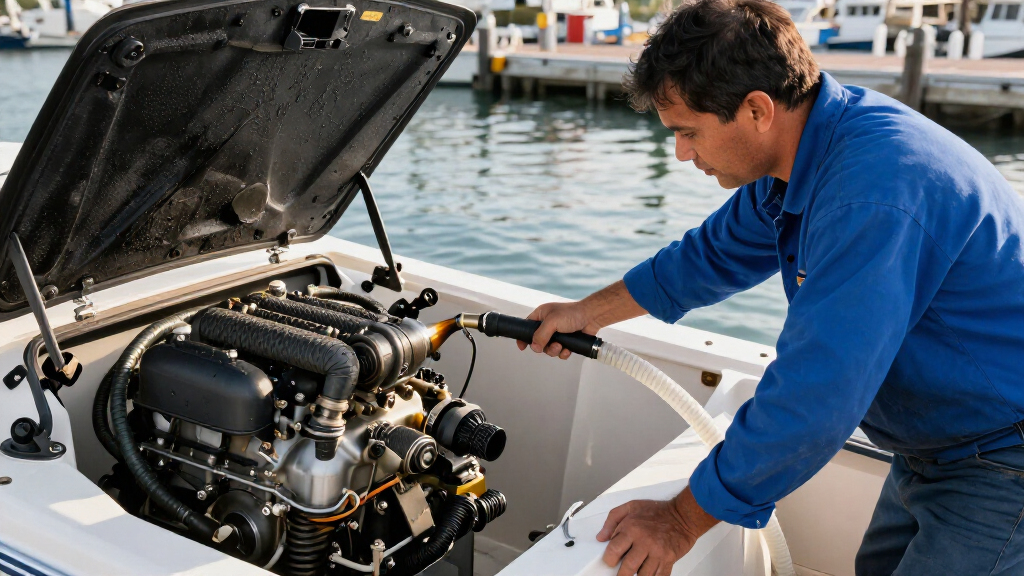
I ranked these 15 extractors by how clearly their design fits boat and marine-engine maintenance, then by the practical details that affect a complete oil change: extraction method, stated tank capacity, power requirements, hose setup, portability, and versatility. Marine-specific hand pumps received an advantage for their intended use, while general-purpose models remained strong choices when their capacity or operating options better served a mixed boat-and-vehicle garage. I treated listed capacity and voltage as product specifications, not as proof of extraction speed or compatibility with every engine.
The order reflects the tradeoffs a boat owner is most likely to face. I favored options with a clear marine use case or a useful balance of capacity and flexibility, then placed models with narrower power requirements, less clearly differentiated formats, or a more specialized role later. Similar products are grouped by the decision they serve: marine-focused hand pumps, manual or pneumatic tanks, larger-capacity units, and powered extractors. Before buying, I’d verify the engine maker’s oil-change procedure and the extractor’s tube dimensions, since a ranking cannot replace fit checks for a specific engine.
Factors to Consider When Choosing Oil Extractor For Boats And Marine Engines
For a boat, choosing an extractor is less about picking the most feature-heavy pump and more about matching the tool to the engine’s access point, service routine, and onboard storage. I’d work through these factors before settling on a model.
Check the Engine’s Approved Oil-Change Method
Start with the engine manufacturer’s service instructions rather than assuming every marine engine can be drained through its dipstick tube. Some engines are designed for suction extraction; others specify a drain point or a particular service procedure. Using an extractor in an access point that is too narrow, too short, or not intended for suction can leave oil behind or risk damaging a tube. Confirm whether the engine needs to be warm for the procedure and follow the maker’s stated guidance. This check can rule out an otherwise appealing pump before you spend time comparing tank capacity.
Match the Hose to the Access Point
A pump’s advertised capacity does not tell you whether its tube will reach the oil in your engine’s sump. Compare the included hose length and diameter with the engine’s dipstick tube or service port, and check whether the product has extension tubing if needed. A tube that is too wide may not enter the access point; one that is too short may stop above the oil. Avoid forcing a probe through resistance, since that can damage the tube or engine components. When product information leaves hose dimensions unclear, treat compatibility as an open question and verify it with the seller or manufacturer.
Choose Manual, Pneumatic, or Electric Around Your Setup
Manual pumps need no power source and can be straightforward for occasional oil changes, but repeated strokes take time and effort. Pneumatic operation can reduce manual work, though it depends on access to a compatible air supply and may be less convenient aboard a boat without one. Electric pumps shift the burden to a battery or other suitable power source, so check voltage and connection requirements against your actual setup. A model listed for 12/24V is not automatically suitable for every onboard electrical system. I’d pay for powered operation when it solves a regular workflow problem, not just because the feature sounds faster.
Size Capacity for Your Service, Not Your Wish List
A larger tank can mean fewer pauses to empty the extractor, especially when servicing an engine with a greater oil volume or handling more than one job. The tradeoff is extra bulk, a larger container to carry, and more used oil to store before disposal. A compact 6L to 6.5L tank can be easier to stow on a boat, but it may require an extra emptying step. Check your engine’s oil capacity and leave room for the possibility that the extractor will collect other fluid during maintenance. Do not plan a service around a tank’s nominal capacity without allowing for safe handling and disposal.
Think About Storage and Used-Oil Handling
Boat storage is limited, so consider the extractor’s overall footprint, hose storage, and how securely the unit can be carried when it contains fluid. A tall or wide tank may be convenient in a garage but awkward in a locker or engine compartment. Ask how the collected oil is emptied and whether the lid and connections can be kept secure between jobs. Plan for a sealed, approved container and a proper used-oil disposal route; an extractor is only one part of the service setup. If the pump will stay aboard, prioritize tidy storage and leak control over capacity you rarely use.
Separate Oil-Only Use From General Fluid Transfer
Some products are positioned for engine oil extraction, while others are presented as broader fluid-transfer tools. That flexibility can help owners who maintain several machines, but it also calls for careful separation of hoses and containers. Residual fluid from fuel, coolant, or other systems can contaminate engine oil or create a handling hazard. Check the manufacturer’s stated fluid compatibility and never use a pump for a fluid it is not rated to handle. A dedicated oil extractor may be the simpler choice if your main goal is routine marine-engine servicing.
Frequently Asked Questions
Can I use a car oil extractor on a boat engine?
Often, but the engine’s service instructions and the extractor’s hose dimensions decide whether it is a good match. A general-purpose pump can work when the engine supports suction extraction and the tube reaches through the intended access point. Marine-specific models may be a more direct fit for boat maintenance, while general-purpose options can be useful if you service cars or small engines too. Do not assume that a pump advertised for boats fits every marine engine. Check the engine manual and product specifications before ordering.
Should I choose a manual pump or a 12V electric extractor for occasional boat maintenance?
For occasional servicing, a manual model may be the simpler choice if you can accept the pumping effort and your engine’s oil volume fits the tank. An electric extractor can reduce manual work, but it adds a power connection and makes voltage compatibility part of the purchase decision. If you service several engines or change oil often, powered operation may be worth the added setup. For a boat without convenient electrical access during maintenance, a manual pump avoids dependence on onboard power. Compare the full setup, not just the pump’s operating method.
Is a 6.5L extractor large enough for my marine engine?
That depends on the engine’s specified oil capacity and whether you plan to service more than one engine before emptying the tank. Compare the manufacturer’s oil-capacity figure with the extractor’s stated capacity, and leave practical room for careful filling and transport. A 6L to 6.5L unit may suit many routine jobs, but it can require an extra emptying step for larger volumes. The 9L options in this roundup may better suit bigger services, although their size can be harder to store aboard. Confirm the capacity before starting a job rather than relying on a rough estimate.
What should I do if the extractor tube will not fit through the dipstick opening?
Do not force it or trim the tube unless the manufacturer specifically allows that change. A tube that is too wide may damage the access point, and an improvised extension can compromise suction or control. Check the extractor’s tube diameter and length against the engine manual, then ask the pump maker whether a compatible smaller probe or extension is available. If suction through the dipstick tube is not supported, follow the engine maker’s alternative oil-change procedure. Fit should be confirmed before the maintenance session, not after the oil is warm.
Are pneumatic extractors a practical choice for a boat owner?
They can be practical when you already have access to a compatible air compressor where the boat is serviced. Without that supply, the pneumatic feature may add little value and a manual mode may be more useful. Check whether the specific model can also be operated manually and whether its instructions state any air-pressure requirements. A boat owner who services engines away from a workshop may prefer a pump that does not depend on compressed air. Choose pneumatic operation for an available, repeatable setup rather than as a substitute for checking the rest of the tool’s fit.
Conclusion
My best overall pick is the Yoursme 34060-0130 Marine Engine Oil Drain Hand Pump for buyers who want a clearly marine-oriented option. For best value and versatility, I’d compare the EWK 6.5L Manual Oil Extractor with the similar 6.5L manual-and-pneumatic choices, then select based on the included setup and your access to air. The BILITOOLS 9L Manual Oil Extractor is my pick for buyers prioritizing a larger tank, while FIRSTINFO’s 9L pneumatic/manual model is suited to shoppers who want both operating options and a pressure gauge. For beginners, a straightforward marine-specific hand pump avoids adding electrical or compressor requirements; for frequent servicing, look at the electric options, including the 12/24V Harpy Eagle or FACFUEL, after checking power compatibility. If compact onboard storage matters most, compare the smaller-capacity manual options and verify their dimensions before purchase. The final choice should follow your engine’s approved extraction method and hose fit, not capacity or power claims alone.