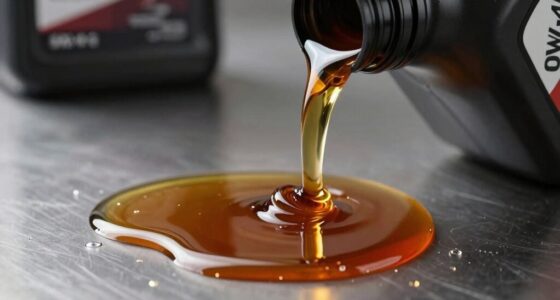

Before ensuring 0W-8 and ultra-low viscosity oils are safe, you need to verify they have proven oxidation stability to prevent breakdown during high temperatures. You should also confirm they’re compatible with engine metals, seals, and gaskets to avoid leaks or corrosion. Additionally, the oils must maintain proper viscosity and protective film under thermal stress. To understand the detailed testing processes and certifications involved, keep exploring these important safety factors.
Key Takeaways
- The oil must demonstrate proven oxidation stability under high-temperature and extended-use conditions.
- Compatibility tests should confirm no adverse effects on engine seals, gaskets, or metals.
- The oil’s viscosity at operating temperatures must remain within safe, effective limits.
- Validation through rigorous testing ensures it maintains protective film and prevents breakdown.
- Certification confirms the oil meets industry standards for safety, performance, and compatibility.

Understanding 0W-8 motor oil is essential as engine technologies evolve toward ultra-low viscosity formulations. These oils are designed to improve fuel efficiency and reduce emissions, but their success depends heavily on their ability to perform under various conditions. Before you trust 0W-8 as a reliable choice, you need to consider critical factors such as oxidation stability and compatibility testing. Oxidation stability refers to how well the oil resists chemical breakdown over time when exposed to heat and oxygen. If the oil isn’t stable, it can form deposits, sludge, or acids that impair engine performance and longevity. Ensuring that a 0W-8 formulation has robust oxidation stability is crucial because ultra-low viscosity oils tend to be more susceptible to oxidation due to their thinness. Manufacturers often conduct rigorous testing to evaluate how the oil behaves under high-temperature conditions and extended use, verifying that it maintains its protective qualities without degrading prematurely. Additionally, comprehensive testing procedures are necessary to confirm the oil’s suitability for diverse engine types and operating environments. Compatibility testing is another vital aspect you must consider. Ultra-low viscosity oils are often formulated with specific additives and base oils that may not be compatible with certain engine components or older oil formulations. Compatibility testing involves evaluating whether the new oil interacts adversely with existing seals, gaskets, and engine metals. If it doesn’t play well with these materials, it could lead to leaks, corrosion, or accelerated wear. Therefore, before adopting 0W-8 oils, you should verify that extensive compatibility testing has been performed, confirming that the oil won’t cause unforeseen issues in your engine’s environment. Moreover, you should look into how these oils perform across different temperature ranges and driving conditions. Ultra-low viscosity oils like 0W-8 are engineered to flow easily at cold starts, but their performance at high temperatures must also be assured. The oil’s ability to maintain its viscosity and protective film during hot operation hinges on its formulation’s stability—highlighting the importance of oxidation stability. Without proper testing and validation, you risk using an oil that could thin out too much or break down, exposing engine parts to increased wear. Ultimately, safe implementation of 0W-8 and other ultra-low viscosity oils depends on thorough testing and validation. You need to ensure that the oil has proven oxidation stability and has undergone comprehensive compatibility testing. Only then can you confidently rely on its performance, knowing it will protect your engine, improve efficiency, and withstand the demands of modern automotive technology.

Mobil 1 Synthetic Motor Oil 0W-8 JASO GLV-1-6 Quarts (1 Case)
PERFORMANCE – Helps increase engine efficiency
As an affiliate, we earn on qualifying purchases.
As an affiliate, we earn on qualifying purchases.
Frequently Asked Questions
How Does Ultra-Low Viscosity Affect Engine Wear Over Time?
Using ultra-low viscosity oil can improve engine longevity by reducing internal friction, which helps prevent wear over time. When you choose this type of oil, you guarantee it meets quality standards and is suitable for your engine’s design. Proper oil change intervals and regular maintenance also play essential roles. By doing so, you optimize wear prevention, keeping your engine running smoothly and extending its lifespan.
Are 0W-8 Oils Compatible With All Engine Types?
Imagine a puzzle where each piece fits perfectly; that’s what oil compatibility feels like. 0W-8 oils generally suit many engine types, but you need to check viscosity considerations and manufacturer guidelines. Some engines, especially older or specialized ones, might not be designed for ultra-low viscosity oils. To keep your engine running smoothly, verify compatibility before switching, ensuring your engine’s unique needs are met.
What Are the Environmental Impacts of Ultra-Low Viscosity Oils?
You should consider that ultra-low viscosity oils can raise biodegradability concerns, as they may break down more slowly in the environment. This can impact ecosystems if leaks or spills occur, potentially harming plants and wildlife. While they help improve fuel efficiency, it’s important to manage their use carefully to minimize ecosystem impact and guarantee that any environmental risks are mitigated through proper handling and disposal.
How Does Temperature Influence the Safety of 0W-8 Oils?
Did you know that temperature changes can cause viscosity to fluctuate by up to 50%? When it gets cold, 0W-8 oils maintain viscosity stability better than traditional oils, guaranteeing reliable lubrication. However, high temperatures can lead to increased thermal expansion, potentially affecting safety. Always check viscosity ratings for your climate, and confirm the oil’s properties stay consistent to prevent engine damage and sustain ideal performance.
What Testing Standards Verify the Safety of Ultra-Low Viscosity Lubricants?
You can trust the safety of ultra-low viscosity lubricants when they’ve undergone rigorous laboratory testing aligned with industry standards. These tests evaluate properties like viscosity, thermal stability, and wear resistance to confirm performance under various conditions. When lubricant manufacturers follow recognized industry standards, such as ASTM or SAE, it confirms that the products meet safety and quality benchmarks before you use them in your machinery.

Oil Pressure Tester Kit, 0-140 PSI Engine Oil Pressure Tester Gauge Tool Kit for Cars ATVs Trucks Use.
FUNCTION: The engine oil pressure tester kit is used to diagnose and test the engine oil pressure value,…
As an affiliate, we earn on qualifying purchases.
As an affiliate, we earn on qualifying purchases.
Conclusion
Before you plunge into 0W-8 and ultra-low viscosity oils, remember, “better safe than sorry.” Make certain you understand your engine’s specifications and trust reputable brands. Don’t rush into the latest trends without proper research and testing. When in doubt, consult with experts or your vehicle’s manual. Only then can you enjoy the benefits of these innovative oils confidently. After all, a wise driver knows that safety always comes first.

Briny River 2pcs Oil Seal Screw Conveyor Oil Seal with Nitrile Rubber Coating Compatible with Honda GX120 GXV120 GXV140 GXV160-91252 888 003 25x38x7mm Black
Compatible with Honda GX120 GXV120 GXV140 GXV160-91252 888 003, etc.
As an affiliate, we earn on qualifying purchases.
As an affiliate, we earn on qualifying purchases.

Engine Oil Tester Gasoline & Diesel Engine Oil Quality Tester Analyzer Detector High-precision Car Engine Oil Diagnostic Tool with 50inch Flexible Probe,Identifier&Sound Prompt,2.8in Backlight Display
【Why You Need Engine Oil Tester】Engine oil tester can help you check your engine oil regularly to ensure…
As an affiliate, we earn on qualifying purchases.
As an affiliate, we earn on qualifying purchases.