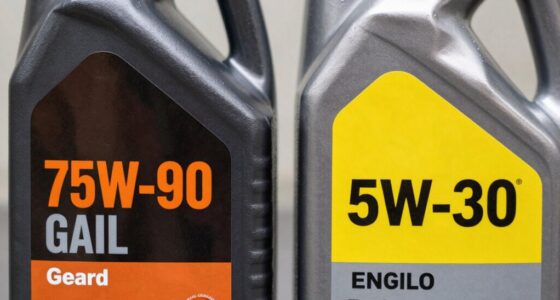

Two 5W-30 oils can behave very differently because their formulations vary—synthetic versus conventional—and their additive packages aren’t the same. Synthetic oils are engineered for better stability, flow at cold temperatures, and engine protection, while conventional oils are simpler and may break down faster. Even if they share the same viscosity rating, how they perform depends on these differences. Keep exploring to understand how choosing the right oil impacts your engine’s health over time.

Get business pricing on garage and car supplies
- Business-only prices and quantity discounts
- Tax-exempt purchasing
- Multiple users, one account, clear invoices
Key Takeaways
- Different formulations (synthetic vs. conventional) lead to varied viscosity stability and flow characteristics.
- Advanced additive packages in synthetic oils enhance protection and cleanliness compared to simpler additives in conventional oils.
- Synthetic oils perform better under extreme temperatures and heavy loads, affecting their behavior.
- The quality and type of base oil influence how each 5W-30 oil resists breakdown and maintains performance.
- Proper formulation matching to driving conditions determines how two oils labeled 5W-30 can behave differently.

Are you trying to choose the right 5W-30 oil for your vehicle? It’s more vital than you might think, especially when you realize that two different 5W-30 oils can behave very differently. The key lies in understanding how they’re formulated and how that impacts performance. One major factor is the distinction between synthetic vs. conventional oils. Synthetic oils are specially engineered through chemical processes to provide more uniform molecules, leading to better stability and flow at extreme temperatures. Conventional oils, on the other hand, are derived directly from crude oil and contain a mix of molecules that can vary in size and structure. This difference influences how each oil performs under different conditions. Synthetic oils generally offer superior protection against engine wear, better fuel efficiency, and enhanced viscosity stability, especially in cold starts or high temperatures. Conventional oils may be sufficient for routine driving but tend to break down faster and may require more frequent changes.
Another vital aspect is the additive formulations used in these oils. Additives are chemicals added to enhance performance, such as detergents to keep the engine clean, anti-wear agents to protect moving parts, and viscosity modifiers to maintain proper flow. Synthetic oils often have more advanced, balanced additive formulations, which contribute to their longer-lasting protective qualities. These formulations help prevent sludge buildup, reduce friction, and improve overall engine performance. In contrast, conventional oils typically have simpler additive packages, which may not provide the same level of durability or engine cleanliness over time. This means that even if two oils are labeled as 5W-30, their actual protective capabilities can differ greatly depending on their additive blend. Understanding these differences can help you select the most suitable oil for your vehicle.
It’s also worth noting that the quality of these additive formulations can influence how each oil behaves in different driving conditions. For example, synthetic oils with high-quality additives perform better in extreme weather, heavy loads, or high-mileage engines. Conversely, conventional oils with basic additive packages might struggle to keep up in such scenarios, leading to increased engine wear or deposits. So, when selecting a 5W-30 oil, you need to consider not just the label but also how the oil’s formulation suits your driving habits and engine requirements. The differences between synthetic and conventional oils, along with their additive formulations, can mean the difference between prime engine protection and premature wear. Knowing these distinctions helps you make an informed choice for your vehicle’s longevity and performance.
As an affiliate, we earn on qualifying purchases.
Frequently Asked Questions
Do All 5W-30 Oils Meet the Same Industry Standards?
Not all 5W-30 oils meet the same industry standards. Your choice depends on oil formulation, whether mineral or synthetic. Synthetic oils typically adhere to stricter standards, offering better performance and stability. Mineral oils may meet basic requirements but often lack the advanced additives found in synthetics. Always check the API or ILSAC certification on the label to verify the oil meets the necessary industry standards for your vehicle’s needs.
Can Brand Reputation Influence Oil Performance Differences?
Think of brand perception as a lighthouse guiding your choices. Yes, your trust in a brand can influence how well the oil performs because reputable brands prioritize quality and consistency. Consumer trust acts like a seal of assurance, often meaning their oils meet high standards. When you choose a trusted brand, you’re more likely to get oil that behaves reliably, ensuring your engine runs smoothly and efficiently.
How Does Oil Viscosity Change With Temperature Variations?
You’ll notice that oil viscosity fluctuates with temperature changes due to its temperature sensitivity. As temperatures drop, the oil thickens, increasing viscosity, which can affect engine performance. Conversely, higher temperatures cause the oil to thin out, reducing viscosity. This variation impacts how well the oil lubricates and protects your engine. Properly formulated oils maintain ideal viscosity across temperature ranges, ensuring smooth operation regardless of external conditions.
Are Synthetic and Conventional 5W-30 Oils Interchangeable?
Synthetic and conventional 5W-30 oils aren’t always interchangeable because their compatibility depends on your engine and oil formulation. Synthetic blends offer a middle ground, combining synthetic and conventional oils, but it’s vital to verify oil compatibility before switching. Using the wrong type may affect engine performance or cause damage. Always consult your vehicle’s manual or a mechanic to guarantee you’re choosing the right oil for maximum protection.
What Role Do Additives Play in Oil Behavior?
You might think additives are just minor extras, but they actually control the oil’s behavior. Additive effects influence how well the oil lubricates and protects your engine, while additive stability determines if these benefits last over time. Ironically, a small tweak in additive formulation can make two 5W-30 oils behave worlds apart. So, don’t underestimate their role—they’re essential for maintaining consistent performance and engine health.
As an affiliate, we earn on qualifying purchases.
Conclusion
So, next time you pick a 5W-30 oil, remember they’re not all created equal—one might be a gentle breeze, while another’s a raging storm. Don’t just settle for the label; explore the specs and choose the one that truly matches your engine’s needs. Because, honestly, using the wrong oil could be like pouring sand into your engine—an almost catastrophic mistake. Make an informed choice and keep your engine running smoothly for miles to come.
best additive packages for motor oil
As an affiliate, we earn on qualifying purchases.
As an affiliate, we earn on qualifying purchases.
high-performance engine oil for extreme temperatures
As an affiliate, we earn on qualifying purchases.
As an affiliate, we earn on qualifying purchases.
Fall Picks
fall essentials
As an affiliate, we earn on qualifying purchases.