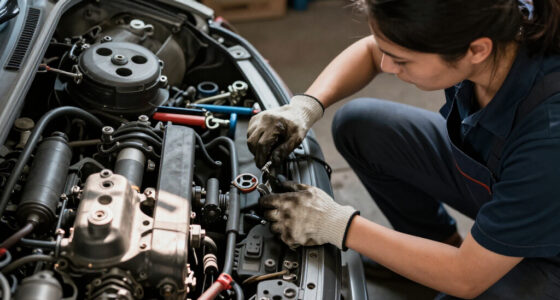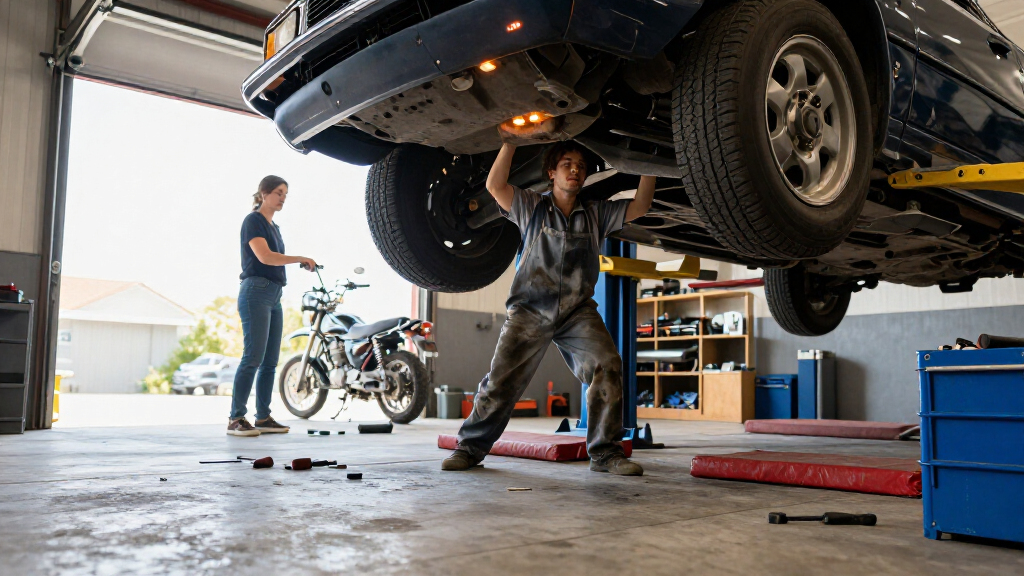

Use an automotive garage creeper to move beneath a vehicle for an inspection or repair while lying on a low, wheeled platform. This guide is for vehicle owners and home mechanics who are new to using a creeper. You will check the work area, confirm the vehicle is supported safely, position yourself, move with control, and put the equipment away. Allow 10-20 minutes for setup and positioning; the repair or inspection takes additional time.

Get business pricing on garage and car supplies
- Business-only prices and quantity discounts
- Tax-exempt purchasing
- Multiple users, one account, clear invoices

DNA Motoring 40-Inch Mechanic Creeper with Padded Headrest, Dual Tool Trays, Low-Profile Design – Red
- ✔ Length: 42 inches
- ✔ Dimensions: 42 x 19 x 4 inches
- ✔ Weight: 12.52 lb

Foldable Z Creeper 2-in-1 Rolling Folding Car Creeper & Seat, 36-Inch Adjustable Roller Garage Chair Lay Down or Sit, 330LBS Capa…
- ✔ Dimensions: 35.5 x 16 x 3.5 inches
- ✔ Weight: 10.69 lb
- ✔ Capacity: 330 lb

Torin BIG RED TRP6240 Rolling Garage Shop Creeper – 40-Inch Mechanic Cart with Padded Headrest, Dual Tool Trays and 6 Swivel Cast…
- ✔ Length: 40 inches
- ✔ Dimensions: 18.7 x 39.76 x 5.12 inches
- ✔ Weight: 5.7 lb
Difficulty: Beginner | Time: 10-20 minutes for setup and positioning; work time varies
What You’ll Need
Tools & Materials:
- Automotive creeper rated for your weight
- Vehicle owner’s manual or repair instructions
- Wheel chocks
- Floor jack and correctly rated jack stands if raising the vehicle
- Work light
- Safety glasses and suitable work clothing
Knowledge:
- How to identify the vehicle’s approved lifting and support points
- How to operate a floor jack and position jack stands, if the vehicle must be raised
Use the creeper on a firm, level floor. A creeper does not support a vehicle. If you need to lift the vehicle, follow the owner’s manual and the jack and stand manufacturers’ instructions. Never work beneath a vehicle supported only by a jack.
DNA Motoring 40-Inch Mechanic Creeper with Padded Headrest, Dual Tool Trays, Low-Profile Design – Red
The DNA Motoring is the most balanced choice here for buyers who want a dedicated rolling creeper with a relatively high stated capacity. Its 350 lb capacity tops this lineup, while the 42 x 19-inch body gives it the longest listed footprint. That extra length may appeal to users seeking a broad platform, though buyers should compare the dimensions with their work area and storage space.Like the Torin, it pairs a padded headrest and shoulder recess with side tool trays, so both provide head support and convenient tool access. The difference is in the stated capacity and construction: DNA Motoring specifies impact-resistant ABS and a 350 lb limit, while Torin lists a plastic frame and 280 lb limit. At 12.52 lb, this model is also substantially heavier than Torin’s 5.7 lb, so frequent lifting and carrying may feel less convenient. The six 3-inch swivel casters support repositioning, but the description does not establish a measured clearance advantage over the other creepers.We would choose this model when capacity and a longer work surface rank above minimum carrying weight. Skip it if compact storage or the easiest possible lift matters more than its broader feature set.
Pros:
- Highest stated capacity in this comparison at 350 lb.
- Padded headrest and shoulder recess provide added support.
- Dual side trays keep tools close while working.
- Six 3-inch swivel casters support repositioning beneath vehicles.
Cons:
- At 12.52 lb, it is heavier to lift than the Torin.
- Its 42-inch length may take more storage space than the Foldable Z.
Best for: Garage users who want a full-length dedicated creeper, side tool trays and the highest stated capacity in this lineup.
Not ideal for: Buyers who need a very light creeper to carry frequently or who have limited storage for a 42-inch body.
Bottom line: For a dedicated creeper with the highest stated capacity and useful tool access, DNA Motoring is the strongest all-around fit in this group.
“For a dedicated creeper with the highest stated capacity and useful tool access, DNA Motoring is the strongest all-around fit in this group.”
Foldable Z Creeper 2-in-1 Rolling Folding Car Creeper & Seat, 36-Inch Adjustable Roller Garage Chair Lay Down or Sit, 330LBS Capa…
The Foldable Z Creeper earns its place by serving two jobs: it rolls as a low-profile creeper and converts into a seat with a pin lock. That flexibility can be useful when garage work alternates between tasks underneath a vehicle and jobs performed while seated. Neither the DNA Motoring nor Torin model offers this second mode, so buyers who value one tool for both positions may prefer the Z even though it has the shortest listed body at 35.5 inches.Its heavy-duty steel frame and 330 lb stated capacity place it between DNA Motoring’s 350 lb rating and Torin’s 280 lb rating. Six swivel polyurethane casters and thick padding round out the under-vehicle setup. The tradeoff is portability and storage: at 10.69 lb, it weighs more than Torin, and its folded form is described as bulky. The product details do not state a folded size, so we would check the available storage area before choosing it for a crowded garage.This model makes the most sense when the seat conversion will see regular use. If we expect to spend nearly all our time lying under vehicles, DNA Motoring offers a longer creeper body and higher stated capacity; for a lighter lift, Torin is the more portable choice.
Pros:
- Converts from creeper to seat with a pin lock.
- Steel frame supports a stated 330 lb capacity.
- Six swivel polyurethane casters support rolling movement.
- Thick padded cushion is specified for extended work.
Cons:
- Folded form remains bulky for tight storage spaces.
- Heavier than the Torin at 10.69 lb.
Best for: DIYers who switch between working beneath a vehicle and seated garage tasks, and want a steel-frame convertible design.
Not ideal for: Users with very tight storage or buyers who want a lightweight, single-purpose creeper.
Bottom line: Choose the Foldable Z when the seat conversion earns its storage space; it is the most versatile option but not the lightest or longest creeper.
“Choose the Foldable Z when the seat conversion earns its storage space; it is the most versatile option but not the lightest or longest creeper.”
Torin BIG RED TRP6240 Rolling Garage Shop Creeper – 40-Inch Mechanic Cart with Padded Headrest, Dual Tool Trays and 6 Swivel Cast…
The Torin BIG RED TRP6240 is the simplest pick for buyers who prioritize easy handling and built-in tool access. At just 5.7 lb, it is half the weight of DNA Motoring’s model and lighter than the Foldable Z, making it the easiest of these three to lift and carry around a workshop. Its 40-inch one-piece molded body also includes dual side trays, a shoulder recess and a padded headrest, so its lighter build does not leave out the convenience features that matter during routine maintenance.Compared with DNA Motoring, Torin gives up stated capacity: 280 lb versus 350 lb. Its plastic frame may also be less reassuring to buyers who specifically want a steel construction. The Foldable Z offers a higher 330 lb capacity and seat conversion, but it is heavier and bulkier when stored. Torin’s six 360-degree swivel casters and low-profile shape are suited to maneuvering under a range of vehicles, though exact vehicle clearance will depend on the vehicle and workspace.We would favor Torin for lighter-duty garage use where portability and tool trays are more useful than a higher capacity rating. Heavier users, or anyone who wants more margin against the stated limit, should look first at DNA Motoring or the steel-framed Foldable Z.
Pros:
- Lightest option here at 5.7 lb.
- Dual side trays keep small tools within reach.
- Padded headrest and shoulder recess add support.
- Six 360-degree swivel casters support maneuverability.
Cons:
- Lowest stated capacity in this group at 280 lb.
- Plastic frame may not suit buyers seeking all-metal construction.
Best for: Home garage users who want a light, easy-to-carry creeper with a padded headrest and two tool trays.
Not ideal for: Heavier users or buyers who prioritize a metal frame and a higher stated capacity.
Bottom line: Torin is the easy-to-carry choice for lighter-duty work, provided its 280 lb capacity and plastic construction fit the buyer.
“Torin is the easy-to-carry choice for lighter-duty work, provided its 280 lb capacity and plastic construction fit the buyer.”
As an Amazon Associate we earn from qualifying purchases.
Before You Start
Park on firm, level ground, switch off the engine, remove the key, and let hot parts cool. Keep people, pets, tools, and loose items out of the work area. If the vehicle is raised, chock the wheels that remain on the ground and confirm the vehicle rests securely on properly placed jack stands before moving underneath it. Do not use a creeper if the floor is wet, sloped, cracked, or cluttered.
Step-by-Step Instructions
Step 1: Inspect the creeper and work area
Clear the floor along the route you will use, including the space beneath the vehicle. Check that the creeper’s frame, padding, headrest, wheels, fasteners, and any adjustment locks are intact. Turn each wheel by hand and remove hair, wire, or debris that could stop it rolling. Check the creeper’s weight rating and do not use it if a part is bent, loose, cracked, or missing.
Tip:Small floor debris can jam a caster or make the creeper stop suddenly. Sweep the route before you lie down.
Check: The route is clear, every wheel turns freely, and the creeper has no visible damage or loose parts.
Step 2: Secure the vehicle
Park the vehicle, set the parking brake, switch off the engine, and remove the key. Chock the wheels that will stay on the floor. If the work requires lifting, use the approved lifting points and support the vehicle on correctly placed jack stands before approaching the underside. Follow the vehicle manual for any model-specific procedure.
Tip:Never place any part of your body beneath a vehicle supported only by a floor jack. Do not crawl under a vehicle that rocks, shifts, or has uncertain support.
Check: The vehicle is stationary, the wheels are secured as needed, and any raised vehicle rests securely on jack stands.
Step 3: Put on protective gear and plan the route
Put on safety glasses and clothing that will not catch on tools or vehicle parts. Remove dangling jewelry and tie back long hair. Use a work light to locate the area you need to reach, then plan a clear path in and out. Keep tools, parts, and cords outside that path.
Tip:Check overhead clearance as well as floor clearance. Exhaust parts, suspension components, and low bodywork can leave less room than expected.
Check: You can see the target area and have a clear exit route with no cords or loose tools across it.
Step 4: Position yourself on the creeper
Place the creeper beside the vehicle on a flat section of floor. Sit down carefully, then lower your upper body onto the padding while keeping your head supported. Keep your hands away from the wheels and caster forks as you settle in. Arrange your shoulders and hips so your body is centered and your arms can reach the intended work area without twisting.
Tip:Do not climb onto a creeper that is already beneath the vehicle. Get into position outside the vehicle first.
Check: You are lying comfortably with your body centered, head supported, and arms free to reach the planned area.
Step 5: Roll beneath the vehicle slowly
Push against the floor with your hands or feet to move in short, controlled increments. Keep your hands and head clear of tires, stands, suspension parts, and sharp edges. Stop before reaching the target area, check your clearance, then make a small adjustment if needed. Do not use a power tool or a moving vehicle to propel the creeper.
Tip:If the creeper catches, stop and back out instead of forcing it. Find and clear the obstruction before trying again.
Check: You have reached the work area without contacting the vehicle, stands, or other equipment, and the creeper remains stable.
Step 6: Inspect or perform the planned work
Keep your body supported on the creeper and use the light to see clearly. Follow the relevant repair procedure, using hand tools with controlled movements. Keep parts and tools within reach without placing them where they can roll into your path. If the vehicle moves, a stand shifts, you feel trapped, or you cannot reach safely, stop work and roll out.
Tip:A creeper provides mobility, not protection from falling parts or hot surfaces. Use the safety equipment and procedures required for the repair.
Check: The inspection or task is complete, no tool or part has been left loose beneath the vehicle, and the vehicle’s support remains stable.
Step 7: Roll out and put the equipment away
Push yourself backward in controlled increments until you are fully clear of the vehicle. Sit up slowly and stand only when the creeper is on stable, open floor. Collect tools and removed parts after you are out. Wipe dirt or oil from the creeper, check it for damage, and store it flat or in its designated rack.
Tip:Clean oily padding and wheels before storage so the creeper is less likely to slip or track residue onto the floor next time.
Check: You are fully out from beneath the vehicle, tools are accounted for, and the clean creeper is stored without blocking a walkway.
Common Mistakes to Avoid
- Crawling beneath a vehicle supported only by a jack. — Use correctly rated jack stands on approved support points, and confirm the vehicle is stable before going underneath.
- Rolling over clutter or a damaged floor. — Clear and inspect the full route, including the area under the vehicle, before getting onto the creeper.
- Reaching too far or twisting to access a part. — Reposition the creeper in small movements so your shoulders and hips stay aligned with the work area.
- Using the creeper on a slope or oily surface. — Work on firm, level, dry flooring; move to a suitable location if the creeper cannot remain still.
Troubleshooting
Problem: A caster will not turn or the creeper stops suddenly.
Solution: Back out carefully, inspect the wheel for hair, wire, or debris, and clear the floor. Do not force a jammed or damaged caster.
Problem: The creeper rolls when you try to get on or off.
Solution: Move it to level, dry ground and steady the frame while sitting down or standing up. If it still moves unpredictably, stop using it and inspect the wheels and brakes if fitted.
Problem: There is not enough clearance to reach the work area.
Solution: Exit the creeper and reassess the vehicle’s approved lifting procedure and the creeper’s height. Do not force your body through a tight gap or alter the vehicle’s support.
Problem: The vehicle shifts, rocks, or a stand moves.
Solution: Stop immediately and roll out if you can do so safely. Keep clear until the vehicle is stable; reset the support using the vehicle and equipment instructions before resuming.
What Success Looks Like
The work is complete when you have reached and left the target area under control, the vehicle remained stationary on its intended supports, all tools and parts are accounted for, and the creeper is clean and stored. If the vehicle was lifted, verify that it remains safely supported until you lower it according to the vehicle and equipment instructions.
Next Steps
Before lowering a raised vehicle, remove tools and materials from beneath it and follow the specified jack stand removal sequence. After the vehicle is back on the ground, check that it sits normally and that wheel chocks can be removed safely. Inspect the creeper after each use; replace damaged parts or retire the unit if it cannot roll or support you reliably. Follow the repair manual’s final checks before driving.
Frequently Asked Questions
Can I use a garage creeper under a vehicle supported by a floor jack?
No. A floor jack alone is not safe support for work underneath a vehicle. Use correctly rated jack stands at approved support points and confirm stability before going beneath it.
Can I use a creeper on a sloped driveway?
No. A creeper can roll unexpectedly on a slope. Move the vehicle and work to firm, level ground before using one.
How do I choose a creeper size?
Check its weight rating, body length, width, and height against your needs and the available clearance. Make sure the wheels and padding are in good condition and that you can enter and exit the work area comfortably.
What should I do if the creeper will not fit beneath the vehicle?
Do not force it beneath the vehicle. Check the creeper’s height and the vehicle’s approved lifting procedure. If you raise the vehicle, support it on jack stands before placing any part of your body underneath.