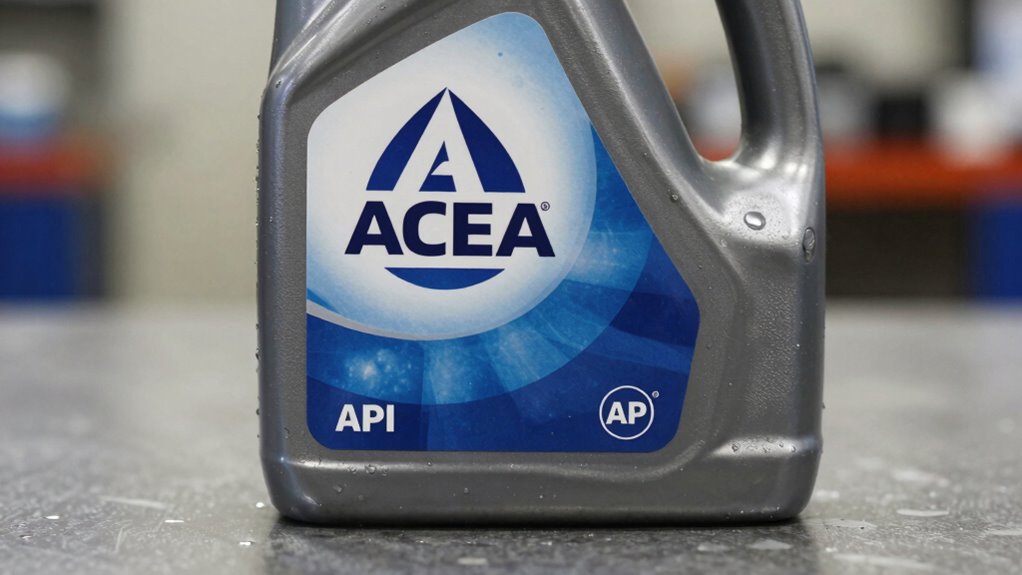

When a motor oil label shows ACEA standards but skips API ratings, it suggests the oil is mainly designed for European vehicle requirements rather than North American needs. ACEA standards focus on European performance criteria, while API ratings target American engines. This often indicates the oil is formulated for European markets or vehicles. Understanding this can help you choose the right oil. Keep exploring to discover what these labels really tell you about engine protection.
Key Takeaways
- ACEA standards are European-focused, emphasizing vehicle performance criteria, while API ratings are primarily North American standards.
- Oils listing ACEA but not API often target European markets and vehicle specifications.
- The absence of API on a label does not mean the oil is incompatible; it may still meet or exceed performance standards.
- Synthetic oils with ACEA standards typically contain advanced additive packages suited for high-performance European vehicles.
- Market focus and formulation priorities influence labeling, with some oils emphasizing ACEA standards over API ratings.

Ever wondered why some motor oil labels list ACEA standards but not API? It’s a good question, especially if you’re trying to understand what the labels really mean for your vehicle. When you see ACEA on a bottle, it’s indicating European standards, which focus on specific performance criteria tailored for European vehicles and driving conditions. Conversely, API ratings are more common in North America and are designed to meet American engine requirements. The absence of API standards on some oils doesn’t mean the oil isn’t suitable—it often reflects the oil’s intended market or its formulation focus.
One key reason some oils list ACEA but not API relates to the type of oil—whether it’s synthetic or conventional—and the kind of additive package it contains. Synthetic oils are engineered with highly refined base stocks, allowing them to perform better under extreme temperatures, reduce engine wear, and often last longer than conventional oils. These oils tend to meet or exceed many standards set by ACEA, especially since they’re designed for high-performance or demanding conditions. Synthetic oils also typically contain a more advanced additive package, which includes detergents, dispersants, anti-wear agents, and viscosity modifiers. These additives work together to keep your engine clean, protect against corrosion, and improve overall efficiency.
Synthetic oils feature advanced additive packages for better performance and durability under extreme conditions.
The additive package differences between synthetic and conventional oils are significant. Synthetic oils usually have a more sophisticated blend of additives, providing better oxidation stability and film strength. This means they perform well in extreme heat or cold and help extend oil change intervals. Conventional oils, on the other hand, often have a simpler additive package, which can limit their performance in high-stress conditions. Because ACEA standards are more aligned with the performance characteristics of synthetic oils, manufacturers targeting European markets often list ACEA standards on their labels. They might omit API ratings if their product surpasses those requirements or is tailored for vehicles that primarily follow European specifications.
In essence, when you see ACEA but not API on a motor oil label, it’s often a sign that the product is designed with advanced additive packages typical of synthetic oils, emphasizing performance, durability, and high-temperature stability. It may also indicate the oil was formulated with European vehicle standards in mind, which sometimes differ from American specifications. Understanding this can help you choose the right oil for your car’s needs, especially if you’re considering synthetic options that boast superior additive packages. Ultimately, it’s about matching your vehicle’s requirements with the oil’s formulation—whether it bears the ACEA mark, the API rating, or both. Being aware of these differences can help you make better decisions when selecting motor oil.

Mobil 1 European Car Formula Full Synthetic Motor Oil 0W-40, 5 Quart
Mobil 1 FS European Car Formula full synthetic motor oil 0W-40 helps to extend engine life even in…
As an affiliate, we earn on qualifying purchases.
As an affiliate, we earn on qualifying purchases.
Frequently Asked Questions
Can a Motor Oil Meet ACEA Standards but Not API?
Yes, a motor oil can meet ACEA standards but not API because of certification differences. European standards like ACEA focus on specific performance criteria, while API standards emphasize North American requirements. If your engine requires API certification, using oil only certified by ACEA might not meet warranty or performance needs. Always check your vehicle’s specifications to guarantee you select oil that complies with the relevant standards for peak performance.
Why Do Some European Oils Omit API Certification?
You’ll notice some European formulations omit API certification because of certification differences. These oils are designed primarily for European engines and standards, which often rely on ACEA, not API. Manufacturers focus on ACEA ratings to meet local regulations and performance needs. Since API certification isn’t always required or relevant for these European products, they may skip it, emphasizing their compliance with regional standards instead of U.S.-based API certification.
Is ACEA Certification Sufficient for American Vehicle Warranties?
You might be surprised to learn that over 80% of European vehicles rely on European standards. If your oil meets ACEA standards, it can be sufficient for European vehicle warranties, but not necessarily for American ones. Using only ACEA-certified oil may void your warranty in the U.S. because American standards, like API, are often required. Always check your vehicle’s warranty requirements before relying solely on European certifications.
How Do ACEA and API Standards Differ in Testing Procedures?
ACEA and API standards differ mainly in laboratory testing and certification processes. ACEA tests focus on European vehicle requirements, emphasizing engine durability and emissions, often involving all-encompassing laboratory testing. API standards, primarily used in the US, prioritize real-world performance and emissions, with certification processes that include rigorous testing and field data. These differences mean ACEA emphasizes durability, while API emphasizes performance and environmental compliance.
Are Acea-Only Oils Suitable for All Vehicle Types?
Did you know that ACEA-only oils make up about 30% of European market sales? These synthetic blends often feature advanced additive packages tailored for European vehicles, so they’re generally suitable for most vehicle types. However, always check your owner’s manual; some cars may require API-specific oils. ACEA oils are versatile, but verify they meet your vehicle’s specific needs for peak performance and protection.

STP Premium Small Engine 4 Cycle Oil Formula, SAE10W-30 Small Engine Oil Engine Care Formula Reduces Wear for Lawnmower, Push Mower, Tractor, 32 Oz, STP
SAE 10W-30 MOTOR OIL FOR SMALL ENGINES: One 32 fl oz bottle of STP Premium Synthetic Blend 4…
As an affiliate, we earn on qualifying purchases.
As an affiliate, we earn on qualifying purchases.
Conclusion
Just as a lighthouse guides ships through foggy waters, understanding why labels list ACEA but not API illuminates your path to better choices. Recognize that these labels are signals, each telling a different story about performance and standards. When you see ACEA but not API, it’s like choosing a vessel built for European seas—tailored for specific conditions. Trust your instincts and navigate wisely, knowing these labels are your compass in a sea of options.

Valvoline European Vehicle Full Synthetic SAE 5W-40 Motor Oil 5 QT
Advanced protection for European gasoline and diesel vehicles against the four main causes of engine breakdown: wear friction…
As an affiliate, we earn on qualifying purchases.
As an affiliate, we earn on qualifying purchases.
Valvoline European Vehicle Full Synthetic SAE 5W-40 Motor Oil 5 QT
Advanced protection for European gasoline and diesel vehicles against the four main causes of engine breakdown: wear friction…
As an affiliate, we earn on qualifying purchases.
As an affiliate, we earn on qualifying purchases.