
The best car tire pressure gauges balance easy reading, a pressure range suited to your tires, and a dependable connection at the valve. I rank the JACO ElitePro Digital Tire Pressure Gauge, 100 PSI as the best overall for everyday car checks, while the AstroAI Digital Tire Pressure Gauge and Inflator stands out for drivers who want to check and add air with one tool. For a simple, battery-free option, the AstroAI A1 offers a different kind of convenience. The main tradeoffs are digital readability versus mechanical simplicity, a compact form versus a hose or inflator, and broad pressure capacity versus a range tailored to passenger tires. Read on for the full comparison and guidance on choosing the right gauge for your vehicle and routine.

Get business pricing on garage and car supplies
- Business-only prices and quantity discounts
- Tax-exempt purchasing
- Multiple users, one account, clear invoices
Complete the kit


Key Takeaways
- A 100 PSI gauge is a practical everyday fit: The JACO ElitePro Digital 100 PSI model prioritizes passenger-car checks, while 200–250 PSI options make more sense when you also maintain higher-pressure tires or equipment.
- Check-and-inflate tools serve a different purpose: The AstroAI Digital Gauge and Inflator combines pressure checking with air delivery, but its fitting and compressor compatibility matter more than they do with a standalone gauge.
- Battery-free choices trade display convenience for simplicity: The AstroAI A1 and pencil-style gauges avoid battery dependence, while digital models are easier for many drivers to read at a glance.
- Hose and glow features address access and visibility: The ETENWOLF T600’s rubber hose can help around awkward valve positions, while glow-dial designs target low-light checks; neither feature matters equally for every car.
- Several entries are duplicate model listings: The roundup includes repeated ETENWOLF glow-dial and AstroAI 150 PSI models, so shoppers should compare the exact listing and configuration rather than treating repeated names as distinct designs.
| JACO ElitePro Digital Tire Pressure Gauge, 200 PSI |  | Best for Fine Digital Adjustment | Maximum pressure: 200 PSI | Readout resolution: 0.10 PSI | Accuracy: ±0.50% full scale (1 PSI) | VIEW LATEST PRICE | See Our Full Breakdown |
| ETENWOLF Tire Pressure Gauge, 0–75 PSI, with Glow Dial | 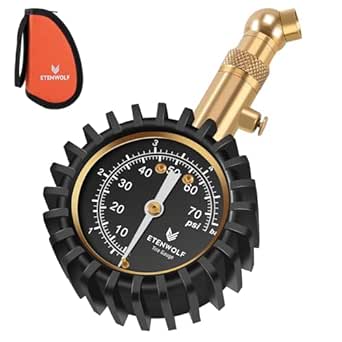 | Best for Low-Light Analog Checks | Pressure range: 0–75 PSI | Accuracy: ANSI B40.1 Grade A (±1% of span) | Chuck: 360-degree swivel | VIEW LATEST PRICE | See Our Full Breakdown |
| ETENWOLF Tire Pressure Gauge, 0–75 PSI, with Glow Dial |  | Best Analog Choice for Weather-Ready Use | Pressure range: 0–75 PSI | Accuracy: ANSI B40.1 Grade A (±1% of span) | Chuck: 360-degree swivel | VIEW LATEST PRICE | See Our Full Breakdown |
| AstroAI Digital Tire Pressure Gauge and Inflator, 3–250 PSI, 1/4-inch NPT |  | Best for Inflating and Checking in One Tool | Pressure range: 3–250 PSI | Other pressure units: 0.2–17.2 BAR; 0.21–1724 kPa; 0.2–17.5 kg/cm² | Accuracy: ±0.5% full scale (ANSI B40.7 Grade 2A) | VIEW LATEST PRICE | See Our Full Breakdown |
| AstroAI A1 Battery-Free Tire Pressure Gauge for Cars, SUVs, and Motorcycles | 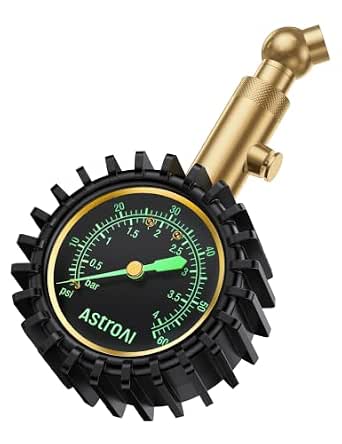 | Best Battery-Free Pick | Measurement range: 2–60 PSI | Accuracy: ±1% | Calibration standard: ANSI B40.1 | VIEW LATEST PRICE | See Our Full Breakdown |
| AstroAI Digital Tire Pressure Gauge, 150 PSI |  | Best for Low-Light Checks | Measurement range: 0–150 PSI | Accuracy: ±1 PSI | Measurement units: PSI, Bar, Kgf/cm², KPA | VIEW LATEST PRICE | See Our Full Breakdown |
| JACO ElitePro Digital Tire Pressure Gauge, 100 PSI |  | Best for Precise Pressure Adjustments | Maximum pressure: 100 PSI | Accuracy: ±0.50% FS (0.50 PSI) | Readout resolution: 0.10 PSI | VIEW LATEST PRICE | See Our Full Breakdown |
| JACO ElitePro Tire Pressure Gauge, 100 PSI |  | Best Analog Pick | Maximum pressure: 100 PSI | Accuracy: Within ±1.5% of ANSI standards | Dial: 2-inch, glow-in-the-dark | VIEW LATEST PRICE | See Our Full Breakdown |
| ETENWOLF T600 Digital Tire Pressure Gauge, 250 PSI, with Rubber Hose |  | Best for High-Pressure Range | Measurement range: 0–250 PSI | Accuracy: ±0.5% of full scale | Display resolution: 0.1 PSI | VIEW LATEST PRICE | See Our Full Breakdown |
| AstroAI Pencil Tire Pressure Gauge, 2-Pack, 10–75 PSI |  | Best Battery-Free Value Set | Quantity: 2 gauges | Measurement range: 10–75 PSI; 70–550 kPa; 0.7–5.5 BAR | Accuracy: ±2% span | VIEW LATEST PRICE | See Our Full Breakdown |
| TireTek 60 PSI Analog Tire Pressure Gauge |  | Best Battery-Free Analog Pick | Type: Analog tire pressure gauge | Pressure range: Up to 60 PSI | Accuracy: ANSI B40.1 Grade B (2%) | VIEW LATEST PRICE | See Our Full Breakdown |
| AstroAI Digital Tire Pressure Gauge, 150 PSI |  | Best for Easy Digital Readings | Type: Digital tire pressure gauge | Pressure range: Up to 150 PSI | Accuracy: Within ±1 PSI | VIEW LATEST PRICE | See Our Full Breakdown |
| ETENWOLF Pencil Tire Pressure Gauge Set, 2 Pack |  | Best Two-Range Mechanical Set | Type: Two pencil-style tire pressure gauges | Gauge ranges: 10–50 PSI and 20–120 PSI | Accuracy: ANSI B40.1 Grade B; 2% of span in the middle 50% and 3% in the outer 25% of range | VIEW LATEST PRICE | See Our Full Breakdown |
| ETENWOLF T300 Digital Tire Pressure Gauge, 3–200 PSI |  | Best for Wide Pressure Range and Temperature Swings | Model: T300 | Pressure range: 3–200 PSI | Accuracy: ±1 PSI; ANSI B40.7 Grade 2A | VIEW LATEST PRICE | See Our Full Breakdown |
| AstroAI Heavy-Duty Digital Tire Pressure Gauge, 0–230 PSI |  | Best Heavy-Duty Dual-Head Pick | Model: ATG180 | Pressure range: 0–230 PSI | Additional units: 0–16 bar, 0–16 kg/cm², and 0–1585 kPa | VIEW LATEST PRICE | See Our Full Breakdown |
| car tire pressure gauge | Accuracy |
|---|---|
| JACO ElitePro Digital Tire Pre | ±0.50% full scale (1 PSI) |
| ETENWOLF Tire Pressure Gauge | ANSI B40.1 Grade A (±1% of span) |
| ETENWOLF Tire Pressure Gauge | ANSI B40.1 Grade A (±1% of span) |
| AstroAI Digital Tire Pressure | ±0.5% full scale (ANSI B40.7 Grade 2A) |
| AstroAI A1 Battery-Free Tire P | ±1% |
| AstroAI Digital Tire Pressure | ±1 PSI |
| JACO ElitePro Digital Tire Pre | ±0.50% FS (0.50 PSI) |
| JACO ElitePro Tire Pressure Ga | Within ±1.5% of ANSI standards |
| ETENWOLF T600 Digital Tire Pre | ±0.5% of full scale |
| AstroAI Pencil Tire Pressure G | ±2% span |
| TireTek 60 PSI Analog Tire Pre | ANSI B40.1 Grade B (2%) |
| AstroAI Digital Tire Pressure | Within ±1 PSI |
| ETENWOLF Pencil Tire Pressure | ANSI B40.1 Grade B; 2% of span in the middle 50% and 3% in the outer 25% of range |
| ETENWOLF T300 Digital Tire Pre | ±1 PSI; ANSI B40.7 Grade 2A |
| AstroAI Heavy-Duty Digital Tir | — |
More Details on Our Top Picks
JACO ElitePro Digital Tire Pressure Gauge, 200 PSI
The JACO ElitePro Digital 200 PSI suits drivers who want a precise reading and the ability to correct pressure without switching tools. Its 0.10 PSI resolution, backlit LCD, and built-in bleeder let you check and release excess air while watching the reading. The 10-inch flexible hose and swivel Schrader chuck also make awkward valve angles easier to handle than a short, rigid gauge. Compared with the AstroAI Digital Tire Pressure Gauge and Inflator, this JACO focuses on measurement and controlled deflation rather than connecting inflation and measurement in one compressor-powered tool. That makes it simpler for checks, but it cannot inflate tires. It also needs two AAA batteries, and its 200 PSI ceiling is more range than most passenger-car owners need. Its lifetime warranty adds reassurance for buyers choosing a dedicated tool.
Pros:- 0.10 PSI resolution supports fine pressure adjustments
- Built-in bleeder lets you release air while monitoring the reading
- Backlit LCD and LED help with low-light checks
- Flexible 10-inch hose, swivel chuck, and lifetime warranty
Cons:- Requires two AAA batteries
- Cannot inflate tires, unlike the AstroAI Digital Tire Pressure Gauge and Inflator
- 200 PSI capacity is unnecessary for many passenger-car tires
Best for: Drivers who regularly check tire pressure and want a readable digital gauge with a bleeder for fine adjustments.
Not ideal for: Drivers who want one tool to inflate tires as well as measure them, or who prefer a battery-free gauge.
- Maximum pressure:200 PSI
- Readout resolution:0.10 PSI
- Accuracy:±0.50% full scale (1 PSI)
- Display:2.5-inch backlit LCD
- Hose length:10 inches
- Chuck:Schrader, 360-degree swivel
- Power:2 AAA batteries included
- Warranty:Lifetime
Our verdict“Choose the JACO if precise digital readings and controlled deflation matter more to you than built-in inflation.”
ETENWOLF Tire Pressure Gauge, 0–75 PSI, with Glow Dial
The ETENWOLF 0–75 PSI Glow Dial is a practical fit for drivers who prefer an analog gauge and often check tires in dim garages or outdoors after dark. Its glow dial avoids dependence on a battery-powered screen, while the 360-degree swivel chuck can make it easier to seat the gauge on valves with limited clearance. The 75 PSI range covers ordinary car tire checks without the extra capacity of the JACO ElitePro Digital 200 PSI, though the JACO offers finer digital resolution and a bleeder for adjustments. ETENWOLF instead includes valve caps, valve cores, and a storage bag, making it a useful kit for basic upkeep. The tradeoff is that this is a Schrader-only analog gauge; buyers who prefer a numeric digital display or need another valve type should choose elsewhere.
Pros:- Glow dial is designed for low-light readability
- 360-degree swivel chuck helps with awkward valve angles
- Includes four valve caps, four Schrader valve cores, and a storage bag
- Designed for use in hot and cold weather
Cons:- Analog dial can be less direct to read than the JACO ElitePro Digital 200 PSI display
- Schrader valve compatibility only
- 75 PSI maximum range does not suit higher-pressure applications
Best for: Car owners who want a battery-free-style analog reading for routine checks, especially in dim garages or changing weather.
Not ideal for: Drivers who need digital readouts, pressure adjustment with a bleeder, or compatibility beyond Schrader valves.
- Pressure range:0–75 PSI
- Accuracy:ANSI B40.1 Grade A (±1% of span)
- Chuck:360-degree swivel
- Valve type:Schrader
- Materials:Brass and rubber
- Dimensions:4.76 × 2.83 × 1.38 inches
- Weight:285 g
- Included components:Gauge, 4 valve caps, 4 Schrader valve cores, storage bag
Our verdict“Pick this ETENWOLF for straightforward analog checks in low light, rather than digital precision or built-in pressure adjustment.”
ETENWOLF Tire Pressure Gauge, 0–75 PSI, with Glow Dial
This ETENWOLF manual gauge is aimed at drivers who want a simple 0–75 PSI analog tool that does not rely on a digital screen. Its glow dial is intended to help in low light, and the 360-degree swivel chuck can ease access when a wheel or valve cap leaves little room to work. The supplied valve caps, valve cores, and storage bag give it a more maintenance-oriented package than the AstroAI A1 Battery-Free Tire Pressure Gauge, which emphasizes a dual PSI/BAR dial and protective rubber armor. Both are analog options, but this ETENWOLF is specified for extreme hot and cold use, while the AstroAI provides the clearer stated 2–60 PSI range. The ETENWOLF’s 75 PSI ceiling covers typical car checks, though reading a dial takes more care than reading the JACO ElitePro Digital 200 PSI’s screen.
Pros:- Glow dial is designed for low-light readability
- 360-degree swivel chuck helps reach valves at different angles
- ANSI B40.1 Grade A calibration
- Includes valve caps, valve cores, and a storage bag
Cons:- Analog dial takes more interpretation than the JACO ElitePro Digital 200 PSI display
- Maximum pressure is 75 PSI
- Designed for Schrader valves
Best for: Drivers who want an analog gauge with a swivel chuck and included valve-service parts for routine car tire maintenance.
Not ideal for: Drivers who want a digital display, a stated dual PSI/BAR scale, or a gauge that measures above 75 PSI.
- Pressure range:0–75 PSI
- Accuracy:ANSI B40.1 Grade A (±1% of span)
- Chuck:360-degree swivel
- Thread style:Schrader
- Materials:Brass and rubber
- Dimensions:4.76 × 2.83 × 1.38 inches
- Weight:285 g
- Included components:Gauge, 4 valve caps, 4 Schrader valve cores, storage bag
Our verdict“Choose this ETENWOLF if you want an analog gauge with a swivel chuck and included valve-service accessories for standard Schrader tires.”
AstroAI Digital Tire Pressure Gauge and Inflator, 3–250 PSI, 1/4-inch NPT
The AstroAI Digital Tire Pressure Gauge and Inflator is the most capable choice here for drivers who already have an air compressor and want to check, inflate, and deflate without swapping tools. Its 0.1 PSI resolution, backlit LCD, and built-in LED flashlight help with precise work in low light, while four selectable units suit users who do not want PSI-only readings. Compared with the JACO ElitePro Digital 200 PSI, AstroAI adds inflation control and a higher 250 PSI ceiling; the JACO is lighter and includes a 10-inch hose, but does not inflate. AstroAI’s central limitation is practical: it requires an air compressor, so it is not a self-contained roadside inflator. Its 10.56-ounce weight and 1/4-inch NPT connection also make it more of a garage tool than a compact glove-box gauge.
Pros:- Combines pressure measurement, inflation, and deflation
- 0.1 PSI resolution with four selectable pressure units
- Backlit LCD and LED flashlight support low-light use
- Automatic activation and shutoff help conserve battery
Cons:- Requires an air compressor for inflation
- Heavier and less convenient to carry than the JACO ElitePro Digital 200 PSI
- 1/4-inch NPT connection may not suit users without compatible compressor fittings
Best for: Home-garage users with an air compressor who want one tool to measure, inflate, and deflate tires.
Not ideal for: Drivers seeking a portable standalone gauge or those without a compatible air compressor.
- Pressure range:3–250 PSI
- Other pressure units:0.2–17.2 BAR; 0.21–1724 kPa; 0.2–17.5 kg/cm²
- Accuracy:±0.5% full scale (ANSI B40.7 Grade 2A)
- Resolution:0.1 PSI
- Connection:1/4-inch NPT
- Materials:ABS, aluminum, copper alloy
- Weight:10.56 ounces
- Warranty:3 years
Our verdict“Choose AstroAI if you have a compressor and want a single garage tool for measuring and adjusting tire pressure.”
AstroAI A1 Battery-Free Tire Pressure Gauge for Cars, SUVs, and Motorcycles
The AstroAI A1 makes the most sense for drivers who want a straightforward gauge that is ready whenever they need it, with no batteries to replace. Its 2-inch glow-in-the-dark dial displays both PSI and BAR, while brass construction and protective rubber armor suit a tool likely to live in a trunk or garage drawer. Compared with the ETENWOLF 0–75 PSI Glow Dial gauges, the A1 has a lower 60 PSI maximum but adds a specified dual-scale display and rubber protection. That range is ample for many car, SUV, and motorcycle checks, but gives less headroom for other applications. The JACO ElitePro Digital 200 PSI is easier to read as a precise digital number and includes a bleeder; the A1 instead offers battery-free simplicity. It is a Schrader-only analog gauge, with no accessories beyond the gauge itself.
Pros:- Battery-free operation avoids dead-battery interruptions
- Glow-in-the-dark dial has PSI and BAR scales
- Brass construction with protective rubber armor
- Compatible with cars, SUVs, motorcycles, bicycles, ATVs, and pickup trucks
Cons:- 60 PSI maximum is lower than the ETENWOLF 0–75 PSI gauges
- Analog reading is less direct than the JACO ElitePro Digital 200 PSI display
- Schrader compatibility only, with no extra accessories included
Best for: Drivers who want a durable, battery-free analog gauge for routine checks on cars, SUVs, motorcycles, and other Schrader-valve vehicles.
Not ideal for: Owners of higher-pressure tires above 60 PSI or anyone who prefers a digital display and pressure-bleeding control.
- Measurement range:2–60 PSI
- Accuracy:±1%
- Calibration standard:ANSI B40.1
- Display:2-inch glow-in-the-dark dial with PSI and BAR scales
- Materials:Brass with protective rubber armor
- Power:Battery-free
- Valve compatibility:Standard Schrader
- Included components:1 tire pressure gauge
Our verdict“Pick the AstroAI A1 for durable, battery-free checks on standard Schrader tires that stay within its 60 PSI range.”
AstroAI Digital Tire Pressure Gauge, 150 PSI
The AstroAI Digital Tire Pressure Gauge is a practical pick for drivers who want a clear reading without adding a hose or bulky inflator to their glove box. Its backlit LCD and illuminated nozzle make it easier to line up with a valve stem and read the result in dim garages or roadside conditions. The 0–150 PSI range covers ordinary car tires and leaves more headroom than the 100 PSI JACO ElitePro Digital, while four selectable units suit drivers who do not use PSI. The tradeoff is that its stated ±1 PSI accuracy is less precise than the JACO digital model’s specification, and AAA batteries will eventually need replacing. I’d choose this for straightforward checks, not for someone prioritizing the finest stated resolution or a built-in pressure bleeder.
Pros:- Backlit display and illuminated nozzle aid use in low light
- 0–150 PSI range gives more headroom than the 100 PSI JACO ElitePro Digital
- Four selectable units: PSI, Bar, Kgf/cm², and KPA
- Compact 50 g body with automatic shutoff
Cons:- Requires two AAA batteries, which need replacement over time
- ±1 PSI stated accuracy is less precise than the JACO ElitePro Digital’s specification
- No built-in pressure bleed valve for adjustments while measuring
Best for: Drivers who want an easy-to-read digital gauge for routine car-tire checks, including in dim parking areas
Not ideal for: Drivers who want to fine-tune pressure with a built-in bleeder or prioritize tighter stated accuracy than ±1 PSI
- Measurement range:0–150 PSI
- Accuracy:±1 PSI
- Measurement units:PSI, Bar, Kgf/cm², KPA
- Valve compatibility:Standard Schrader valves
- Display:Backlit LCD
- Auto-off:After 30 seconds of inactivity
- Batteries:2 AAA batteries included
- Dimensions and weight:5.31 x 2.17 x 1.1 inches; 50 g
Our verdict“Choose this compact AstroAI if readable low-light measurements matter more than a bleeder valve or finer stated accuracy.”
JACO ElitePro Digital Tire Pressure Gauge, 100 PSI
The JACO ElitePro Digital 100 suits drivers who want to check pressure and make small corrections without disconnecting to find a separate tool. Its 0.10 PSI display resolution and stated ±0.50% full-scale accuracy give a more detailed readout than the AstroAI Digital Tire Pressure Gauge, 150 PSI, whose stated accuracy is ±1 PSI. A built-in bleed valve lets you release air while watching the reading, and the 10-inch hose with a swivel chuck can make awkward valve access less fiddly. The narrower 100 PSI maximum is ample for typical car tires but offers less headroom than the AstroAI and ETENWOLF T600. Its brass-and-steel construction adds durability, though the hose and fittings make it less pocket-simple than a pencil gauge. I’d pick it for adjustment control, not maximum range.
Pros:- 0.10 PSI readout resolution and stated ±0.50% full-scale accuracy
- Built-in bleed valve allows pressure reduction while monitoring the reading
- 10-inch flexible hose and 360-degree swivel chuck help with valve access
- Brass and alloy steel construction with lifetime warranty
Cons:- 100 PSI maximum is lower than the AstroAI 150 PSI and ETENWOLF T600
- Requires two AAA batteries
- Hose-and-fitting design is less compact than a pencil-style gauge
Best for: Car owners who regularly fine-tune tire pressure and value a detailed digital readout with an integrated bleed valve
Not ideal for: Drivers needing readings above 100 PSI or a minimal, battery-free gauge for occasional checks
- Maximum pressure:100 PSI
- Accuracy:±0.50% FS (0.50 PSI)
- Readout resolution:0.10 PSI
- Display:2.5-inch backlit LCD
- Hose length:10 inches
- Chuck:360-degree swivel angled air chuck; 1/4-inch NPT
- Materials:Brass and alloy steel
- Battery and auto shutoff:2 AAA batteries included; shuts off after 150 seconds of inactivity
- Warranty:Lifetime
Our verdict“Pick the JACO if you want a precise digital gauge for checking and reducing pressure, and do not need readings above 100 PSI.”
JACO ElitePro Tire Pressure Gauge, 100 PSI
The JACO ElitePro analog gauge is for drivers who would rather read a dial than depend on batteries or an electronic display. Its glow-in-the-dark 2-inch dial and pressure-holding reading make it possible to check the result after removing the chuck, while the bleed valve lets you lower pressure without swapping tools. Compared with the digital JACO ElitePro 100, this version trades a numerical LCD and fine 0.10 PSI resolution for a simpler, battery-free analog setup. The brass body, protective guard, flexible hose, and swivel chuck make it more substantial than the AstroAI pencil gauge, but also less pocketable. Its 100 PSI ceiling fits routine car use, though it is not the widest-range option in this roundup. Choose it for a self-contained manual gauge, not for digital precision.
Pros:- Glow-in-the-dark dial helps with visibility in dim conditions
- Reading stays in place until reset, so it can be read after disconnecting
- Bleed valve and 360-degree swivel chuck support pressure adjustments
- Brass construction, shock-resistant guard, and lifetime warranty
Cons:- Manual dial reading is less direct than the digital JACO ElitePro 100 display
- 100 PSI maximum is below the AstroAI 150 PSI and ETENWOLF T600 ranges
- Bulkier than a simple pencil gauge for glove-box storage
Best for: Drivers who want a battery-free analog gauge with a bleed valve for routine car-tire checks
Not ideal for: Buyers who prefer an exact digital readout, need a very compact gauge, or require readings above 100 PSI
- Maximum pressure:100 PSI
- Accuracy:Within ±1.5% of ANSI standards
- Dial:2-inch, glow-in-the-dark
- Pressure reading:Reading stays in place until reset
- Material:Brass
- Features:Flexible leak-proof hose, 360-degree swivel chuck, built-in air bleeder
- Weight:5.6 ounces
- Warranty:Lifetime
Our verdict“Choose this JACO if you prefer a sturdy, battery-free dial and do not need the digital readout of its ElitePro counterpart.”
ETENWOLF T600 Digital Tire Pressure Gauge, 250 PSI, with Rubber Hose
The ETENWOLF T600 is the range-focused choice here: its 0–250 PSI capacity goes well beyond the 100 PSI limit of both JACO ElitePro gauges and the 150 PSI AstroAI digital model. That extra headroom matters for buyers checking more than ordinary passenger-car tires, though it is more range than most standard car-tire checks require. The flexible hose, rotating chuck, and built-in bleeder make it easier to reach a valve and make small pressure reductions without disconnecting. Its backlit display and 0.1 PSI resolution also make readings clear and detailed. Compared with the JACO ElitePro Digital, it supports a broader range and operating-temperature span, but lists units as PSI, BAR, and kPa rather than four choices. It uses AA batteries, which are included but must be installed before use.
Pros:- 0–250 PSI range offers more headroom than the JACO ElitePro 100 and AstroAI 150 PSI
- Flexible hose and rotating chuck help reach recessed valve stems
- Built-in bleeder allows pressure adjustments while connected
- Backlit display, 0.1 PSI resolution, and stated ±0.5% full-scale accuracy
Cons:- AA batteries must be installed before first use
- 250 PSI capacity is unnecessary for many routine passenger-car checks
- Lists three measurement units, fewer than the four offered by the AstroAI 150 PSI
Best for: Drivers checking vehicles or tires that may exceed 100 PSI and who want a hose-mounted digital gauge with a bleeder
Not ideal for: Passenger-car owners seeking a basic compact gauge who have no need for the 250 PSI range or hose fittings
- Measurement range:0–250 PSI
- Accuracy:±0.5% of full scale
- Display resolution:0.1 PSI
- Units:PSI, BAR, kPa
- Operating temperature:-14°F to 140°F (-20°C to 70°C)
- Connection:1/4-inch NPT
- Batteries:Two replaceable AA batteries included
- Weight and dimensions:2.4 ounces; 1.77 x 5.51 x 7.48 inches
- Product support:2 years
Our verdict“Choose the T600 if you need a broad pressure range and hose-assisted access; skip it for simple, low-range car checks.”
AstroAI Pencil Tire Pressure Gauge, 2-Pack, 10–75 PSI
This AstroAI two-pack favors simplicity and backup over digital convenience: both pencil gauges work without batteries, so one can stay in the glove box while the other is kept in a garage or another vehicle. The 10–75 PSI range suits many car, pickup, and bicycle checks, but it is a firm limit; exceeding it can permanently damage the gauge. Compared with the digital AstroAI 150 PSI, these are less convenient to read in low light and have a lower ceiling, but they avoid battery upkeep and include a deflator valve on each gauge. Stainless steel construction and pocket clips make them practical to carry, while the stated ±2% span accuracy is less precise than the JACO ElitePro Digital’s specification. I’d choose this set for basic, occasional checks—not for fine pressure adjustments or high-pressure applications.
Pros:- Two gauges provide a spare or allow one to stay in a second vehicle
- Battery-free design avoids electronic power requirements
- Measures in PSI, kPa, and BAR, with a deflator valve on each gauge
- Stainless steel construction and pocket clips support portable storage
Cons:- 75 PSI maximum is below the AstroAI 150 PSI digital gauge’s range
- Analog indicator is harder to read in low light than a backlit digital display
- ±2% span accuracy is less precise than the JACO ElitePro Digital’s stated accuracy
Best for: Drivers who want a simple battery-free gauge in multiple cars, or a spare for occasional car and bicycle checks
Not ideal for: Drivers who need readings above 75 PSI, an illuminated display, or more precise digital resolution
- Quantity:2 gauges
- Measurement range:10–75 PSI; 70–550 kPa; 0.7–5.5 BAR
- Accuracy:±2% span
- Material:Stainless steel
- Certification:ANSI B40.1 Grade B
- Features:Deflator valve, chuck, ABS indicator bar, pocket clip
- Dimensions:6.89 x 1.18 x 0.71 inches
- Weight:1.76 ounces
Our verdict“Choose this two-pack for straightforward battery-free checks and a spare, provided 75 PSI covers your needs.”
TireTek 60 PSI Analog Tire Pressure Gauge
The TireTek suits drivers who want a straightforward, battery-free gauge for ordinary car pressures. Its 60 PSI range is a closer fit for passenger vehicles than the much broader ranges of the ETENWOLF T300 or AstroAI Heavy-Duty Digital, while the swiveling angled chuck can make valve access easier in awkward positions. The glow-in-the-dark dial helps in dim garages, and its rubber cover adds grip and some protection from knocks. A built-in bleed valve lets you release excess air without removing the gauge, which is useful for fine adjustments. The tradeoff is its analog scale: readers who prefer a large numeric readout may find the AstroAI Digital Tire Pressure Gauge, 150 PSI easier to scan. Its 60 PSI ceiling also rules it out for some high-pressure applications.
Pros:- ANSI B40.1 Grade B calibration with stated 2% accuracy
- Glow-in-the-dark dial supports reading in dim conditions
- Bleed valve allows pressure adjustment while the gauge is connected
- Rubber cover and swiveling 45-degree chuck support grip and access
Cons:- Analog scale can take longer to read than a digital display
- 60 PSI maximum is limiting for high-pressure tires
- Does not offer selectable measurement units
Best for: Drivers who want a durable, battery-free gauge for checking and adjusting passenger-car, motorcycle, or RV tires.
Not ideal for: Buyers who need a digital readout, or owners of tires that may exceed its 60 PSI range.
- Type:Analog tire pressure gauge
- Pressure range:Up to 60 PSI
- Accuracy:ANSI B40.1 Grade B (2%)
- Chuck:45-degree angled, fully swiveling
- Pressure adjustment:Built-in pressure relief valve
- Materials:Alloy steel, brass, and rubber
- Power:No batteries required
- Dimensions and weight:1.25 × 2.75 × 5 inches; 5.6 ounces
Our verdict“Choose the TireTek if you want a protected, battery-free analog gauge for typical vehicle tires and do not need a high-pressure range.”
AstroAI Digital Tire Pressure Gauge, 150 PSI
This AstroAI is the clearest fit for drivers who want a backlit numeric display without moving to a bulky heavy-duty gauge. Its stated accuracy is within ±1 PSI, and four units—PSI, bar, kgf/cm², and kPa—make it more adaptable than the TireTek 60 PSI Analog Tire Pressure Gauge, which uses a marked dial and tops out at 60 PSI. The illuminated nozzle and screen also help when checking tires in a dim garage or at night. At 150 PSI, it has plenty of headroom for common vehicle use, though it does not match the 200–230 PSI reach of the ETENWOLF T300 or AstroAI Heavy-Duty Digital. The main compromise is dependence on two AAA batteries; automatic shutoff helps conserve them, but the gauge is not ready to work if its batteries run out.
Pros:- Stated accuracy within ±1 PSI
- Backlit LCD and illuminated nozzle aid low-light checks
- Displays pressure in four selectable units
- Automatic shutoff and included batteries simplify routine use
Cons:- Requires two AAA batteries to operate
- 150 PSI maximum is lower than the ETENWOLF T300 and AstroAI Heavy-Duty Digital
- ABS construction is less metal-focused than heavy-duty alternatives
Best for: Drivers who prefer quick, readable digital measurements and want multiple units for car, motorcycle, or light-truck tire checks.
Not ideal for: Buyers seeking a battery-free tool or a gauge with a range above 150 PSI.
- Type:Digital tire pressure gauge
- Pressure range:Up to 150 PSI
- Accuracy:Within ±1 PSI
- Measurement units:PSI, bar, kgf/cm², and kPa
- Display and nozzle:Backlit LCD; illuminated nozzle
- Power:Two included AAA batteries
- Auto shutoff:After 30 seconds
- Dimensions and weight:7.9 × 1.2 × 4.3 inches; 2.4 ounces
- Warranty:1 year
Our verdict“Pick this AstroAI for an easy-to-read digital gauge with multiple units, provided you are comfortable keeping AAA batteries on hand.”
ETENWOLF Pencil Tire Pressure Gauge Set, 2 Pack
The ETENWOLF set stands apart by pairing two different pressure ranges rather than relying on one all-purpose gauge: a 10–50 PSI model for lower-pressure tires and a 20–120 PSI model for higher-pressure needs. That makes it more versatile across a household’s vehicles than the single-range TireTek 60 PSI Analog Tire Pressure Gauge, while its ANSI B40.1 Grade B calibration provides a stated accuracy standard. Stainless steel bodies and zinc alloy heads offer a sturdier feel than a basic plastic digital gauge, and the included cases help keep each gauge together with its accessories. These are still pencil-style tools, so readings require interpreting a marked scale rather than glancing at the AstroAI 150 PSI’s LCD. The pair also takes more storage space, and the compact gauges can be misplaced if not returned to their cases.
Pros:- Two ranges cover different tire pressure needs
- ANSI B40.1 Grade B calibration
- Stainless steel bodies and zinc alloy heads
- Includes two cases and 16 valve stem caps
Cons:- Pencil scales take more interpretation than a digital display
- Two separate gauges require more storage and organization
- Small gauges can be easy to misplace
Best for: Households with vehicles that need different pressure ranges and drivers who prefer simple mechanical gauges without batteries.
Not ideal for: People who want a large digital readout, or buyers likely to misplace small tools and their separate cases.
- Type:Two pencil-style tire pressure gauges
- Gauge ranges:10–50 PSI and 20–120 PSI
- Accuracy:ANSI B40.1 Grade B; 2% of span in the middle 50% and 3% in the outer 25% of range
- Materials:Stainless steel bodies; zinc alloy heads
- Included accessories:Two storage cases and 16 valve stem caps
- Deflation:Can be used to deflate tires
- Item weight:117 g
- Item dimensions:5.8 × 2.9 × 0.7 inches
Our verdict“Choose this set if you want battery-free gauges for both lower- and higher-pressure tires and are comfortable reading pencil-style scales.”
ETENWOLF T300 Digital Tire Pressure Gauge, 3–200 PSI
The T300 is the strongest match here for drivers who need one digital gauge to cover a broad span of tire pressures and work in changing weather. Its 3–200 PSI range reaches well beyond the AstroAI Digital Tire Pressure Gauge, 150 PSI, while the stated ±1 PSI accuracy and ANSI B40.7 Grade 2A calibration offer a defined accuracy target. Thermal compensation for -4°F to 130°F makes it better suited to keeping in a vehicle through seasonal conditions than a gauge without a stated operating range. An LED light supports checks in dark areas, and replaceable AAA batteries avoid a sealed-power design. The tradeoffs are a plastic body and Schrader-only fit; bicycle owners using Presta valves need a separate adapter, which is not included. For ordinary car-only use, this range may be more than necessary.
Pros:- Broad 3–200 PSI measurement range
- Stated ±1 PSI accuracy and ANSI B40.7 Grade 2A calibration
- Thermal compensation specified for -4°F to 130°F
- LED light, replaceable batteries, and automatic shutoff
Cons:- Presta valve adapter is not included
- Plastic construction may be less appealing to buyers seeking a metal-bodied gauge
- Requires two AAA batteries
Best for: Drivers who check cars, trucks, RVs, or other tires across a broad pressure range and keep a gauge in a vehicle through temperature changes.
Not ideal for: Cyclists with Presta valves who expect an adapter in the package, or car owners who only need a simple low-range gauge.
- Model:T300
- Pressure range:3–200 PSI
- Accuracy:±1 PSI; ANSI B40.7 Grade 2A
- Operating temperature:-4°F to 130°F (-20°C to 54°C)
- Power:Two AAA batteries
- Valve type:Schrader
- Included components:Gauge and two AAA batteries
- Dimensions and weight:6.3 × 1.46 × 1.06 inches; 110 g
- Warranty:3 years
Our verdict“Choose the T300 if you need a broad-range digital gauge with a stated operating-temperature span, but plan on an adapter for Presta valves.”
AstroAI Heavy-Duty Digital Tire Pressure Gauge, 0–230 PSI
This AstroAI is built for buyers who value a metal-bodied gauge and dual-head chuck over a compact, car-only tool. Its 0–230 PSI range exceeds the ETENWOLF T300’s 200 PSI ceiling, and the dual-head design is aimed at reaching valves across cars, trucks, RVs, motorcycles, and bicycles. The backlit LCD and integrated flashlight serve different jobs: one makes the reading easier to see, while the other lights the valve area. It also supports PSI, bar, kg/cm², and kPa. Compared with the lighter AstroAI Digital Tire Pressure Gauge, 150 PSI, this model has a wider range and stainless steel construction, but its 12.6-inch length and 8-ounce weight make it less convenient to stash in a small glove box. The supplied details do not state a numerical accuracy tolerance, which may matter to precision-focused buyers.
Pros:- 0–230 PSI range with four pressure units
- Stainless steel construction and dual-head chuck
- Backlit LCD and integrated flashlight support low-light checks
- Batteries are included and the gauge shuts off automatically
Cons:- Longer and heavier than the compact AstroAI 150 PSI gauge
- Product data does not specify a numerical accuracy tolerance
- Broad maximum range may be unnecessary for passenger-car-only use
Best for: Drivers and fleet owners checking a mix of cars, trucks, RVs, motorcycles, or bicycles who want a wide range and dual-head access.
Not ideal for: Buyers who want a short, lightweight glove-box gauge or need a stated accuracy tolerance before choosing.
- Model:ATG180
- Pressure range:0–230 PSI
- Additional units:0–16 bar, 0–16 kg/cm², and 0–1585 kPa
- Accuracy standard:ANSI B40.7 Grade 2A (0.5%)
- Construction:Stainless steel
- Chuck:Dual head
- Display and lighting:Backlit LCD and integrated flashlight
- Auto shutoff:30–40 seconds
- Dimensions and weight:12.6 × 2.2 × 1.4 inches; 8 ounces
Our verdict“Choose this model for its dual-head access, metal construction, and 230 PSI ceiling if compact storage and a published accuracy tolerance are not your priorities.”

How We Picked
I ranked these car tire pressure gauges by how well their design matches real maintenance needs: readable measurement, a useful pressure range, ease of attaching to a valve, and the level of versatility the tool adds. I also weighed construction and practical details such as a hose, an inflator connection, battery-free operation, or a compact pencil format. A broad range is helpful for mixed vehicle and equipment use, but it is not automatically better for routine passenger-car checks.
The order favors options that appear most straightforward for regular car maintenance, then separates specialized picks by their use case. Digital models gain an edge when clear readouts and added functions help, while mechanical gauges remain relevant for buyers who want fewer electronic dependencies. Duplicate product names are treated as repeated listings rather than separate innovations; confirm the exact model and included configuration before buying.
Factors to Consider When Choosing Car Tire Pressure Gauges
Choosing among these gauges is less about collecting the most features and more about matching the tool to your vehicle, storage habits, and inflation setup. I would start with the pressure range and valve access, then decide whether a display, battery-free operation, or an integrated inflator will actually make checks easier.
Match the Gauge Range to Your Tires
Check the recommended cold tire pressure on the vehicle placard or in the owner’s manual before choosing a gauge. For most passenger-car routines, a range focused on ordinary tire pressures is easier to use than paying attention to a very high maximum that your tires may never need. A 200–250 PSI range is more useful if you also maintain high-pressure vehicle tires or other equipment. Do not confuse the gauge’s maximum capacity with the correct pressure for your car. A gauge should let you read your target pressure clearly, not encourage you to inflate toward its upper limit. If your household has several vehicle types, choose for the highest legitimate pressure requirement while keeping readability at your normal car pressure in mind.
Choose a Readout You Can Use Reliably
Digital displays can make a reading easier to see, especially when small markings or poor lighting make an analog scale hard to interpret. They do add battery dependence, so check how the model powers on and whether its controls feel manageable for occasional use. Mechanical dial and pencil gauges avoid electronic power, but their markings still need to be legible at the pressure range you use. A common mistake is choosing a display style based only on appearance instead of checking whether you can read it while holding the gauge at the valve. Glow features may help in dim conditions, though they do not replace a clear scale or a secure valve connection. If several drivers will share the tool, favor a display and operating method everyone can understand quickly.
Think About Valve Access and the Chuck
Wheel design can make a valve awkward to reach, so the shape and reach of the gauge matter as much as its scale. A hose may help when a wheel opening is tight or the valve sits at an uncomfortable angle, while a compact pencil gauge can be easier to keep in a glove box. Before buying, think about whether the chuck can be pressed onto your valves without a struggle and whether you can hold it steady during a reading. Poor alignment can cause air to escape and produce inconsistent results. A longer or more flexible connection can improve access, but it may add bulk to storage. If you have recessed or hard-to-reach valves, prioritize connection geometry over extra measurement capacity.
Decide Whether You Need an Inflator
A standalone gauge measures pressure, while a gauge-and-inflator tool is designed to work with an air source so you can check and add air in the same setup. That combination can reduce tool switching in a garage, but it is only useful if the fitting matches your compressor hose and the connection standard you use. The AstroAI inflator model lists a 1/4-inch NPT fitting, so compatibility deserves a check before purchase. An integrated tool can be less convenient to carry in a car than a small gauge. It also cannot replace a compressor or other air supply. Choose this format for regular home inflation work, not simply because it has more functions.
Weigh Battery-Free Simplicity Against Digital Features
Battery-free gauges remove one maintenance task and can be reassuring as an emergency glove-box tool. Pencil gauges are also compact, though their small scales and simple construction may be less comfortable for drivers who want a prominent readout. Digital gauges favor quick visual checks, but a dead or missing battery can leave you without the display when you reach for the tool. Think about how often you check pressure and whether the gauge will live in a vehicle, a home workshop, or both. For occasional roadside use, low-maintenance simplicity may matter more than additional functions. For regular maintenance, an easy-to-read digital model may justify keeping track of its power needs.
Buy for the Full Set of Vehicles, Not a Single Spec
Many households use one gauge for a car, a second vehicle, and sometimes a motorcycle or other tires. In that case, range, chuck access, and storage convenience should all fit the most demanding item you will check. Two-pack pencil sets can make sense when you want a gauge in more than one vehicle, but they do not provide the display style or extra functions of a digital tool. Likewise, a heavy-duty model may suit broader workshop use while feeling like more tool than a driver needs for one car. Match the purchase to who will use it and where it will be stored, rather than choosing the model with the largest number on its specification sheet. When listings share the same product name, verify the exact model variant and included items.
Frequently Asked Questions
Is a 200–250 PSI tire pressure gauge better for a regular car?
Not by itself. A higher maximum pressure is useful when you also check tires or equipment that require more pressure than a passenger car, but it does not make the gauge more accurate for your vehicle. For routine car maintenance, prioritize a scale that is easy to read near your vehicle’s recommended pressure. Check the tire placard or manual for the correct target rather than relying on the gauge’s maximum. If you maintain several types of vehicles, a higher-range model may be a practical shared tool.
Should I choose a digital gauge or a battery-free pencil gauge?
Choose based on how you prefer to read and maintain the tool. A digital display is often easier to interpret quickly, while a pencil gauge avoids batteries and can be compact enough to keep in a vehicle. Pencil models have smaller markings, which may be less comfortable if your eyesight or lighting makes fine scales difficult. Digital models require you to keep their power source ready. If the gauge is mainly for occasional emergency checks, battery-free operation may appeal; for frequent checks, a clear display may be worth the added upkeep.
Do I need a tire gauge that also inflates tires?
An inflator gauge makes the most sense if you already use a compatible compressor and often add air at home or in a workshop. It can combine checking and inflation, but it is bulkier and depends on fitting compatibility. The AstroAI inflator listing specifies a 1/4-inch NPT connection, so compare that with your air line before choosing it. If you only need to check pressure or carry a tool in the car, a standalone gauge is usually simpler. An inflator gauge does not provide air on its own.
What should I choose if my wheel valves are hard to reach?
Focus on the connection and reach of the tool rather than its maximum pressure rating. A gauge with a hose can make it easier to line up with a valve in a tight wheel opening, while a compact pencil design may be harder to hold at an awkward angle. Consider your wheel layout and valve position before buying, since access differs across vehicles. A steady, well-seated connection also helps avoid air loss during the check. If possible, confirm the product’s chuck and hose details in the listing before ordering.
Are the repeated model names in this roundup separate versions?
Not necessarily. The roundup includes two ETENWOLF glow-dial listings and two AstroAI 150 PSI digital gauge listings, and matching names alone do not establish a meaningful design difference. Listings may represent the same model or differ by configuration, included items, or seller details. Compare the exact product identifiers, range, and stated features before choosing between repeated entries. Do not assume a duplicate listing adds a separate capability to the available options.
Conclusion
For most drivers, I would start with the JACO ElitePro Digital 100 PSI as the best overall fit for routine car pressure checks. The AstroAI A1 is my best value-style choice for shoppers who prefer battery-free simplicity, while the AstroAI Digital Tire Pressure Gauge and Inflator is the premium-style pick for buyers who already have a compatible air source and want one tool for checking and adding air. Beginners may find a clear digital gauge easier to read than a small pencil scale; if avoiding batteries matters more, choose a mechanical alternative instead. For hard-to-reach valves, look at the ETENWOLF T600’s hose, and for low-light use, compare the ETENWOLF glow-dial models. Match the gauge to your vehicle’s recommended pressure and storage needs, then verify the exact listing when model names repeat.
Fall Picks
fall essentials
As an affiliate, we earn on qualifying purchases.