For most buyers seeking an electric gear oil transfer pump, my best overall pick is the 24V Gear Oil Transfer Pump with 100W Motor and 10 ft Hose, which pairs a dedicated transfer-pump setup with a longer hose. The 12V Oil Extractor Pump, 3.2 GPM stands out for a stated flow rate, while the Harpy Eagle 12/24V 100W kit offers voltage flexibility and a storage case. The main tradeoffs are matching the pump to thick gear oil, choosing a compatible power source, and deciding whether you need a pump for extraction or fluid transfer. Some products are described as oil extractors, while the Fill-Rite is a high-flow fuel pump, so intended fluid use matters as much as the headline specs. Read on for the full breakdown and buyer guidance.

Get business pricing on garage and car supplies
- Business-only prices and quantity discounts
- Tax-exempt purchasing
- Multiple users, one account, clear invoices
Complete the kit


Key Takeaways
- The 24V 100W transfer pump with a 10 ft hose is the clearest dedicated transfer pick; its stated hose length may make reaching a fill point easier, but buyers still need to confirm oil compatibility and flow performance.
- The 3.2 GPM figure makes the 12V oil extractor the easiest model to compare on stated flow, though a published rate alone does not show how quickly it will move cold, viscous gear oil.
- Harpy Eagle’s 12/24V design is the standout for power-source flexibility, while the 12V-only kits suit buyers who already have a compatible 12V supply.
- Several 100W extractor models have overlapping headline specs; hose arrangement, included accessories, and intended use are more useful differentiators than wattage alone.
- The Fill-Rite FR4211H is a different kind of tool: its stated 20 GPM and mechanical meter target fuel transfer, so it should not be treated as a gear-oil pump without explicit fluid-compatibility approval.
| Faitio 12V 100W Electric Oil Extractor Pump |  | Best Overall for 12V Gear-Oil Extraction | Voltage: 12V DC | Motor power: 100W | Maximum flow rate: 4.2 qt/min | VIEW ON AMAZON | See Our Full Breakdown |
| Amarine Made 12V 60W Oil Extractor Pump |  | Best for Light-Duty, Multi-Vehicle Use | Voltage: 12V | Power: 60W | Current: 5A | VIEW ON AMAZON | See Our Full Breakdown |
| STEAUTY 24V 100W Electric Oil Extractor Pump |  | Best for 12V/24V Power Flexibility | Voltage: 12V or 24V | Power: 100W | Maximum flow rate: 3.2 GPM; varies with power supply and oil viscosity | VIEW ON AMAZON | See Our Full Breakdown |
| Oil Extractor Pump 12V 100W – DIY Engine Oil Change |  | Best for a Ready-to-Connect Home Setup | Voltage: 12V DC | Power: 100W | Pump design: Self-priming gear pump | VIEW ON AMAZON | See Our Full Breakdown |
| 24V Gear Oil Transfer Pump with 100W Motor and 10 ft Hose |  | Best for Long-Hose 24V Transfers | Operating voltage: 24V | Motor power: 100W | Flow rate: Up to 3.2 GPM (12 L/min) | VIEW ON AMAZON | See Our Full Breakdown |
| Harpy Eagle Electric Oil Change Extractor Pump, 12/24V, 100W, with Storage Case |  | Best for Multi-Voltage Flexibility | Voltage: 12/24V | Motor power: 100W | Pumping rate: Up to 1 quart per minute | VIEW ON AMAZON | See Our Full Breakdown |
| 12V 100W Portable Oil Transfer Pump Set |  | Best for a Ready-to-Connect Kit | Voltage: 12V | Power: 100W | Flow rate: 1–4 L/min | VIEW ON AMAZON | See Our Full Breakdown |
| 12V 100W Electric Oil Transfer Pump Set |  | Best for Specified Fluid Versatility | Voltage: 12V | Motor power: 100W | Flow rate: 1–4 L/min | VIEW ON AMAZON | See Our Full Breakdown |
| 12V Oil Extractor Pump, 3.2 GPM Electric Gear Oil Change Pump Kit |  | Best for High-Flow Transfer | Voltage: 12V DC | Power: 78W standard; 120W maximum | Flow rate: 3.2 GPM | VIEW ON AMAZON | See Our Full Breakdown |
| Fill-Rite FR4211H 12V 20 GPM Fuel Transfer Pump with Mechanical Meter |  | Best for Dedicated Fuel Transfer | Voltage: 12V | Flow rate: 20 GPM | Discharge hose: 12 feet | VIEW ON AMAZON | See Our Full Breakdown |
| gear oil transfer pump electric | Voltage | Flow rate | Weight | Power |
|---|---|---|---|---|
| Faitio 12V 100W Electric Oil E | 12V DC | — | 3.44 lb | — |
| Amarine Made 12V 60W Oil Extra | 12V | 0.8–1.0 liters/min | — | 60W |
| STEAUTY 24V 100W Electric Oil | 12V or 24V | — | 7.63 lb | 100W |
| Oil Extractor Pump 12V 100W | 12V DC | — | — | 100W |
| 24V Gear Oil Transfer Pump wit | — | Up to 3.2 GPM (12 L/min) | — | — |
| Harpy Eagle Electric Oil Chang | 12/24V | — | 4.49 pounds | — |
| 12V 100W Portable Oil Transfer | 12V | 1–4 L/min | 5.32 pounds | 100W |
| 12V 100W Electric Oil Transfer | 12V | 1–4 L/min | 6.3 pounds | — |
| 12V Oil Extractor Pump | 12V DC | 3.2 GPM | — | 78W standard; 120W maximum |
| Fill-Rite FR4211H 12V 20 GPM F | 12V | 20 GPM | — | — |
More Details on Our Top Picks
Faitio 12V 100W Electric Oil Extractor Pump
The Faitio 12V 100W is my strongest all-around pick for buyers who want to extract gear or differential oil using a vehicle battery. Its dipstick-tube extraction avoids getting under a vehicle, and its stated flow rate of up to 4.2 qt/min is a clear advantage over the slower Amarine Made 60W pump. The self-priming design and compatibility with gear, differential, and transmission fluids make it more aligned with this roundup than an engine-oil-only extractor.
There are limits: the engine should be warmed for faster flow, and continuous operation is capped at 30 minutes. It also cannot handle gasoline, diesel, or water. I’d choose the STEAUTY 24V pump instead for a 24V setup or a dedicated gear-pump configuration, but the Faitio is the more straightforward fit for typical 12V vehicle maintenance.
Pros:- Extracts oil through a dipstick tube, reducing the need to access an under-vehicle drain plug.
- Works with gear, differential, transmission, and motor oils.
- 100W pure copper motor with a stated maximum flow of 4.2 qt/min.
- Self-priming design supports a simpler extraction setup.
Cons:- Continuous operation is limited to 30 minutes.
- Warming the engine for 3–5 minutes is recommended for faster oil flow.
- Incompatible with gasoline, diesel, and water.
Best for: DIY vehicle owners who want a 12V pump for extracting gear, differential, or transmission fluid without lifting the vehicle.
Not ideal for: Buyers who need to transfer gasoline, diesel, or water, or who need to run a pump continuously for longer than 30 minutes.
- Voltage:12V DC
- Motor power:100W
- Maximum flow rate:4.2 qt/min
- Continuous operation:Up to 30 minutes
- Motor material:100% pure copper
- Compatible fluids:Motor oil, gear oil, differential fluid, transmission fluid
- Incompatible fluids:Gasoline, diesel, water
- Weight:3.44 lb
Our verdict“Choose the Faitio for versatile 12V vehicle-fluid extraction, but skip it if your job involves incompatible fluids or extended continuous pumping.”
Amarine Made 12V 60W Oil Extractor Pump
The Amarine Made is the lineup’s lightweight, ready-to-connect option for owners maintaining several kinds of equipment. At 16 ounces, it is easier to store and carry than the 3.44-pound Faitio, and its included hoses, locks, and battery clamps reduce the parts a buyer needs to source separately. Its 0.8–1.0 liters-per-minute flow, however, is modest beside the Faitio’s stated 4.2 qt/min, so I’d reserve it for smaller or occasional extraction jobs rather than faster gear-oil transfers.
The key limitation is especially relevant to this roundup: the product data says it is not for gearbox oil. That makes it a poor choice for buyers specifically pumping gear oil, despite its broad list of vehicle types. It also needs cooling breaks and is restricted to 30 minutes per use. I’d pick it for portable light-duty oil extraction, not as a dedicated gear-oil pump.
Pros:- Lightweight 16-ounce design is easy to carry and store.
- Includes inlet and outlet hoses, hose locks, and battery clamps.
- Runs from a 12V supply and suits a range of vehicle and equipment types.
- Hose lengths and connection sizes are specified for planning a basic setup.
Cons:- Not suitable for gearbox oil, making it a weak fit for dedicated gear-oil work.
- Stated flow of 0.8–1.0 liters per minute is slower than the Faitio 12V 100W.
- Limited to 30 minutes per use and requires cooling during extended jobs.
Best for: Owners of motorcycles, lawn equipment, boats, or other small equipment who need a portable 12V extractor for suitable oils and want hoses and battery clamps included.
Not ideal for: Anyone specifically transferring gearbox or gear oil, or buyers who need faster flow or extended pumping.
- Voltage:12V
- Power:60W
- Current:5A
- Flow rate:0.8–1.0 liters/min
- Inlet hose length:1.2 m
- Outlet hose length:1.5 m
- Included accessories:Inlet hose, outlet hose, 2 hose locks, 2 battery clamps
- Restrictions:Not for gasoline, water, gearbox oil, or flammable liquids; maximum 30 minutes per use
Our verdict“Choose the Amarine Made for lightweight, occasional extraction of suitable oils, but skip it if gear oil is the main fluid you need to transfer.”
STEAUTY 24V 100W Electric Oil Extractor Pump
The STEAUTY stands apart from the Faitio and the 24V-only STEAUTY model because it supports either 12V or 24V power. That flexibility can matter for owners moving between a vehicle battery and a 24V machinery setup. Its self-priming gear-pump design is intended for thicker oils, including gear and transmission fluids, while two brass hose barbs accommodate 19 mm and 12.7 mm ID hoses.
The stated maximum of 3.2 GPM depends on both supply voltage and oil viscosity, so I would not treat it as a guaranteed rate with thick gear oil. Unlike the 24V STEAUTY with its included 10-foot hose, this package does not list hoses, which adds setup work. At 7.63 pounds, it is also less convenient to move than the compact Faitio. Its appeal is power-source flexibility, not the simplest out-of-box kit.
Pros:- Supports both 12V and 24V power supplies.
- Self-priming gear-pump design is intended for oil and lubricant transfer.
- Brass fittings accommodate two common hose inner diameters.
- Manufacturer states a three-year warranty.
Cons:- Hoses are not listed as included, unlike the 24V STEAUTY with a 10-foot hose.
- The 3.2 GPM maximum varies with supply voltage and oil viscosity.
- At 7.63 lb, it is heavier than the Faitio extractor.
Best for: Owners of mixed 12V and 24V vehicles or machinery who want a self-priming gear pump and can supply their own hoses.
Not ideal for: Buyers who want a complete hose kit, a lightweight portable extractor, or a flow rate that stays consistent across different oils and power supplies.
- Voltage:12V or 24V
- Power:100W
- Maximum flow rate:3.2 GPM; varies with power supply and oil viscosity
- Pump design:Self-priming gear pump
- Hose fittings:Brass barbs for 19 mm and 12.7 mm ID hoses
- Hoses included:Not listed
- Weight:7.63 lb
- Warranty:3 years
Our verdict“Choose this STEAUTY when one pump needs to work with both 12V and 24V supplies and you already have compatible hoses.”
Oil Extractor Pump 12V 100W – DIY Engine Oil Change
This 12V 100W extractor is aimed at buyers who would rather connect a supplied kit than assemble a pump-and-hose setup. Its self-priming gear pump, leak-proof hoses, clamps, and battery clips are presented as a quick-install package, while a metal body and thermal cut-off address durability and heat management. Compared with the STEAUTY 24V model, it is more focused on a ready-to-connect 12V setup; compared with the Faitio, its supplied accessories are the clearer convenience point.
The product data lists gear oil and transmission fluid as compatible, but it does not give a flow rate, so buyers cannot readily compare its transfer speed with the Faitio’s stated 4.2 qt/min or STEAUTY’s stated 3.2 GPM. It also needs warmed oil for better flow and has no automatic shut-off, so the operator must monitor the job. Gasoline, diesel, and water are excluded.
Pros:- Self-priming gear pump is designed to start without pre-filling.
- Hoses, clamps, and battery clips are included for a ready-to-connect setup.
- Metal body and thermal cut-off are specified for durability and heat protection.
- Compatible with engine oil, gear oil, and transmission fluid.
Cons:- No flow rate is provided, making performance harder to compare with the Faitio or STEAUTY pumps.
- No automatic shut-off is listed, so the operator must monitor pumping.
- Oil should be warmed for better flow, and gasoline, diesel, and water are excluded.
Best for: Home-garage and marine DIY owners who want a 12V pump kit with hoses and battery clips for occasional oil changes.
Not ideal for: Buyers who need a published flow-rate benchmark, automatic shut-off, or a pump for gasoline, diesel, or water.
- Voltage:12V DC
- Power:100W
- Pump design:Self-priming gear pump
- Compatible fluids:Engine oil, gear oil, transmission fluid
- Incompatible fluids:Gasoline, diesel, water
- Body material:Metal
- Included accessories:Hoses, clamps, battery clips
- Safety feature:Thermal cut-off
Our verdict“Choose this model for a convenient 12V DIY kit with listed gear-oil compatibility, provided you can work without a published flow rate or automatic shut-off.”
24V Gear Oil Transfer Pump with 100W Motor and 10 ft Hose
For buyers with a 24V supply who need hose reach as well as gear-oil compatibility, this STEAUTY package is the most purpose-built option here. It pairs a self-priming 100W gear pump with a cuttable, reinforced 10-foot hose and brass fittings. That makes it more complete for a remote transfer setup than the other STEAUTY 24V/100W pump, which lists fittings but no included hoses. The stated 3.2 GPM gives buyers a benchmark, though actual flow can vary with fluid and setup.
The tradeoff is less flexibility: this model requires 24V, while the other STEAUTY supports 12V or 24V. Cutting the hose may help tailor a particular installation, but it is not reversible and calls for planning before setup. At 9.59 pounds, it is also heavier than the Faitio. I’d choose it for a fixed or semi-permanent 24V transfer arrangement, not for a lightweight vehicle kit.
Pros:- Includes a 10-foot reinforced hose that can be cut to suit a setup.
- Self-priming gear-pump design is intended for gear oil, transmission fluid, and lubricants.
- 100W copper motor and two brass fittings support a configurable transfer arrangement.
- Stated maximum flow rate is 3.2 GPM (12 L/min).
Cons:- Requires a 24V power source, unlike the dual-voltage STEAUTY pump.
- Cutting the hose to adjust its length is permanent.
- At 9.59 lb, it is heavier than the Faitio 12V extractor.
Best for: Owners of 24V trucks, boats, or machinery who want a self-priming gear-oil pump with a long hose included.
Not ideal for: 12V-only vehicle owners, buyers who need a lightweight kit, or anyone unwilling to cut the hose to fit a specific setup.
- Operating voltage:24V
- Motor power:100W
- Flow rate:Up to 3.2 GPM (12 L/min)
- Hose length:10 ft (3 m), cuttable
- Hose inner diameter:19 mm
- Hose outer diameter:23 mm
- Hose fittings:Two brass fittings
- Warranty:3 years
Our verdict“Choose this STEAUTY for a 24V setup that benefits from the included long hose, but pick a dual-voltage or 12V model if your power source is uncertain.”
Harpy Eagle Electric Oil Change Extractor Pump, 12/24V, 100W, with Storage Case
The Harpy Eagle stands out among these extractors because its 12/24V compatibility suits buyers who may work with different vehicle electrical systems. Its 100W metal rotary motor is specified for up to 1 quart per minute, a measured pace compared with the 1–4 L/min claims for the 12V Portable Oil Transfer Pump Set. That slower stated rate is a tradeoff for a kit geared toward organized, occasional maintenance rather than speed. Two 4-foot hoses, quick-release plugs, and a hose clip help with reach and tidier storage, while the included case keeps the accessories together. I’d shortlist it for cars, boats, motorcycles, and equipment where the voltage flexibility matters; buyers seeking a faster transfer rate or a pump specifically built for a different service method should look elsewhere.
Pros:- 12/24V compatibility accommodates more electrical setups than the 12V-only kits.
- Two 4-foot hoses and a 59-inch power cable provide useful reach.
- Quick-release plugs and a hose clip help control and store the hoses.
- Storage case, manual, and oil-capacity guide are included.
Cons:- Stated pumping rate is up to 1 quart per minute, slower than the 1–4 L/min claims of some 100W alternatives.
- Extraction-focused design may not fit vehicles or equipment requiring another oil-change method.
Best for: Owners maintaining a mix of 12V and 24V vehicles or equipment who want a cased extraction kit.
Not ideal for: Buyers prioritizing faster transfer or needing a pump designed for service methods other than oil extraction.
- Voltage:12/24V
- Motor power:100W
- Pumping rate:Up to 1 quart per minute
- Hose length:4 feet each
- Power cable length:59 inches (1.5 m)
- Weight:4.49 pounds
- Included accessories:Storage case, instruction manual, oil-capacity guide
Our verdict“Choose the Harpy Eagle if 12/24V flexibility and organized storage matter more than the highest stated flow rate.”
12V 100W Portable Oil Transfer Pump Set
This 12V Portable Oil Transfer Pump Set is a practical pick for buyers who want the pump, tubes, and battery clamps in one package. Its stated 1–4 L/min flow rate is higher on paper than the Harpy Eagle’s up-to-1-quart-per-minute figure, though actual pace can depend on the oil and setup. The 100W copper motor and aluminum-alloy pump head give the kit a clear materials specification, and its foam-lined storage box helps keep parts together between jobs. The tradeoff is that it needs a 12V battery connection, so it lacks the Harpy Eagle’s 12/24V flexibility. Its 1.5 m tubes also call for checking reach against the vehicle before buying. I’d favor this set for occasional 12V gear-oil or engine-oil extraction, not for users seeking a pump for unrelated fluids.
Pros:- Includes battery clamps, inlet and outlet tubes, and a foam-lined storage box.
- Stated flow rate of 1–4 L/min gives buyers a clearer speed reference than the Harpy Eagle’s quart-per-minute rating.
- 100W copper motor and aluminum-alloy pump head are specified.
- One-year warranty is listed.
Cons:- Requires a 12V power source and battery connection.
- The 1.5 m tubes may not reach comfortably on larger vehicles or equipment.
- Designed for oil extraction, limiting use with incompatible fluids.
Best for: DIY owners with a 12V vehicle who want battery clamps, tubing, and storage included in one extraction kit.
Not ideal for: Owners of 24V-only equipment or buyers needing longer-than-1.5 m tubes or broad fluid compatibility.
- Voltage:12V
- Power:100W
- Flow rate:1–4 L/min
- Pump head material:Aluminum alloy
- Inlet tube:1.5 m length; 6 mm diameter
- Outlet tube:1.5 m length; 10 mm diameter
- Power cord length:1.4 m
- Weight:5.32 pounds
- Warranty:1 year
Our verdict“Pick this kit for a complete, portable 12V setup, but choose the Harpy Eagle if you need 24V compatibility.”
12V 100W Electric Oil Transfer Pump Set
Among the compact 12V kits, this pump has one of the clearer stated fluid ranges: engine oil, gear oil, lubricating oil, diesel, and other non-corrosive fluids. That makes it more adaptable on paper than the oil-focused Harpy Eagle, though it still isn’t a general-purpose pump for corrosive liquids. Its 100W copper motor and aluminum-alloy head are paired with a stated 1–4 L/min flow rate, matching the range listed for the 12V Portable Oil Transfer Pump Set. The difference is in the included setup: this package lists a tube clamp and storage box, while the other set specifies battery clamps and foam lining. At 6.3 pounds, it is also heavier than that 5.32-pound alternative. I’d choose it when the listed fluid compatibility is useful, but compare the power connection details before purchase.
Pros:- Lists gear oil, engine oil, lubricating oil, diesel, and other non-corrosive fluids as compatible.
- 100W copper motor and aluminum-alloy pump head are specified.
- Includes 1.5 m inlet and outlet tubes, a clamp, and a storage box.
- One-year warranty is listed.
Cons:- Limited to non-corrosive fluids.
- The 1–4 L/min flow rate may vary with fluid and operating conditions.
- At 6.3 pounds, it is heavier than the 12V Portable Oil Transfer Pump Set.
Best for: 12V vehicle and small-equipment owners who want a stated range covering gear oil, lubricating oil, and diesel.
Not ideal for: Buyers who need to pump corrosive fluids, work from 24V power, or prioritize the lightest kit in this group.
- Voltage:12V
- Motor power:100W
- Flow rate:1–4 L/min
- Pump head material:Aluminum alloy
- Power cord length:1.4 m
- Tube length:1.5 m
- Compatible fluids:Engine oil, gear oil, lubricating oil, diesel, and other non-corrosive fluids
- Weight:6.3 pounds
- Warranty:1 year
Our verdict“Choose this set if its specified non-corrosive fluid range suits your jobs and you accept a heavier 12V kit.”
12V Oil Extractor Pump, 3.2 GPM Electric Gear Oil Change Pump Kit
The headline 3.2 GPM flow claim sets this pump apart from the smaller 100W extractors, whose listed rates are 1–4 L/min. That makes this kit worth a closer look for buyers who need a faster stated transfer rate, but its instructions contain a key limitation: it is not suitable for extracting oil through a dipstick tube. That changes the buying decision. The Harpy Eagle and the two portable 100W sets are framed around extraction, while this model’s dipstick restriction may rule it out for common extraction routines. Its all-copper construction and thermal protection add useful safeguards, and the listed work cycle is up to 120 minutes. I’d check that the pump’s required connection and intended setup match the vehicle before choosing it; the 12V supply and cycle limit make it less flexible for extended or stationary work.
Pros:- Listed 3.2 GPM flow rate is much higher on paper than the 1–4 L/min claims of the 100W portable kits.
- All-copper construction is specified.
- Thermal protection is built in.
- Rated for a work cycle of up to 120 minutes.
Cons:- Not suitable for extracting oil through a dipstick tube.
- Requires a 12V power source.
- Work cycle is limited to up to 120 minutes.
Best for: 12V vehicle or marine owners who need a higher stated flow rate and can use a non-dipstick extraction setup.
Not ideal for: DIY owners whose routine depends on drawing oil through the dipstick tube, or anyone without a 12V supply.
- Voltage:12V DC
- Power:78W standard; 120W maximum
- Flow rate:3.2 GPM
- Maximum pressure:0.3 MPa / 43.5 PSI
- Work cycle:Up to 120 minutes
- Construction:All-copper
- Thermal protection:Built in
- Dipstick-tube extraction:Not suitable
Our verdict“Consider this pump for higher-flow 12V transfer only if your service setup does not require dipstick-tube extraction.”
Fill-Rite FR4211H 12V 20 GPM Fuel Transfer Pump with Mechanical Meter
The Fill-Rite FR4211H is the outlier here: it is a high-volume fuel transfer pump, not a gear-oil extractor. Its 20 GPM rating and 1-inch discharge are aimed at moving approved fuels, while the Harpy Eagle and the other portable kits are designed around oil extraction and smaller service tasks. Cast-iron construction, a 34-inch suction pipe, and a 12-foot discharge hose suit a fixed or mobile fuel setup better than a compact vehicle-maintenance kit. A mechanical meter and rotating junction box also support installation and tracking fuel volume. The main tradeoff is compatibility: its listed fluids are gasoline, diesel, kerosene, specified alcohol blends, and biodiesel up to B20—not gear oil. I would not buy it for a gear-oil change; it belongs in this roundup only as a clearly distinct transfer option.
Pros:- 20 GPM flow rating is suited to fuel transfer rather than small oil-extraction jobs.
- Cast-iron construction is specified.
- Mechanical meter supports tracking fuel volume.
- 12-foot discharge hose and 34-inch suction pipe suit a mounted or mobile setup.
Cons:- Listed compatible fluids are fuels, not gear oil.
- Requires a 12V power source, which limits setup options.
- Its 1-inch discharge and fuel-focused design make it a poor fit for routine vehicle oil extraction.
Best for: Operators setting up a 12V mobile or mounted fuel station for the listed fuel types and needing metered transfer.
Not ideal for: Anyone shopping specifically for a gear-oil transfer or extraction pump; its listed application is fuel transfer.
- Voltage:12V
- Flow rate:20 GPM
- Discharge hose:12 feet
- Discharge size:1 inch
- Suction pipe length:34 inches
- Power cable:18 feet
- Construction:Cast iron
- Compatible fuels:Gasoline, diesel, kerosene, ethanol and methanol blends, biodiesel up to B20
Our verdict“Buy the Fill-Rite for a metered 12V fuel-transfer setup, not for gear-oil changes.”
How We Picked
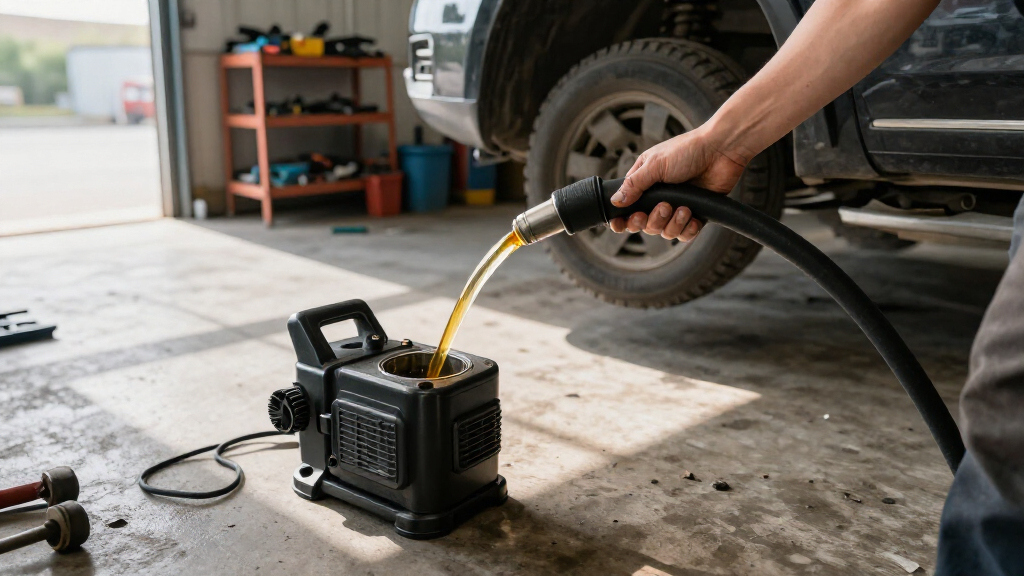
I ranked these options around how well their stated design and specifications match electric gear oil transfer—not around headline numbers alone. I prioritized products presented as transfer pumps, then weighed voltage and wattage, stated flow information, hose setup, included accessories, and practical features such as a storage case. I also separated extraction-focused pumps from transfer-focused models because drawing oil from an engine and filling a gearbox can call for different hose arrangements and operating methods.
Where product details do not state gear-oil compatibility, viscosity limits, duty cycle, or measured flow under load, I treat that as an information gap rather than assume performance. That is why the dedicated 24V transfer model ranks ahead of general-purpose extractors, while the Fill-Rite fuel pump ranks last for this use despite its much higher stated flow. Buyers should verify the exact fluid approval and operating limits with the manufacturer before using any pump with gear oil.
Factors to Consider When Choosing Gear Oil Transfer Pump Electric
Choosing an electric gear oil transfer pump starts with the job, not the biggest motor or flow figure. I would check the fluid specification, the route from container to fill point, and the available power before comparing kits. These factors help avoid a pump that runs but cannot handle the oil or fit the task.
Match the Pump to the Fluid and the Job
Gear oil can be much thicker than the fluids many generic oil-extractor listings describe, especially in cold conditions. Confirm that the manufacturer explicitly approves the pump for the oil type and viscosity you plan to move. Also distinguish extraction, which draws fluid out through an access point, from transfer, which sends fluid into a housing or reservoir. A pump advertised for engine-oil changes may not have the right connections or operating limits for filling a differential. Do not infer compatibility from the words “oil pump” or from motor wattage; ask the seller or manufacturer when the specification is unclear.
Choose Voltage Around Your Power Source
A 12V pump can be convenient for a vehicle battery or a suitable 12V supply, while a 24V model is a better fit for equipment that already uses 24V power. Dual-voltage designs can serve more than one setup, but confirm how the pump switches or connects between voltages before buying. Check the required current and connector type as well as voltage; a matching voltage does not guarantee a compatible supply. Avoid powering a pump from an undersized source, which can cause poor operation or electrical problems. If you work away from a vehicle, include the power supply and cable reach in your setup plan.
Read Flow Claims in Context
A listed flow rate can help compare models, but it may reflect ideal conditions rather than real use with viscous gear oil. Ask whether the figure applies to the fluid you intend to pump, and whether it was measured with a particular hose length or lift. Long hoses, narrow fittings, bends, and cold oil can all slow delivery. A higher number is not automatically better if you need controlled filling at a small opening. For gearboxes and differentials, steady, manageable flow may be more useful than a fast pump that is difficult to stop at the correct level.
Plan Hose Length, Fittings, and Fill Access
Before choosing a kit, measure the distance between the oil container, pump, and fill port, then check the port size and access angle. A longer hose can reduce repositioning, but it also adds resistance and can leave more oil inside the line after use. Verify whether the kit includes the right intake and discharge hoses, adapters, clamps, and a way to keep the line clean. Do not assume that a pump advertised as a set includes every fitting needed for your vehicle or machine. A dry fit before the job can reveal clearance problems without risking a spill.
Check Duty Cycle and Care Requirements
Small electric pumps may be designed for intermittent use rather than long, continuous runs. Look for a stated duty cycle, maximum run time, cooling requirements, and instructions for priming or flushing. Gear oil residue can be difficult to remove, so ask whether the pump can be dedicated to one fluid or cleaned safely between uses. A case can help keep components together, but it does not replace proper draining and storage. If the maker does not publish operating limits, treat that uncertainty as a reason to seek clarification before using the pump on an expensive machine.
Separate Gear-Oil Pumps From Fuel Equipment
Fuel transfer pumps and oil transfer pumps are not interchangeable just because both move liquid. Seals, materials, motor design, and safety approvals may differ by fluid and application. The Fill-Rite FR4211H in this roundup is identified as a fuel pump, so its high stated flow does not make it a suitable gear-oil choice. Check the manufacturer’s fluid list and any relevant safety instructions before repurposing equipment. When compatibility is not explicit, choose a pump documented for the fluid rather than relying on a generic label or adapter.
Frequently Asked Questions
Can I use an engine-oil extractor to fill a differential with gear oil?
Not automatically. An extractor may be built around drawing fluid out, while differential service usually needs a suitable discharge hose and controlled filling. Gear oil viscosity can also exceed what a general engine-oil pump is designed to handle. Check the pump’s approved fluids, viscosity limits, hose arrangement, and operating instructions before use. If the documentation does not name gear oil, ask the manufacturer rather than relying on the product title.
Is a 12V pump or a 24V pump better for a vehicle or machine?
The right voltage is the one supported by your available power source and the pump’s own specifications. Many passenger vehicles provide a 12V system, while some commercial or industrial equipment uses 24V. A dual-voltage pump can be useful across mixed equipment, but only if its connections and selection method suit your setup. Check current draw, cable length, and connector requirements as well as voltage. Never connect a pump to a supply that only matches its voltage but cannot support its electrical load.
Should I choose a pump by its advertised GPM?
Use the flow figure as a comparison point, not a guarantee of performance with gear oil. Flow can change with oil temperature, viscosity, hose diameter, hose length, and lift height. A rating may also be measured with a thinner fluid than the one you plan to use. For careful gearbox filling, a controllable, compatible pump may be preferable to the highest advertised flow. Look for test conditions or ask the manufacturer what flow to expect with your specific fluid.
Can the Fill-Rite FR4211H be used for gear oil because it has a high flow rate?
Its product description identifies it as a fuel transfer pump, so I would not select it for gear oil based on flow alone. Fuel and gear oil can require different wetted materials, seals, and safety precautions. Use it only if Fill-Rite explicitly approves the exact gear oil and application. The mechanical meter does not establish fluid compatibility. For this roundup’s purpose, a pump documented for oil transfer is a safer match than a fuel-specific unit.
What should I check before ordering a pump kit?
Confirm gear-oil compatibility, voltage, current draw, duty cycle, and the stated viscosity range first. Then compare hose length and diameter with the route to your fill point, and verify that the kit includes suitable fittings and clamps. Check whether the pump is intended to extract fluid, transfer it, or perform both tasks. Consider how you will power, drain, clean, and store it after use. If any of these details are missing, get written guidance from the manufacturer before putting the pump into service.
Conclusion
For a general gear-oil transfer setup, my best overall choice is the 24V Gear Oil Transfer Pump with 100W Motor and 10 ft Hose, provided its maker confirms compatibility with your oil. The best value is the 12V 100W Electric Oil Transfer Pump Set for buyers who need a straightforward 12V kit and have checked its included fittings and fluid limits. For beginners, the Harpy Eagle 12/24V kit is the easiest fit across differing power systems, though its dual-voltage setup should be verified before use. The best premium-style pick is also the Harpy Eagle for its storage case and voltage flexibility, rather than an unsupported claim of higher pumping performance. For a specific need, the 12V Oil Extractor Pump, 3.2 GPM is the clearest option when a stated flow figure matters, while the Fill-Rite should remain a fuel-transfer choice unless gear-oil approval is confirmed.