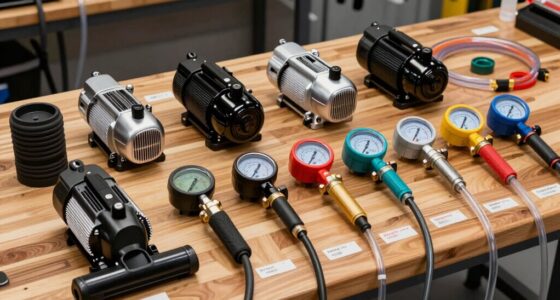

For most DIY gear-oil changes, I’d start with the Slippery Pete 30cc Fluid Pump: its bottle-mounted design is a straightforward match for quart or gallon containers. The 30cc Hand Oil Transfer Pump offers a similar manual approach, while the KAERKA 3L Transmission Fluid Pump suits jobs where a hose and separate reservoir are more useful. The main tradeoff is between simple, compact pumps and higher-capacity setups that take more room or require power; bottle compatibility and hose access matter just as much as stroke volume. One product in this lineup is gear oil in a pouch, not a pump, so it serves a different role. Read on for the full comparison and guidance on choosing a setup for your fill port.

Get business pricing on garage and car supplies
- Business-only prices and quantity discounts
- Tax-exempt purchasing
- Multiple users, one account, clear invoices
Complete the kit


Key Takeaways
- Bottle-mounted manual pumps lead this lineup for routine DIY use: the two 30cc options attach to gallon or wide-mouth quart bottles, avoiding a separate reservoir.
- The Slippery Pete and the generic 30cc pump are close alternatives, not different pump styles: compare their included fittings and bottle compatibility rather than expecting a major difference in pumping approach.
- The KAERKA’s 3L reservoir and 59-inch hose answer a different problem: it can help when a bottle-mounted pump’s reach or container arrangement is inconvenient.
- The two 12V, 100W pumps trade hand pumping for powered operation: they may suit buyers who value motorized transfer, but buyers should verify fluid compatibility and fill-port fit before choosing one for gear oil.
- The Valvoline FlexFill pouch is not a pump: its 75W-90 gear oil may be useful as the fluid source, but transferring it still requires a suitable method.
| 30cc Hand Oil Transfer Pump for Gallon and Wide-Mouth Quart Bottles |  | Best for Precise Manual Filling | Fluid capacity per stroke: 30cc | Compatible bottles: Gallon bottles and wide-mouth quart bottles | Tube length: 24 inches | VIEW ON AMAZON | See Our Full Breakdown |
| Slippery Pete 30cc Fluid Pump for Gallon and Wide-Mouth Quart Bottles |  | Best for Multi-Bottle Compatibility | Brand: Slippery Pete | Model: 573034 | Dispense per stroke: 1 ounce (30cc) | VIEW ON AMAZON | See Our Full Breakdown |
| 12V 100W Oil Transfer Pump Set for Cars, Trucks, Boats, and More |  | Best Powered Transfer Option | Power: 100W | Power source: 12V | Flow rate: 1–4 liters per minute | VIEW ON AMAZON | See Our Full Breakdown |
| Oil Extractor Pump 12V 100W for Engine Oil and Fluids |  | Best for Extended Powered Jobs | Voltage: 12V DC | Power: 100W | Flow rate: 1–4.2 quarts per minute | VIEW ON AMAZON | See Our Full Breakdown |
| Aosdc Fluid Transfer Pumps for Standard Quart Bottles, 2-Pack, 28 mm, 8 cc per Stroke, with Adapter |  | Best for Standard Quart Bottles | Brand: Aosdc | Quantity: 2 pumps | Bottle cap size: 28 mm | VIEW ON AMAZON | See Our Full Breakdown |
| KAERKA 3L Transmission Fluid Pump with 59-Inch Hose |  | Best for Multi-Fluid Vehicle Maintenance | Brand: KAERKA | Capacity: 3 L | Hose length: 59 in (150 cm) | VIEW ON AMAZON | See Our Full Breakdown |
| Valvoline FlexFill Advanced Full Synthetic 75W-90 Gear Oil, 1 Quart Pouch |  | Best for Direct-Fill Convenience | Viscosity: 75W-90 | Package size: 1 quart | Type: Full synthetic gear oil | VIEW ON AMAZON | See Our Full Breakdown |
More Details on Our Top Picks
30cc Hand Oil Transfer Pump for Gallon and Wide-Mouth Quart Bottles
For filling a differential through a tight access point, this hand pump offers a useful balance of measured dispensing and reach. Its 30cc per stroke gives you more control over each addition than the Aosdc pump, which moves just 8cc per stroke, while the 24-inch flexible tube can reach around nearby components. Multiple bottle threads support several listed fluid brands and bottle formats, so you may be able to pump directly from a compatible container rather than decanting first. The tradeoff is hands-on work: unlike the 12V 100W pumps in this lineup, it needs repeated manual strokes and won’t suit anyone trying to move a larger volume quickly. Check your bottle opening before buying, since compatibility is not universal. It makes the most sense for occasional gear-oil service where control matters more than speed.
Pros:- Dispenses a measured 30cc per stroke for controlled filling
- Works with compatible gallon and wide-mouth quart bottles
- 24-inch flexible tubing helps reach tight fill openings
- Multiple thread options support several listed fluid brands
Cons:- Manual pumping takes time and effort over larger fills
- Bottle compatibility depends on matching the threads and opening
Best for: DIY vehicle owners who fill differentials occasionally from compatible gallon or wide-mouth quart bottles and want controlled manual dispensing.
Not ideal for: Drivers with standard quart bottles or anyone moving larger volumes who wants powered transfer rather than repeated hand pumping.
- Fluid capacity per stroke:30cc
- Compatible bottles:Gallon bottles and wide-mouth quart bottles
- Tube length:24 inches
- Thread compatibility:Multiple; includes compatibility with Red Line, AGL, Toyota ATM, Amsoil, and Castrol Edge
- Operation:Manual hand pump
- Listed fluid uses:Gear oil, transmission fluid, and antifreeze
Our verdict“Choose this pump for measured, occasional gear-oil fills when your bottle is compatible and manual operation is acceptable.”
Slippery Pete 30cc Fluid Pump for Gallon and Wide-Mouth Quart Bottles
The Slippery Pete is a strong fit for gear-oil jobs where the bottle varies from one service to the next. It pairs four thread adapters with three suction tubes, giving it more specified setup options than the 30cc Hand Oil Transfer Pump, whose listing describes multiple threads but does not detail the suction-tube selection. Each stroke dispenses 30cc, a practical middle ground between controlled hand filling and the powered transfer offered by the 12V pumps. Its 24-inch hose also helps reach recessed fill ports. The main limitation is easy to miss: it fits gallon and wide-mouth quart bottles, but not standard quart bottles. It still requires repeated manual pumping, so it is better for routine top-ups and moderate fills than fast, high-volume work.
Pros:- Four thread adapters accommodate different compatible bottle openings
- Three suction tubes offer options for different bottle heights
- Moves 30cc per stroke for measured manual dispensing
- 24-inch fill tube helps reach awkward fill ports
Cons:- Does not fit standard quart bottles
- Repeated hand pumping is slow for larger fluid transfers
Best for: Home mechanics who use gallon or wide-mouth quart fluid containers and want several adapter and suction-tube options in one manual kit.
Not ideal for: Buyers who primarily use standard quart bottles or want an electric pump for faster, less hands-on transfer.
- Brand:Slippery Pete
- Model:573034
- Dispense per stroke:1 ounce (30cc)
- Fill tube length:24 inches
- Suction tubes:3
- Thread adapters:4 sizes
- Bottle compatibility:Gallon and wide-mouth quart bottles; not standard quart bottles
- Item weight:4.4 ounces
Our verdict“Pick the Slippery Pete if you need a configurable manual pump for gallon or wide-mouth quart bottles, but skip it for standard quart containers.”
12V 100W Oil Transfer Pump Set for Cars, Trucks, Boats, and More
If you prefer motorized transfer to repeated hand strokes, this set brings a 12V, 100W motor and a stated flow range of 1–4 liters per minute. That makes it a different kind of tool from the Slippery Pete and 30cc Hand Oil Transfer Pump: those manual pumps give you stroke-by-stroke control, while this one is aimed at moving fluid with less ongoing effort. The 1.5-meter inlet and outlet tubes provide room to position the pump around a vehicle or boat, and its compact format supports portable use. For 75W-90, viscosity and temperature can affect real flow, so the stated range should not be treated as a guaranteed rate for cold gear oil. It also needs a 12V source and may be less suited to large jobs than its powered design suggests.
Pros:- 12V 100W motor reduces repeated manual pumping
- Stated flow range is 1–4 liters per minute
- 1.5-meter inlet and outlet tubes allow flexible placement
- Compact design is suited to portable automotive and marine tasks
Cons:- Requires a 12V power source and does not plug into a household outlet
- Flow can be slow for larger jobs and varies with fluid conditions
- Motorized transfer offers less stroke-by-stroke control than the manual 30cc pumps
Best for: Vehicle, truck, or boat owners with a suitable 12V power source who want powered fluid transfer for occasional maintenance.
Not ideal for: People without a 12V supply, or buyers who need precise small-volume control or dependable fast flow with cold, thick 75W-90.
- Power:100W
- Power source:12V
- Flow rate:1–4 liters per minute
- Inlet and outlet tube length:1.5 meters
- Cord length:1.4 meters
- Dimensions:11.8 × 9.4 × 4.1 inches
- Warranty:1 year
Our verdict“Choose this set for powered, portable transfer when you have 12V available and can accept flow variation with thick gear oil.”
Oil Extractor Pump 12V 100W for Engine Oil and Fluids
Among the powered choices here, this extractor is the more job-focused option: it is listed for thick oils including gear oil and supports operation for up to 60 minutes. That stated run time gives it an advantage over the other 12V 100W set for longer sessions, while the included carry case makes storage and transport more orderly. Its reported flow range—1–4.2 quarts per minute—is stated in different units from the other pump’s liters-per-minute figure, so I would compare the products by their intended use rather than assume a direct speed advantage. Neither electric pump matches the small-dose control of the Slippery Pete. Flow also varies with oil viscosity and temperature, making cold 75W-90 a possible bottleneck. This pick makes more sense for extended fluid work than for occasional, precisely measured filling.
Pros:- Listed for thick fluids including gear oil and transmission fluid
- Supports operation for up to 60 minutes
- Includes a carry case for storage and transport
- 12V DC, 100W design provides powered transfer
Cons:- Flow rate varies with oil viscosity and temperature
- Not suitable for gasoline or water
- Needs a 12V DC power source and is less suited to precise small doses than a manual pump
Best for: DIY mechanics who have a 12V DC source and expect longer automotive fluid-transfer sessions involving gear oil or other listed thick fluids.
Not ideal for: Occasional users who need only a small, controlled fill, or anyone transferring gasoline or water.
- Voltage:12V DC
- Power:100W
- Flow rate:1–4.2 quarts per minute
- Maximum supported operation:Up to 60 minutes
- Included storage:Carry case
- Listed compatible fluids:Engine oil, gear oil, transmission fluid, and diesel fuel
- Not suitable for:Gasoline or water
Our verdict“Choose this extractor for longer powered jobs with compatible automotive fluids, not for small fills or gasoline and water transfer.”
Aosdc Fluid Transfer Pumps for Standard Quart Bottles, 2-Pack, 28 mm, 8 cc per Stroke, with Adapter
Standard quart bottles are the defining reason to choose this two-pack. Unlike the Slippery Pete, which explicitly does not fit standard quart bottles, the Aosdc pumps are made for 28 mm caps and include an adapter that helps hold the fill tube in place. That can make a simple differential top-up less fiddly, and two pumps let you keep separate tools for different fluids or have a spare. The compromise is output: at 8cc per stroke, it moves much less per pump than the 30cc hand pumps, so filling a larger volume takes more strokes. Its short, 7-inch body is compact, but the supplied details do not give a long hose measurement, so buyers with deeply recessed fill ports should check whether the tube will reach their setup. Choose it for bottle fit, not speed.
Pros:- Designed for standard quart bottles with 28 mm caps
- Two pumps provide a spare or allow separate fluid-use assignments
- Butterfly adapter helps hold the fill tube during pumping
- Listed for gear oil, transmission fluid, engine oil, and other fluids
Cons:- 8cc per stroke means substantially more pumping than with the 30cc options
- The supplied specifications do not state a tube length for judging reach
Best for: DIYers who buy gear oil in standard quart bottles with 28 mm caps and value a two-pump set for occasional small fills.
Not ideal for: Anyone filling larger volumes or reaching a distant, recessed port who would benefit from higher output per stroke or a specified long hose.
- Brand:Aosdc
- Quantity:2 pumps
- Bottle cap size:28 mm
- Capacity per stroke:8cc
- Adapter:Butterfly third-hand adapter
- Item weight:3.84 ounces
- Product dimensions:7 × 1.18 × 1.18 inches
- Listed fluid uses:Gear oil, transmission fluid, and engine oil
Our verdict“Pick this two-pack when standard 28 mm quart-bottle fit matters more than fast transfer or high output per stroke.”
KAERKA 3L Transmission Fluid Pump with 59-Inch Hose
The KAERKA suits buyers who want one pump for repeated automotive fluid jobs, including filling a differential with 75W-90 gear oil. Its 3 L reservoir holds more than a quart-bottle pump, while the 59-inch flexible TPU hose gives extra reach to awkward fill ports. A brass ball valve and included universal filler tube add control and fit flexibility. Compared with the 30cc Hand Oil Transfer Pump, this is a larger, more adaptable setup rather than a simple bottle-mounted hand pump. The tradeoff is manual effort: moving fluid takes pumping, and the larger reservoir is less convenient for a single small top-up. It makes most sense for home mechanics who service several vehicles or handle multiple fluid types, not buyers seeking a compact, quick one-use tool.
Pros:- Works with gear oil, differential fluid, ATF, and other automotive fluids.
- 59-inch flexible TPU hose reaches fill ports that are awkward to access.
- 3 L capacity reduces the need for frequent refills during larger jobs.
- Includes a universal filler tube, brass ball valve, sealing tape, and gloves.
Cons:- Manual pumping requires effort during fluid transfer.
- Its larger reservoir is less convenient than quart-bottle pumps for small jobs.
- Designed for automotive maintenance rather than general-purpose liquid transfer.
Best for: Home mechanics who regularly fill differentials or transmissions across multiple vehicles and want a reusable pump with a long hose.
Not ideal for: Drivers doing a single small gear-oil top-up who prefer a compact bottle-mounted pump or want powered fluid transfer.
- Brand:KAERKA
- Capacity:3 L
- Hose length:59 in (150 cm)
- Hose material:TPU
- Reservoir material:PE
- Valve:Brass ball valve
- Item weight:2.5 lb
- Included accessories:Universal filler tube, sealing tape, gloves, and instruction manual
Our verdict“Choose the KAERKA if you want a higher-capacity manual pump for recurring vehicle fluid jobs; choose a bottle-mounted pump for occasional small fills.”
Valvoline FlexFill Advanced Full Synthetic 75W-90 Gear Oil, 1 Quart Pouch
This is the lineup’s gear oil rather than a separate transfer pump, so it suits buyers whose priority is getting 75W-90 into a compatible application with less added equipment. The squeezable one-quart pouch is designed to make filling easier and faster than handling a rigid container, and its stated temperature range runs from -50°F to 300°F. Unlike the KAERKA 3L Transmission Fluid Pump, it does not offer a reusable reservoir, long hose, or a way to transfer other fluids; the package itself is the dispensing method. That can simplify a one-quart job, but access and squeezing effort may still be issues at a cramped fill port or during a larger fill. Check the vehicle’s fluid specification before buying: the listed applications include manual transmissions, limited-slip use, and towing, but the product may not suit every system or older gear design.
Pros:- Squeezable pouch is designed to simplify dispensing compared with a rigid container.
- Full synthetic 75W-90 formulation is specified for manual transmissions, limited-slip use, and towing.
- Listed operating temperature range spans -50°F to 300°F.
- One-quart package can suit a modest fill without a separate transfer pump.
Cons:- It is gear oil, not reusable transfer equipment.
- One-quart package may be insufficient for larger service jobs.
- Application and additive compatibility must be checked against the vehicle’s specifications.
Best for: Owners whose vehicle calls for compatible 75W-90 gear oil and who want a one-quart package designed for direct, easier filling.
Not ideal for: Mechanics who need a reusable pump for multiple fluid types, a long reach hose, or a larger-volume fill.
- Viscosity:75W-90
- Package size:1 quart
- Type:Full synthetic gear oil
- Temperature range:-50°F to 300°F
- Applications:Manual transmissions, limited slip, and towing
- Package format:Squeezable FlexFill pouch
Our verdict“Pick the Valvoline pouch when your vehicle specifies this 75W-90 formulation and direct dispensing suits the fill; choose the KAERKA when you need reusable transfer equipment.”

How We Picked
I ranked these options by how directly their design suits a 75W-90 gear-oil change: container fit, practical hose access, control while filling, and the amount of setup needed. For thick gear oil, a pump’s stated output alone does not tell the whole story; a narrow hose, awkward bottle orientation, or incompatible opening can make a nominally capable pump inconvenient. I also separated products that are pumps from the Valvoline oil pouch, since the pouch supplies fluid but does not perform the transfer.
The Slippery Pete 30cc pump ranks first as a familiar bottle-mounted manual format with stated compatibility for gallon and wide-mouth quart bottles. The other 30cc pump offers a similar value-focused alternative; KAERKA ranks well for buyers who need its reservoir-and-hose arrangement, while the 12V units make more sense when powered operation is a priority and their intended-fluid fit is confirmed. The compact 8cc-per-stroke two-pack ranks for smaller bottle openings and controlled dispensing, not speed. I treated each product’s stated specifications as the basis for comparison and did not assume unlisted gear-oil compatibility or performance.
Factors to Consider When Choosing Transfer Pump For 75w 90 Gear Oil
Choosing a transfer pump for 75W-90 is less about chasing the largest output figure and more about matching the pump to the container, vehicle opening, and job. I’d check these points before buying, especially when the listing does not explicitly confirm compatibility with gear oil.
Match the pump to the gear-oil container
Start with the package your oil comes in, not just the pump’s advertised capacity. Bottle-mounted pumps can be convenient when their threads or opening dimensions match your quart or gallon container, but a pump described for a wide-mouth quart may not fit every bottle. A separate-reservoir model avoids some bottle-thread issues, though it adds a container that needs filling and cleaning. Check the neck, cap, and adapter dimensions before ordering, and don’t assume a general-purpose label means universal fit. A mismatch can leave you decanting oil into another vessel, adding mess rather than saving time.
Prioritize hose reach and fill-port access
Vehicle layout can matter more than pump style: a fill port may sit behind a wheel, above a crossmember, or at an angle that limits hand movement. Measure the path from where the bottle or reservoir can sit to the fill opening, allowing slack for bends. A longer hose can improve access, but it may also be harder to control and store. Check the hose’s outside diameter as well as its length; it needs to reach the opening without forcing or wedging it in place. If the port is cramped, a smaller hose or adapter may be more useful than a larger pump.
Treat stroke volume as only one part of speed
A stated output per stroke helps compare manual pumps, but it does not predict the time needed to move thick gear oil by itself. Hose length, internal diameter, temperature, and the pump’s design all affect how easily fluid moves. Smaller strokes can give you more control near a fill-port limit, while a higher-volume stroke can reduce repeated pumping when the setup flows freely. Powered pumps remove repeated hand strokes, but the listing should identify suitable fluids and operating limits before you use one with 75W-90. If a specification is missing, contact the manufacturer rather than treating “oil transfer” as proof of compatibility.
Choose manual or powered operation for the job you actually do
For occasional differential or gearbox service, a manual pump keeps the setup simple and avoids a power connection. A 12V unit may be attractive for repeated transfers or a workflow where powered operation matters, but it brings additional setup and compatibility checks. Think about where the vehicle will be parked, whether a suitable power source is available, and how you will control flow at the fill port. Don’t buy a powered model solely because its wattage sounds substantial; wattage does not confirm suitability for gear oil. For one-off maintenance, simplicity can outweigh motorized operation.
Plan for cleanup, storage, and cross-contamination
Gear oil can leave residue in a hose, pump head, or reservoir, so decide how you will store the equipment between jobs. A pump dedicated to gear oil reduces the chance of mixing residue from other fluids, especially if the same tool might otherwise be used for engine oil or coolant. Check whether the hose or reservoir can be drained and whether replacement tubing or seals are available. Avoid returning transferred oil to its original container once it has passed through used equipment. If you service several fluid types, labeling separate pumps is a simple way to prevent mistakes.
Know when a pouch or adapter is part of the solution
A container designed for flexible dispensing may make pouring easier, but it is not automatically a pump and may not reach a recessed fill port. The Valvoline pouch in this roundup is a source of 75W-90, so you still need a transfer method if gravity pouring will not work. Adapters can bridge a gap between a bottle neck and pump, yet an adapter only helps when its dimensions and seal match. Before buying extra fittings, identify the opening size and the shape of the fill port. Paying for a more elaborate setup makes sense when it solves a measured access problem, not just because it includes more parts.
Frequently Asked Questions
Can I use any oil transfer pump with 75W-90 gear oil?
No. A general oil-transfer description does not confirm that a pump’s seals, tubing, or operating method suit 75W-90 gear oil. Check the manufacturer’s stated fluid compatibility and any temperature or viscosity limits before use. If the product information does not name gear oil or provide a relevant viscosity range, ask the manufacturer rather than guessing. Also verify that the hose fits the vehicle’s fill port without forcing it.
Is a bottle-mounted pump or a separate-reservoir pump better for a differential fill?
It depends on the container and the vehicle’s access. A bottle-mounted pump keeps the oil source and pump together, which can make a routine fill simpler if the bottle fits the pump and can be positioned near the opening. A separate reservoir and longer hose may help when the fill port is awkwardly placed or the bottle cannot sit where you need it. The reservoir adds transfer and cleanup steps, so it is not automatically the easier option. Measure the working space and hose route before choosing.
Will a 12V, 100W transfer pump necessarily move 75W-90 gear oil?
No; voltage and wattage describe electrical requirements and power, not confirmed fluid compatibility. A pump’s materials, design, and stated viscosity range determine whether it is appropriate for a particular oil. Gear oil flow can also vary with temperature, hose dimensions, and the route to the fill port. Check the manufacturer’s instructions for approved fluids before using a powered pump with 75W-90. If those instructions are unclear, choose a model with explicit guidance or contact the manufacturer.
How do I avoid overfilling when using a transfer pump?
Follow the vehicle maker’s fill procedure, since the correct level can depend on vehicle position and the specified inspection method. Use a controlled pumping pace and pause to check the level rather than assuming a set number of strokes equals the right amount. Keep the vehicle level if the service procedure calls for it, and stop when the specified level or flow condition is reached. A smaller per-stroke pump can offer finer control, though it may take more strokes. Don’t rely on the bottle’s remaining volume as a substitute for checking the fill point.
Can I use the Valvoline FlexFill pouch without buying a pump?
Possibly, if the pouch can be positioned to dispense into your vehicle’s fill opening without spilling or stretching the opening. The pouch is gear oil, not a pump, and a recessed or angled port may make direct dispensing impractical. Check the vehicle’s access and the pouch’s dispensing design before relying on it alone. A compatible pump or dispensing adapter may still be needed to reach the opening cleanly. Keep the transfer method separate from the question of whether the oil itself meets your vehicle’s specification.
Conclusion
For a typical DIY gear-oil change, my best overall pick is the Slippery Pete 30cc pump because its bottle-mounted format fits a common quart-or-gallon workflow. The best value alternative is the similarly sized 30cc hand pump, especially when its included fittings match your oil container. For beginners, I’d favor either manual 30cc option over a powered setup because the process is simpler to understand and does not require a power source. The best pick for reach and a separate reservoir is the KAERKA, while the 12V units are for buyers who specifically want powered transfer and can confirm gear-oil compatibility. If you need the oil itself rather than a pump, the Valvoline pouch serves that purpose; it does not replace a transfer tool.