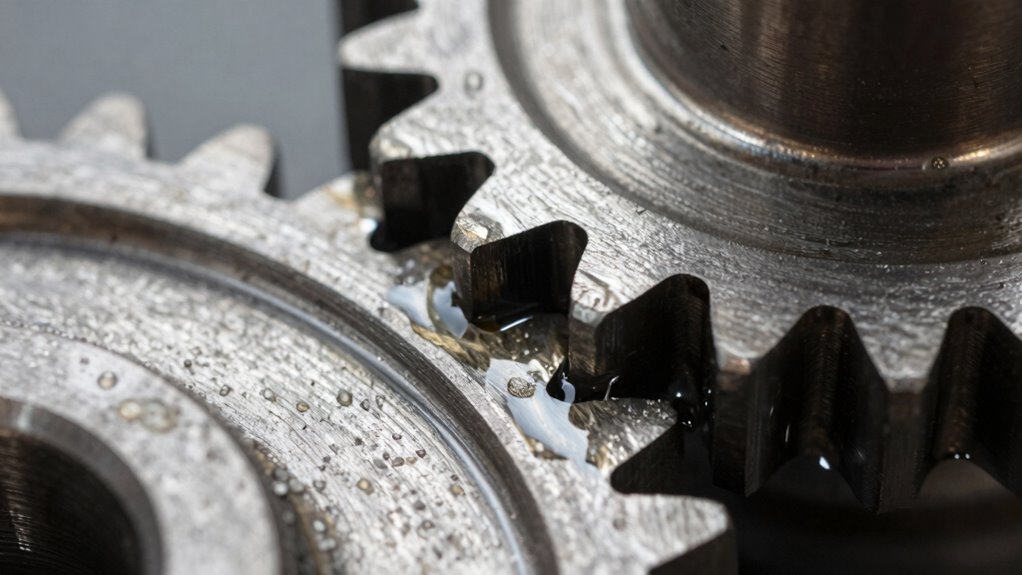

When oil films are too thin to keep parts floating, boundary lubrication takes over. In this state, molecular interactions between additive molecules and surfaces become essential. These additives form protective layers that prevent direct metal contact, reducing friction and wear. Since fluid films can’t cushion the surfaces, the stability and chemistry of these thin boundary films determine how well the machinery performs under high pressure. Understanding how these molecules work can help you keep equipment running smoothly even in challenging conditions.

Get business pricing on garage and car supplies
- Business-only prices and quantity discounts
- Tax-exempt purchasing
- Multiple users, one account, clear invoices
Key Takeaways
- Boundary lubrication occurs when lubricant layers are only a few molecules thick, preventing full separation of contact surfaces.
- Additive molecules adsorb onto surfaces, forming protective layers that minimize direct metal-to-metal contact.
- Molecular interactions, such as bonding and alignment of additives, are crucial for maintaining low friction under thin film conditions.
- Proper boundary films reduce wear and extend machinery lifespan when oil films cannot fully separate parts.
- The effectiveness of boundary lubrication relies on stable, resilient molecular layers that operate under high pressure and limited lubrication.
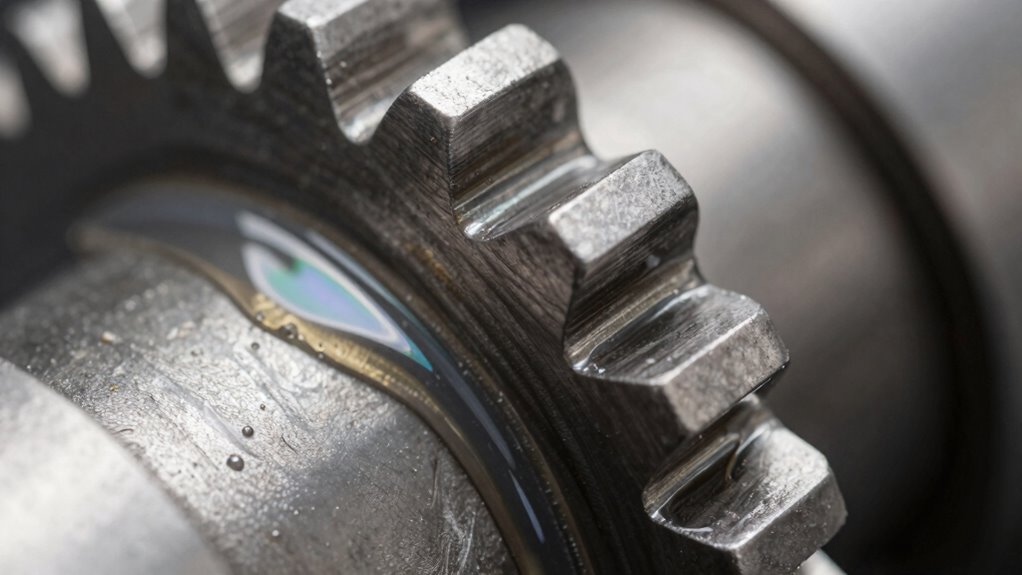
Have you ever wondered how two surfaces glide smoothly against each other under high pressure, even when there’s minimal lubrication? It’s a fascinating process that hinges on more than just a thick oil film. When the lubricant layer becomes extremely thin—sometimes just a few molecules thick—traditional hydrodynamic lubrication no longer applies. Instead, boundary lubrication takes over, where the surfaces are in such close contact that molecular interactions become the main factor determining how smoothly they move past each other. This regime is vital in many machinery applications where high loads and limited lubrication make a full fluid film impossible.
Boundary lubrication involves molecular interactions that enable surfaces to slide smoothly under high pressure with minimal lubricant.
In boundary lubrication, the key players are the molecules of additives in the lubricant. These additives are specially designed to adsorb onto the surfaces, forming a protective layer that minimizes direct metal-to-metal contact. Their performance depends heavily on molecular interactions—how well they bond, align, and form stable films on the surfaces. When optimized, they reduce friction and wear markedly, even under extreme conditions. You can think of additive performance as the lubricant’s ability to adapt to the surface conditions, creating a thin, resilient barrier that prevents metal surfaces from grinding against each other.
The effectiveness of additive molecules isn’t just about their presence but how they behave at a molecular level. They must adsorb strongly enough to stay put under high pressure but not so strongly that they become brittle or break apart. When these molecules properly interact with the surface, they arrange themselves into ordered layers, effectively reducing direct contact between the parts. This is why additive chemistry is vital—different additives have different molecular structures tailored for specific conditions, whether it’s extreme pressure, temperature, or surface roughness. Furthermore, the stability of these boundary films depends on the molecular interactions between additives and surfaces, which are essential for maintaining low friction and wear resistance over time.
Your understanding of boundary lubrication also benefits from recognizing how additive performance influences overall system reliability. Well-designed additives create a stable boundary film, allowing components to operate smoothly despite thin oil layers. This reduces wear and prolongs equipment lifespan. When additives perform optimally, they also improve energy efficiency by lowering friction—saving fuel and reducing operational costs.
In essence, boundary lubrication isn’t just about the thinness of the oil film but about the molecular interactions between additives and surfaces. Their ability to form and maintain protective, low-friction layers under challenging conditions is what keeps machines running smoothly when conventional lubrication fails. So, next time you see machinery operating under high loads with minimal lubrication, remember that sophisticated molecular interactions and additive performance are quietly working behind the scenes to keep everything moving seamlessly.
Products Worth Considering

DEWALT 20V MAX XR Impact Driver, 1/4 Inch High Torque Brushless 3-Speed Cordless with LED Light, Extended Runtime (DCF845B)

DEWALT 20V MAX Drill and Impact Driver Combo Kit (DCK240C2)

Milwaukee M18 FUEL 18V Lithium-Ion Brushless Cordless 1 in. Impact Wrench Extended Reach D-Handle Kit with Two 12.0 Ah Batteries
As an affiliate, we earn on qualifying purchases.
Frequently Asked Questions
How Does Temperature Affect Boundary Lubrication Performance?
Temperature effects substantially impact boundary lubrication performance. As temperature rises, oil viscosity decreases, making it thinner and less able to form a protective film. This can lead to increased metal-to-metal contact and wear. Conversely, lower temperatures increase viscosity, which can cause thicker films that might hinder movement. You should monitor temperature changes carefully to guarantee ideal lubrication conditions, preventing damage due to too thin or too thick oil films.
What Are Common Signs of Boundary Lubrication Failure?
You’ll notice signs like increased friction and unusual wear patterns, which indicate boundary lubrication failure. These issues cause equipment to run noisier, overheat, or operate less smoothly. You might also see metal particles in the lubricant or surface scoring on components. Addressing these signs promptly helps prevent costly damage. Regular maintenance and monitoring ensure the lubrication remains effective, reducing friction rise and wear that signal boundary lubrication problems.
Can Boundary Lubrication Be Used in High-Speed Applications?
While boundary lubrication can sometimes handle high-speed challenges, it’s generally not ideal for such applications due to lubrication limits. High speeds tend to push oil films thin, risking metal contact and wear. You might find better success with hydrodynamic or elastohydrodynamic lubrication methods that form thicker, more reliable films. Relying solely on boundary lubrication at high speeds could lead to faster wear and potential equipment issues.
How Do Additives Improve Boundary Film Stability?
Additives improve boundary film stability through additive chemistry that enhances film reinforcement. They form protective layers, reducing metal-to-metal contact and minimizing wear. For example, anti-wear and extreme pressure additives create a stronger boundary film, even under high stress. This results in better film stability, preventing metal degradation and extending equipment life. You’ll notice smoother operation and less maintenance needed, as additives help maintain a consistent, durable boundary film.
What Materials Are Best Suited for Boundary Lubrication?
You’ll find that materials like hardened steel, ceramics, and composites work best for boundary lubrication because they offer excellent material compatibility and resist surface roughness. These materials withstand pressure and friction, reducing wear when oil films are too thin. Choosing the right pairings guarantees smoother operation, minimizes damage, and extends equipment life—highlighting how material properties and surface conditions work together in boundary lubrication.
Conclusion
In boundary lubrication, oil films act like delicate threads holding parts together, preventing direct metal contact. When these films become too thin, wear and damage strike like lightning, risking your equipment’s life. By understanding and controlling boundary conditions, you keep your machinery running smoothly, like a well-oiled machine. Remember, the thin line between protection and destruction is just a nanometer thick—so pay close attention, or you might find yourself caught in a storm of costly repairs.