
TL;DR

Get business pricing on garage and car supplies
- Business-only prices and quantity discounts
- Tax-exempt purchasing
- Multiple users, one account, clear invoices
A report by Avery Dennison authors Max VanRaaphorst and Avery Dennison outlines a pressure-sensitive adhesive tape strategy for battery-pack thermal management. It describes approaches to heat transfer, cell-to-cell barriers and venting, but the supplied material does not establish independent performance results or confirm adoption by battery makers.
Avery Dennison authors Max VanRaaphorst and Avery Dennison have outlined a three-part pressure-sensitive adhesive (PSA) tape strategy for battery-pack thermal management in a report published by Charged EVs. The approach addresses heat transfer, barriers between cells and the management of gases and flames during cell failure; the supplied report describes proposed applications and product capabilities, not independently verified safety outcomes.
The report frames the challenge around battery packs becoming denser and more demanding as manufacturers pursue higher energy density and faster charging. Those design pressures make it harder to add thermal-management materials while keeping packs lightweight, electrically insulated and suitable for production. The authors say thermal runaway in one cell can threaten neighboring cells if heat, flames and vented material are not controlled.
Its first proposed use for PSA tape is to connect cells or modules thermally to cooling components, such as cold plates or cooling fins, while maintaining electrical insulation. The report says thin film-based dielectric tapes can provide the required breakdown voltage at less thickness than the thermosetting powder coatings it discusses. It gives an example of 85-micrometer tape versus 250-micrometer coating and estimates about a 66% reduction in conductive thermal resistance, assuming comparable thermal conductivity. The authors say this could allow heat to move nearly three times faster; those figures are claims in the report and depend on the stated assumptions.
The second part is to laminate or encapsulate materials such as mica, aerogel or ceramic paper with low-thermal-conductivity PSA tape. The authors say this could create a mechanically stronger barrier that slows heat transfer between cells, while specialized release liners could help automated assembly avoid damaging fragile materials. The third part concerns venting: the report names Avery Dennison anisotropic venting tapes as an approach for directing gases and flames during cell failure. The supplied source text ends before explaining how those tapes are positioned or providing performance data.
Three Functions in One Pack
The proposal matters because battery designers must manage competing safety and engineering needs: moving heat away from cells during normal operation, electrically isolating high-voltage components, and limiting the spread of a failure. Materials that add bulk or are difficult to handle can complicate pack design and automated manufacturing. The report presents PSA tape as a thin, customizable material that can be die-cut and applied by hand or machine.
If the described materials perform as claimed in a given pack design, they could give engineers another way to combine bonding, insulation and thermal-management functions without relying on a single thick coating or a loose barrier. But the report does not establish that tapes alone can prevent thermal runaway or contain every failure. Pack safety depends on the cell design, cooling system, pack structure, sensors and controls, and validation under relevant failure conditions.
pressure sensitive adhesive tape for battery cooling
As an affiliate, we earn on qualifying purchases.
As an affiliate, we earn on qualifying purchases.
Why Battery Packs Need Barriers
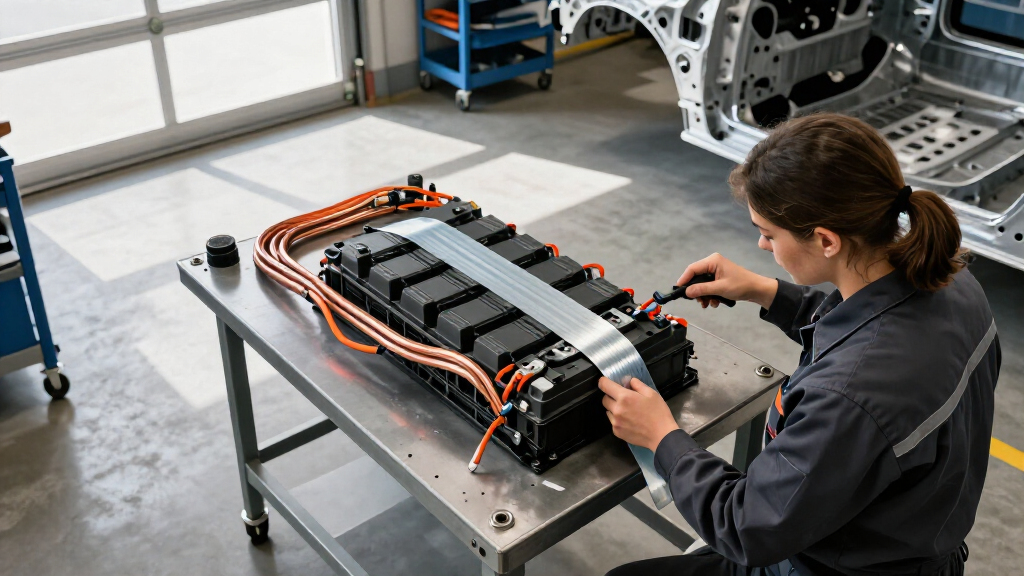
The report places tape applications within existing battery-pack assembly needs, including cell connections, wrapping, gasketing, sealing, insulation and wire management. PSA tape uses an adhesive designed to bond under pressure without a separate curing step, according to the authors. The material can also be combined with films or barrier sheets and shaped to fit specific pack layouts.
Three technical problems organize the report. First, heat must pass from cells to cooling hardware without compromising dielectric strength. Second, compact pack layouts leave little room to separate cells when one overheats. Third, failed cells can vent hot gases, flames and particulates, creating pressure and exposing neighboring cells. The authors say mica and similar materials can act as insulators but may be fragile and harder to integrate into automated production.
“A comprehensive PSA-tape-based strategy for thermal runaway prevention and mitigation in battery packs”
— Max VanRaaphorst and Avery Dennison, report authors
thermal management PSA tape for batteries
As an affiliate, we earn on qualifying purchases.
As an affiliate, we earn on qualifying purchases.
Performance Evidence Still Missing
The provided report material does not include independent test results, named battery-pack customer deployments, certification details or a comparison across full-pack failure scenarios. It also does not specify the conditions behind the reported heat-transfer figures beyond the assumption of comparable thermal conductivity. The claims should be read as the authors’ technical estimates, not as proof that a particular pack will avoid or contain thermal runaway.
The source excerpt cuts off during its explanation of anisotropic venting tapes. It therefore does not clarify their construction, how they direct vented gases, what operating limits apply or how their performance was measured. The report also does not identify which tape configuration, if any, is intended for a specific vehicle or battery chemistry.
As an affiliate, we earn on qualifying purchases.
Validation and Pack Integration
The next practical step for battery makers would be to evaluate the proposed materials within their own pack designs, including testing heat transfer, electrical insulation, mechanical durability and vent behavior. Pack-level safety testing would be needed to assess whether barriers and venting features limit propagation under defined failure conditions and remain effective after exposure to heat, chemicals and mechanical stress.
The supplied material does not announce a product launch, customer program, regulatory decision or testing milestone. Further details about the venting-tape design and evidence supporting the stated performance estimates would help clarify how the approach compares with other thermal-management materials. Until then, the report is best understood as a manufacturer-authored strategy proposal rather than a confirmed change in battery-pack safety practice.
dielectric PSA tape for lithium-ion batteries
As an affiliate, we earn on qualifying purchases.
As an affiliate, we earn on qualifying purchases.
Key Questions
What did the report propose?
It outlined PSA tape uses for heat transfer, cell isolation and vent management in battery packs.
Does the report prove the tapes prevent thermal runaway?
No. The supplied material describes the authors’ proposed applications and performance estimates, but does not provide independent evidence that the approach prevents or contains thermal runaway in full-pack testing.
What is the reported thickness comparison?
The authors compare 85-micrometer dielectric PSA tape with 250-micrometer thermosetting dielectric powder coating. They estimate about 66% lower conductive thermal resistance, assuming comparable thermal conductivity.
How does the proposal address cell failure?
It describes laminating insulating materials such as mica, aerogel or ceramic paper with tape to form barriers, and using anisotropic venting tape to manage gases and flames. Details about the venting design are absent from the supplied excerpt.
Source: rss
Halloween Picks
halloween
As an affiliate, we earn on qualifying purchases.