ACEA families are labels that show what kind of engine oil is best for your vehicle. A/B oils are for most cars with gasoline or light diesel engines, focusing on cleaning and fuel savings. C oils suit newer engines with emission systems, and E oils are made for heavy-duty trucks and equipment, offering stronger protection. Understanding these categories helps you choose the right oil. Keep exploring to discover how to pick the best one for your engine.

Get business pricing on garage and car supplies
- Business-only prices and quantity discounts
- Tax-exempt purchasing
- Multiple users, one account, clear invoices
Key Takeaways
- ACEA classifies motor oils for different engine types and vehicle uses, ensuring engine protection and compliance.
- A/B oils are for passenger cars with gasoline or light diesel engines, focusing on cleaning and fuel efficiency.
- C oils are designed for modern vehicles with emission systems, prioritizing low ash and compatibility with exhaust after-treatment.
- E oils are heavy-duty formulations for trucks and commercial vehicles, offering high protection under demanding conditions.
- Always match the ACEA category to your vehicle’s manual and driving conditions for optimal engine performance.
ACEA A/B engine oil for passenger cars
As an affiliate, we earn on qualifying purchases.
As an affiliate, we earn on qualifying purchases.
What Are ACEA Oil Families and Why Do They Matter?
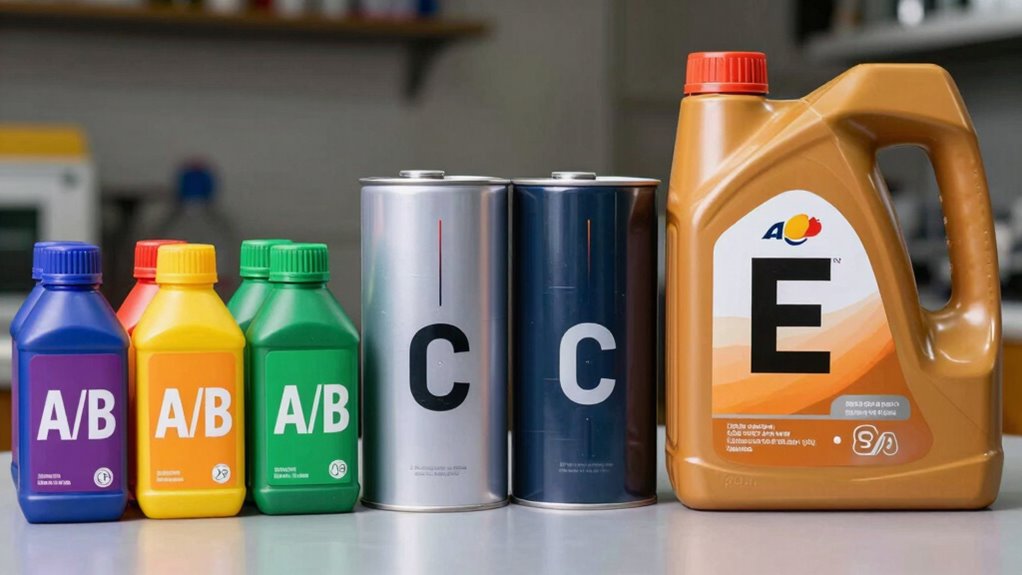
Understanding ACEA oil families is essential because they categorize motor oils based on performance standards set by the European Automobile Manufacturers Association. These families help you identify oils that meet specific quality and durability benchmarks for different vehicle types. Each family groups oils designed for particular engine requirements, whether for gasoline, diesel, or more specialized engines. Recognizing these groups ensures you select the right oil for your vehicle’s needs, promoting excellent performance and longevity. ACEA standards also specify limits for contaminants, wear protection, and fuel efficiency. By understanding the oil families, you can confidently choose products that align with your car’s manufacturer recommendations, helping you maintain engine health and avoid potential issues caused by incompatible oils. Additionally, performance standards help ensure oils are suitable for various driving conditions and engine types.
ACEA C emission system compatible motor oil
As an affiliate, we earn on qualifying purchases.
As an affiliate, we earn on qualifying purchases.
How Do the A/B, C, and E ACEA Classes Differ?

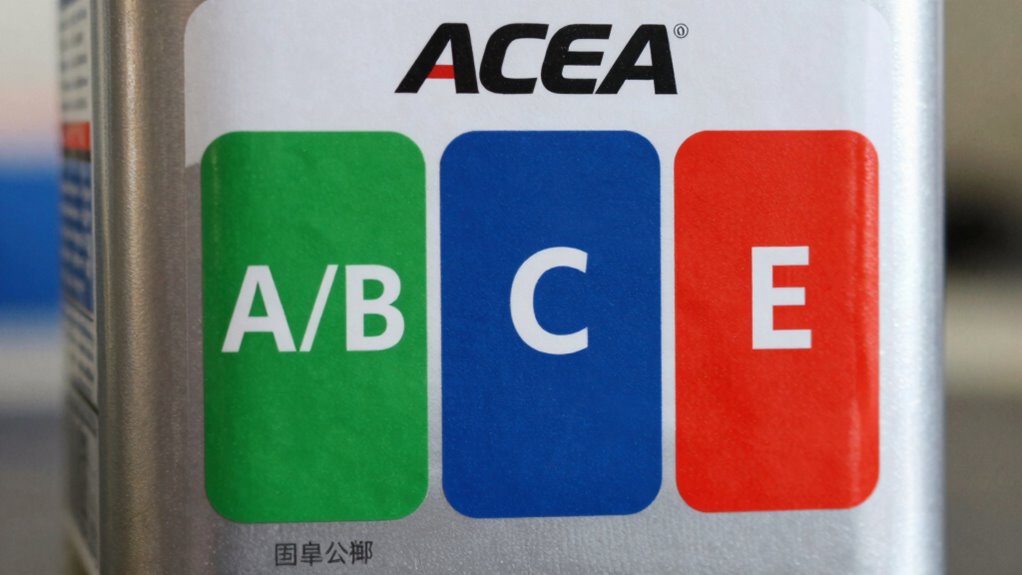
The A/B, C, and E ACEA classes serve different purposes by targeting specific engine types and performance needs. The A/B class is designed for passenger cars and light trucks, focusing on gasoline and diesel engines that operate under typical driving conditions. The C class caters to vehicles with catalytic converters and particulate filters, emphasizing compatibility and low emissions. The E class is intended for heavy-duty applications, such as trucks and commercial vehicles, handling high loads and extended operating hours. Each class has unique specifications for viscosity, additive content, and performance standards. A comprehensive understanding of engine compatibility and usage conditions helps you choose the right oil for your vehicle’s engine type and longevity, ensuring ideal performance and durability.
Heavy-duty truck engine oil ACEA E category
As an affiliate, we earn on qualifying purchases.
As an affiliate, we earn on qualifying purchases.
Which ACEA Family Is Best for Your Car?
Which ACEA Family Is Best for Your Car?
Choosing the right ACEA family for your car depends on your vehicle’s engine type and how you drive. If you have a passenger car with a gasoline or light-duty diesel engine, ACEA A/B oils are typically your best choice. They’re designed for everyday driving and offer good fuel efficiency and engine protection. If you drive a vehicle with a modern, high-performance engine or require lower emission standards, ACEA C oils are suitable, especially for cars with advanced exhaust after-treatment systems. Heavy-duty trucks or commercial vehicles should use ACEA E oils, which are formulated for durability under tough conditions. Always check your owner’s manual for manufacturer recommendations, and choose the ACEA family that aligns with your vehicle’s specifications and your driving habits. Understanding oil classification standards can help you make the best choice for your engine’s needs.
European standard motor oil for diesel engines
As an affiliate, we earn on qualifying purchases.
As an affiliate, we earn on qualifying purchases.
Is ACEA E-Class Oil Right for Heavy-Duty Vehicles?

If you operate heavy-duty vehicles, you need oil that offers strong performance and reliable protection. ACEA E-Class oils are designed to handle tough conditions and keep your engines running smoothly. But, is this oil compatible with your equipment and providing the right level of protection?
Heavy-Duty Performance Benefits
Heavy-duty vehicles demand engine oils that can withstand extreme conditions and deliver reliable performance over long distances. ACEA E-class oils are formulated to meet these demanding needs, offering superior protection against wear, oxidation, and deposit buildup. They help maintain engine cleanliness and ensure smooth operation under high load and temperature. These oils also support fuel efficiency, reducing emissions and operating costs. With enhanced viscosity stability, they protect engine components even during intense use or extended oil change intervals. Additionally, high-performance formulations ensure consistent lubrication even in the most challenging environments. Incorporating regional flavor insights can provide further benefits for specific operating regions. If your heavy-duty fleet faces tough conditions—such as heavy hauling or frequent idling—ACEA E-class oils provide the durability and performance you need. They’re designed to keep engines running efficiently, minimizing downtime and extending equipment lifespan.
Oil Compatibility and Protection
Is ACEA E-Class oil the right choice for your heavy-duty vehicles? If you operate trucks, buses, or construction equipment, this oil offers strong compatibility with your engine needs. E-Class oils are designed specifically for high-performance, heavy-duty applications, providing excellent wear protection and deposit control. They meet rigorous standards to withstand extreme pressures, high temperatures, and heavy loads, helping extend engine life. Plus, they are formulated to protect against sludge buildup and corrosion, ensuring your engine stays clean and efficient. Proper oil selection is vital for maintaining peak performance and avoiding costly repairs. If your vehicle’s manufacturer recommends ACEA E-Class oils, you can trust they’re engineered to offer the compatibility and protection your heavy-duty engine demands. Using the right oil is crucial for ensuring optimal engine performance and longevity in demanding conditions. Additionally, choosing oils with appropriate viscosity ratings can further enhance engine efficiency and durability.
How to Choose the Right ACEA Oil for Your Vehicle

Choosing the right ACEA oil for your vehicle starts with understanding its specific needs and matching them to the appropriate oil classification. First, check your owner’s manual for manufacturer recommendations. Then, consider your driving conditions—city, highway, or heavy-duty use. Once you identify these factors, select an ACEA category that aligns with your needs. For example, ACEA A/B suits gasoline and diesel engines, while ACEA C is for vehicles requiring low SAPS oils, and ACEA E is for heavy-duty diesel applications. Here’s a quick guide:
| Vehicle Type | Recommended ACEA Category |
|---|---|
| Gasoline engines | A/B |
| Diesel engines (light) | A/B or C |
| Vehicles with emissions systems | C |
| Heavy-duty diesel trucks | E |
| Commercial fleets | E |
Additionally, choosing the correct electric bike horsepower can significantly impact your riding experience and performance. Understanding ACEA classifications helps ensure you select the optimal oil for your vehicle’s longevity and efficiency, and being familiar with market volatility can assist in making informed investment decisions related to vehicle maintenance assets.
How Do ACEA Standards Affect Oil Performance and Engine Protection?

ACEA standards guarantee that your oil is compatible with your engine’s requirements, helping prevent damage caused by incompatible formulations. They also set benchmarks for engine wear prevention, keeping your engine running smoothly over time. By choosing oils that meet these standards, you can boost performance and extend your engine’s lifespan. Additionally, selecting certified oils can help you avoid scams and subpar products, ensuring your investment provides reliable protection. Maintaining compliance with these standards is crucial for optimal engine operation and efficiency, especially when considering appliance maintenance plans that support engine and appliance longevity. Ensuring your oil meets ACEA standards can also contribute to sustained engine performance, which is vital for long-term vehicle health. Incorporating engine wear prevention measures, such as using oils that meet ACEA specifications, further enhances your vehicle’s durability and reliability over time.
Oil Compatibility Standards
Understanding oil compatibility standards is essential because they directly influence how well an oil performs and protects your engine. These standards ensure that oils meet specific quality, additive, and performance criteria, making sure they work safely with your vehicle’s materials and design. For example, ACEA standards specify the types of base oils and additives that can be used, ensuring harmony with different engine types and emission systems. Using oils that meet the correct standards prevents issues like corrosion, sludge buildup, or seal deterioration. It also guarantees that the oil will maintain its viscosity and protective qualities throughout its service life. By choosing oils aligned with ACEA compatibility standards, you help ensure your engine stays protected, efficient, and reliable over time.
Engine Wear Prevention
Adhering to oil compatibility standards directly impacts how well your engine is protected against wear. When your oil meets ACEA standards, it’s formulated to prevent metal-to-metal contact, reduce friction, and minimize deposits. Different ACEA categories target specific engine types and driving conditions, ensuring ideal protection. For example:
| ACEA Category | Engine Type | Wear Prevention Focus |
|---|---|---|
| A/B | Gasoline and Diesel | Reduces deposits and wear |
| C | Gasoline, Diesel, Hybrid | Protects after-treatment systems |
| E | Heavy-duty Diesel | Handles extreme loads and wear |
Choosing the right ACEA standard means your engine stays cleaner, runs smoother, and lasts longer. Proper oil selection is key to preventing wear and maintaining performance. Additionally, understanding engine operating conditions can help you select the most suitable oil for your specific needs. Recognizing the importance of AI-driven technology in monitoring engine health can further optimize your vehicle’s longevity and performance.
Myths and Facts About ACEA Oil Classifications

Many people believe that all ACEA oil classifications are the same or that they don’t matter when choosing motor oil, but that’s a misconception. In reality, each classification targets specific engine needs and fuel types. For example, ACEA A/B oils are designed for gasoline engines, focusing on cleaning and wear protection. C oils are compatible with a mix of gasoline and diesel engines, especially those with catalytic converters, ensuring low ash content. E oils are meant for heavy-duty diesel trucks, providing high wear protection and deposit control. Assuming all ACEA oils are interchangeable can harm your engine or reduce its lifespan. Always check your vehicle’s requirements and match them with the correct ACEA classification to ensure maximum performance and protection. Understanding engine specifications can help you make better oil choices. Recognizing the differences in oil classifications ensures optimal engine longevity and efficiency, especially as different engine types have varying lubrication needs. Additionally, choosing the appropriate oil viscosity for your engine can further optimize performance and fuel efficiency. Being aware of lubrication standards can also guide in selecting the most suitable oil for your vehicle’s operating conditions.
How to Match Your Vehicle Type With the Correct ACEA Oil

Choosing the right ACEA oil for your vehicle starts with knowing what type of engine it has and what those classifications mean. If you drive a gasoline engine, look for ACEA A or B categories, which are designed for petrol engines and light-duty diesel engines, respectively. For diesel engines, especially modern ones, ACEA C oils are often recommended because they provide better protection and compatibility with emission systems. Heavy-duty trucks with high-mileage or commercial engines typically require ACEA E oils, optimized for durability and heavy loads. Always check your vehicle’s owner’s manual to see which ACEA class is specified. Matching the right oil ensures peak performance, engine longevity, and compliance with manufacturer standards. Don’t guess—verify your engine type and follow the manufacturer’s recommendations.
Can You Mix Different ACEA Classes? What You Should Know

Mixing different ACEA oil classes is generally not recommended because each class is formulated with specific additive packages and performance standards. Using oils from different classes can lead to incompatible additives, reducing lubrication efficiency and potentially harming your engine. For example, combining a C class oil with an E class oil might dilute the protective qualities each offers, especially under extreme conditions. Even if the oils seem similar, their formulations are tailored for specific engine types and emissions standards. Mixing oils can also affect oil viscosity and performance, leading to increased wear or deposits. To keep your engine running smoothly and avoid unnecessary risks, stick to one ACEA class recommended by your vehicle manufacturer or oil supplier. Always follow the manufacturer’s guidelines for oil compatibility. Understanding ACEA classifications helps ensure you select the right oil for your engine’s needs and maintain optimal engine protection. Being aware of engine oil compatibility is essential to prevent potential damage, especially when considering oil formulation differences.
Final Tips for Picking the Best ACEA Oil for Your Engine

Selecting the right ACEA oil for your engine starts with understanding your vehicle’s specific requirements and the conditions you drive in. Check your owner’s manual for the recommended ACEA category and oil specifications. Consider your climate—if you face extreme cold or heat, choose an oil formulated for those conditions. Look at your driving habits; frequent short trips or heavy towing may require a different oil grade. Always prioritize quality over price to guarantee ideal engine protection and longevity. If unsure, consult your mechanic or the oil manufacturer’s guidelines. Remember, using an oil that matches your engine’s needs helps improve performance, fuel efficiency, and reduces wear and tear. Making an informed choice now saves you from costly repairs later.
Frequently Asked Questions
Can ACEA Classifications Change With New Engine Technologies?
Yes, ACEA classifications can change with new engine technologies. As automotive tech advances, engine requirements evolve, prompting ACEA to update standards to guarantee compatibility and performance. You should stay informed about these updates because they can impact the type of oil you need for your vehicle. Regularly checking for the latest ACEA classifications helps you choose the right engine oil, maintaining your engine’s health and performance.
Are ACEA Standards Recognized Internationally or Only in Europe?
You’ll find that ACEA standards are recognized primarily in Europe, but they also influence global markets. Many international manufacturers adopt these standards to meet European regulations and guarantee quality. While not legally mandatory worldwide, ACEA classifications serve as a reliable benchmark for engine oil performance. So, whether you’re importing or exporting, understanding ACEA standards helps you navigate international automotive requirements, making your choices more informed and compliant across borders.
How Often Should I Change My Oil Based on ACEA Recommendations?
You should change your oil every 10,000 to 15,000 kilometers or roughly every 6 to 12 months, depending on your driving habits and the vehicle’s age. Always follow your vehicle manufacturer’s specific recommendations, which often align with ACEA standards. If you drive under severe conditions like frequent short trips or heavy loads, consider more frequent oil changes to keep your engine running smoothly.
Do OEMS Require Specific ACEA Classes for Warranty Purposes?
Yes, OEMs often require specific ACEA classes for warranty purposes. They want you to use the right oil for your vehicle’s engine, transmission, and emissions system to guarantee peak performance and avoid voiding your warranty. By following their recommended ACEA specifications, you protect your investment, maintain engine health, and keep your warranty valid. Always check your owner’s manual or consult your dealer to confirm the correct oil class for your vehicle.
Are There Differences in Pricing Between Various ACEA Oil Families?
Yes, you’ll notice differences in pricing between various ACEA oil families. Typically, oils in the C and E categories tend to be more expensive due to their advanced formulations and specific performance standards. A/B oils are generally more affordable, offering good quality for everyday use. Your choice depends on your vehicle’s needs and manufacturer recommendations, but expect to pay more for oils with higher standards and specialized features.
Conclusion
Choosing the right ACEA oil is like finding the perfect puzzle piece—fit it right, and your engine runs smoothly. Whether you need A/B for lighter cars, C for versatility, or E for heavy-duty work, understanding these classes helps you make smarter choices. Don’t let confusion cloud your decision; with the right oil, you’re steering your engine toward a long, healthy life. Think of it as giving your car a well-deserved boost!
Fall Picks
fall essentials
As an affiliate, we earn on qualifying purchases.